Three the Hard Way (1974)
Starring Jim Brown, Fred Williamson, Jim Kelly, Sheila Frazier, Jay Robinson, Alex Rocco, Corbin Bersen and Irene Tsu. Directed by Gordon Parks, Jr. From Allied Artists Pictures Corporation.
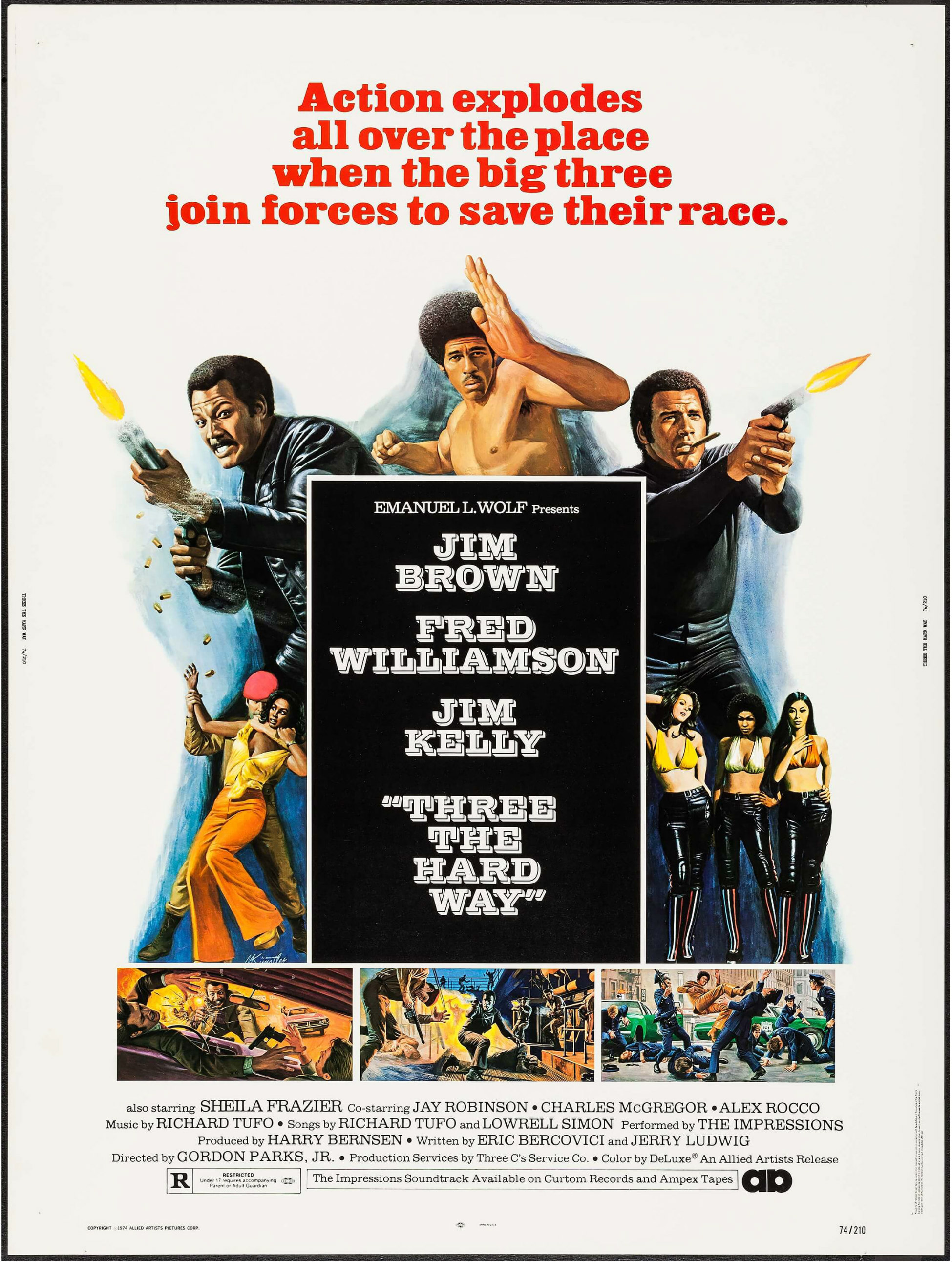
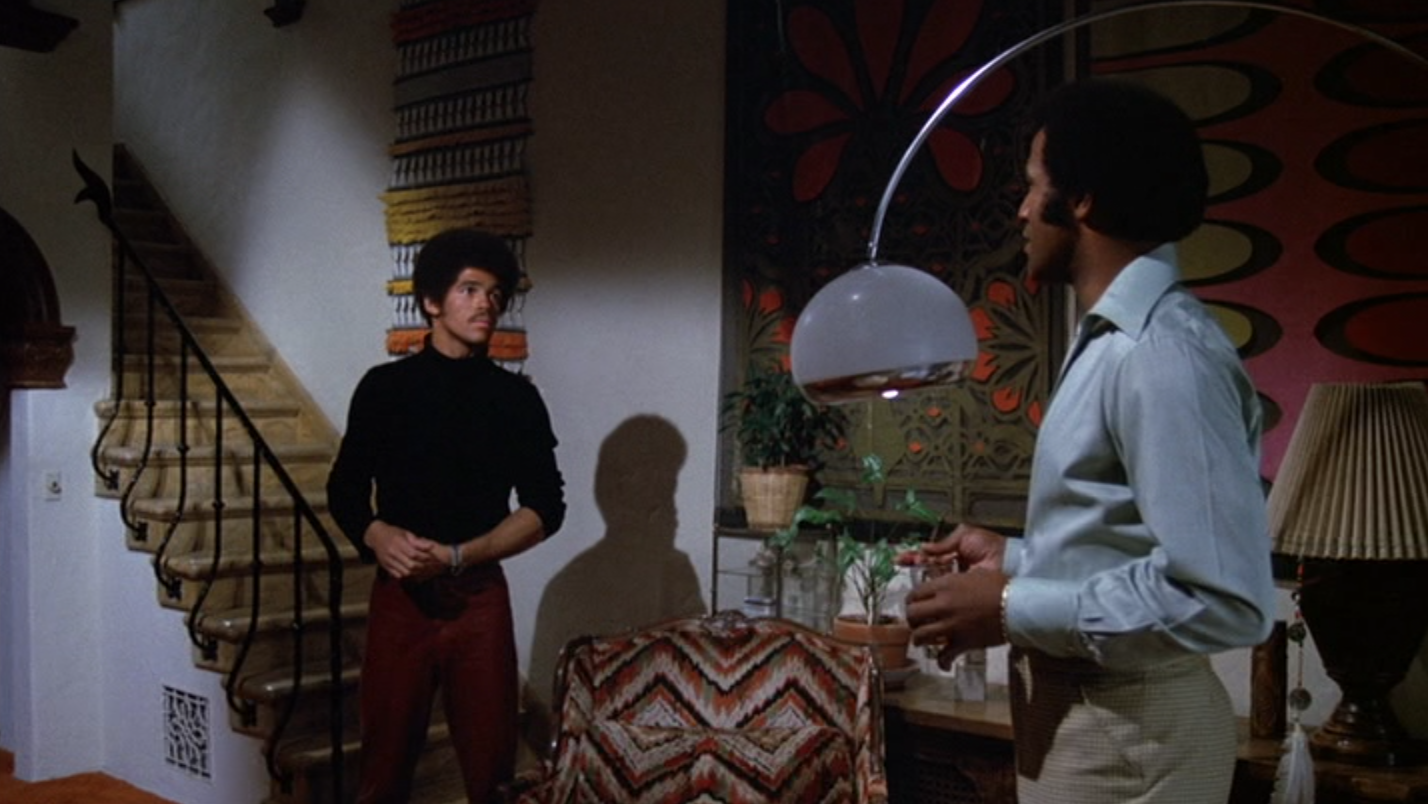
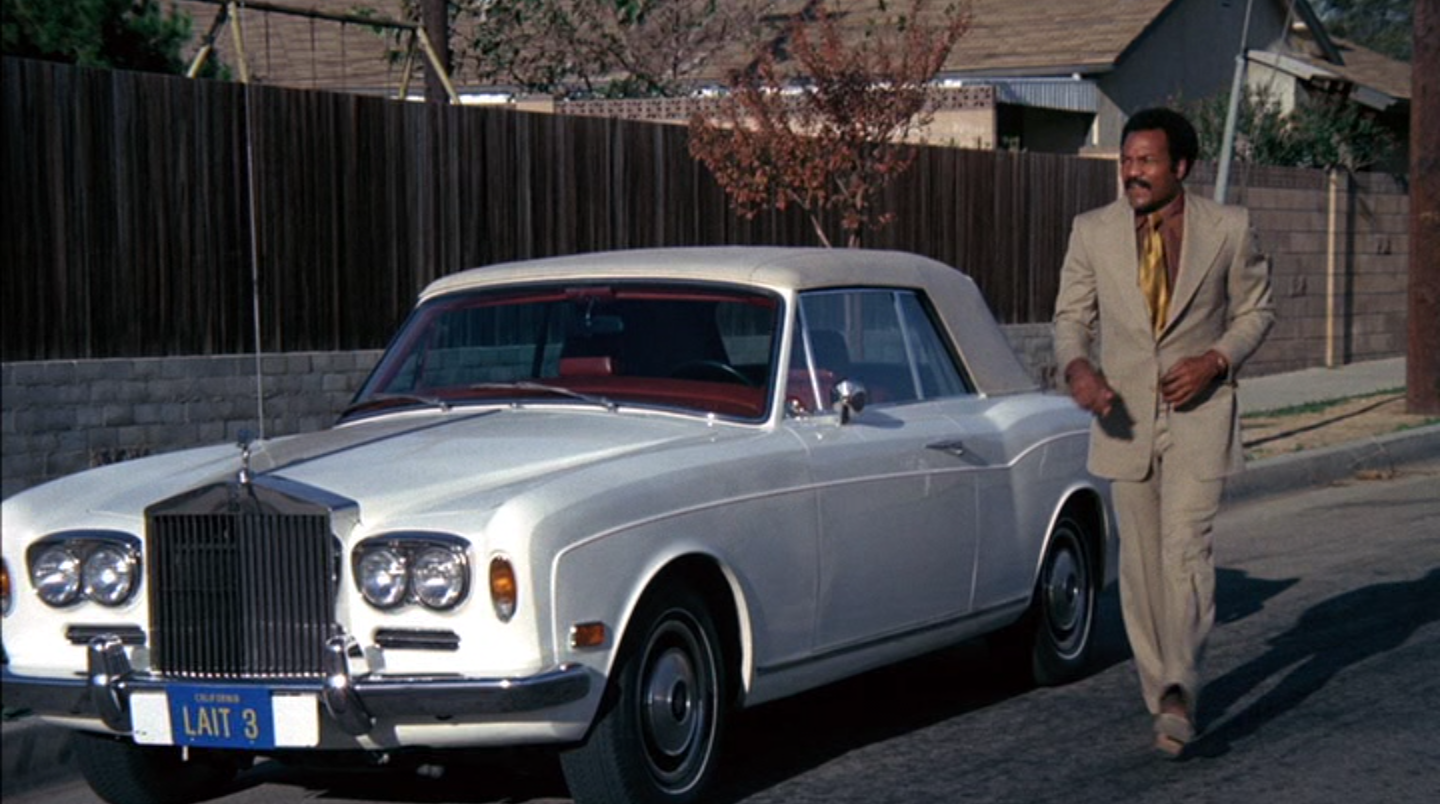
A young black man named House (Junero Jennings) escapes from a sinister camp where many other young blacks have been sickened or killed in experiments. Though injured, he makes his way to his friend, classy and prosperous record producer Jimmy Lait (Brown). Lait gets House to a hospital where House tries to explain what’s going on. All House can get out is that those who were holding him captive have “found a way…only us”. House passes out and Jimmy heads back to a session where he is recording the Impressions. He leaves his girl, Wendy (Frazier), behind at the hospital. Henchmen arrive and kill House, silencing him, and they abduct Wendy.
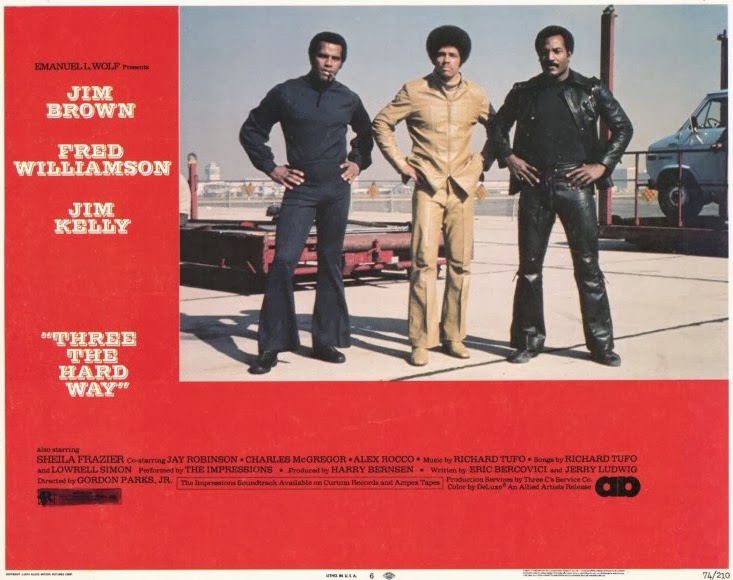
Lait is determined to get Wendy back and to investigate what happened to House and so he travels to Chicago to ask his old buddy for help. Jagger Daniels (Williamson) is a prominent PR man but he – like Jimmy Lait – is always ready to throw down. Lait says he needs help and Jagger is on board. The two head to New York where they recruit their old running mate Mister Keyes (Kelly). The three brothers in arms are together again and they are promptly harassed by several goons, one of which they grab and they force him to tell where Wendy has been taken and what is in the offing.
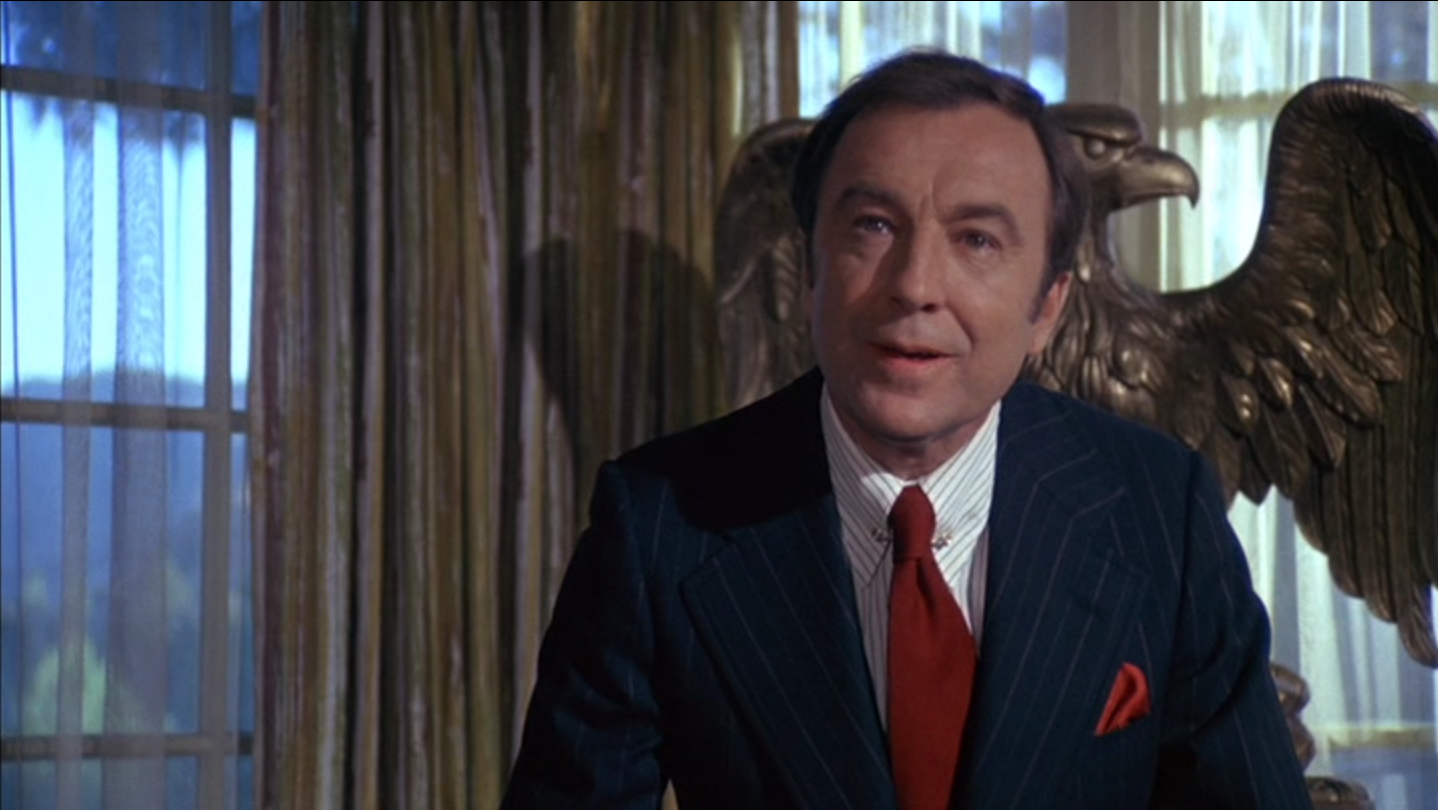
The three learn that unhinged Monroe Feather (Robinson) has hatched an insidious plot with the help of Dr. Fortero (Richard Angarola, Valley of the Dolls). The doctor has concocted a serum that is mortally dangerous to African Americans but harmless to whites. The racist Feather plans to add this potion to the water supplies of Los Angeles, Washington, D.C. and Chicago to “cleanse” the country of its black population.
My regular readers will know that in the winter of 2021 I discovered the exciting world of “blaxploitation” films and tried to assimilate and discuss in simple terms these “urban action films” of the 1970s. I won’t repeat myself here but for a look at these often misunderstood movies, see my articles here. Suffice it to say that I was thrilled to find these dynamic movies and began to try and watch all I could. I was introduced to the machismo of Jim Brown and the charisma of Fred Williamson. I had known of Jim Kelly from the very dawn of my life spent watching films from his appearance in Enter the Dragon. When I learned of Three the Hard Way and the fact that all three were in it, I was overjoyed. Seeing the film for the first time, I was not disappointed.
I’ve written twice before about Allied Artists, the studio behind our film, their origins and Presley saving them. After this film, the studio had only a few more years to go before descending into bankruptcy. Our director is Gordon Parks, Jr., who had made his directorial debut helming his previous film, a seminal blaxploitation movie, 1972’s Super Fly. Parks’ next film after Three the Hard Way was the western Thomasine and Bushrod starring Max Julien and Vonetta McGee and featuring a theme song written by Arthur Lee and performed by his band, Love. His next and last was the Romeo & Juliet adaptation, Aaron Loves Angela starring Moses Gunn and Irene Cara and featuring cameos from José Feliciano and Walt Frazier. Sadly, Parks was killed in 1979 in a plane crash in Nairobi where he was making a film. Many will recognize his name; Parks the Younger was the son of the legendary Gordon Parks, the renaissance man who gave the world Shaft. Producing our film is one Harry Bernsen though he wasn’t really a “film producer”; he has but four feature films on his CV, the first two as associate producer. 1971’s Fools’ Parade was directed by Andrew McLaglen and starred Jimmy Stewart, George Kennedy, Anne Baxter and Kurt Russell. That same year saw the release of another Andy McLaglen film produced by Bernsen, Something Big with Dean Martin and Brian Keith. Immediately after our film, he produced the western Take a Hard Ride that reunited this trio of stars and added Lee Van Cleef. Perhaps most notably, Harry Bernsen was married to Jeanne Cooper, she of Tony Rome and The Young and the Restless. Together they had three children, one of which was Corbin Bernsen who is in our film – though virtually unrecognizable – as one of the kids House gets to take him to Jimmy at the start of the film.
Fans of Seventies TV might recognize the name of one of our co-writers, Eric Bercovici. His father, Leonardo, wrote the script for The Bishop’s Wife. Leo was called before HUAC in the Fifties after he was named by Edward Dmytryk and he would work sparingly thereafter. He directed and co-wrote with his son, Eric, 1961’s Square of Violence. Eric’s mother, Frances, committed suicide in 1951 when Eric was 18 and the elder Bercovici was up before the House Un-American committee. Sadly, Leo’s second wife also died suddenly. Swedish actress Märta Torén died of a cerebral hemorrhage in 1957. Leo was then made a widower twice in a six-year span.
Eric Bercovici (1933-2014) was a lifelong TV writer but he did pen the scripts for 11 films, including Change of Habit – Presley’s last – our film and the following one for this team, Take a Hard Ride. I often would see his name in the credits of the dozen Hawaii Five-O episodes he wrote. The pinnacle for Eric came when he wrote and produced the epic 1980 mini series Shōgun, work for which he won a Prime Time Emmy. I should note that, on Three the Hard Way and Take a Hard Ride, Bercovici wrote with one Jerrold L. Ludwig, a two-time Prime Time Emmy Award winner.
Legendary stunt man Hal Needham (1931-2013) formed Stunts Unlimited in 1970. This was an A-list conglomerate of the finest stunt technicians that was impossible to join; you had to be recruited by Needham and his fellow founders. Hal and his team had worked on many motorcycle movies, John Wayne westerns, The French Connection and Burt Reynolds films by 1974 and in that year Hal coordinated the stunts for six movies including our film and Chinatown. In Three the Hard Way, you’ll catch Hal Needham and Stunts Unlimited among the opening credits.
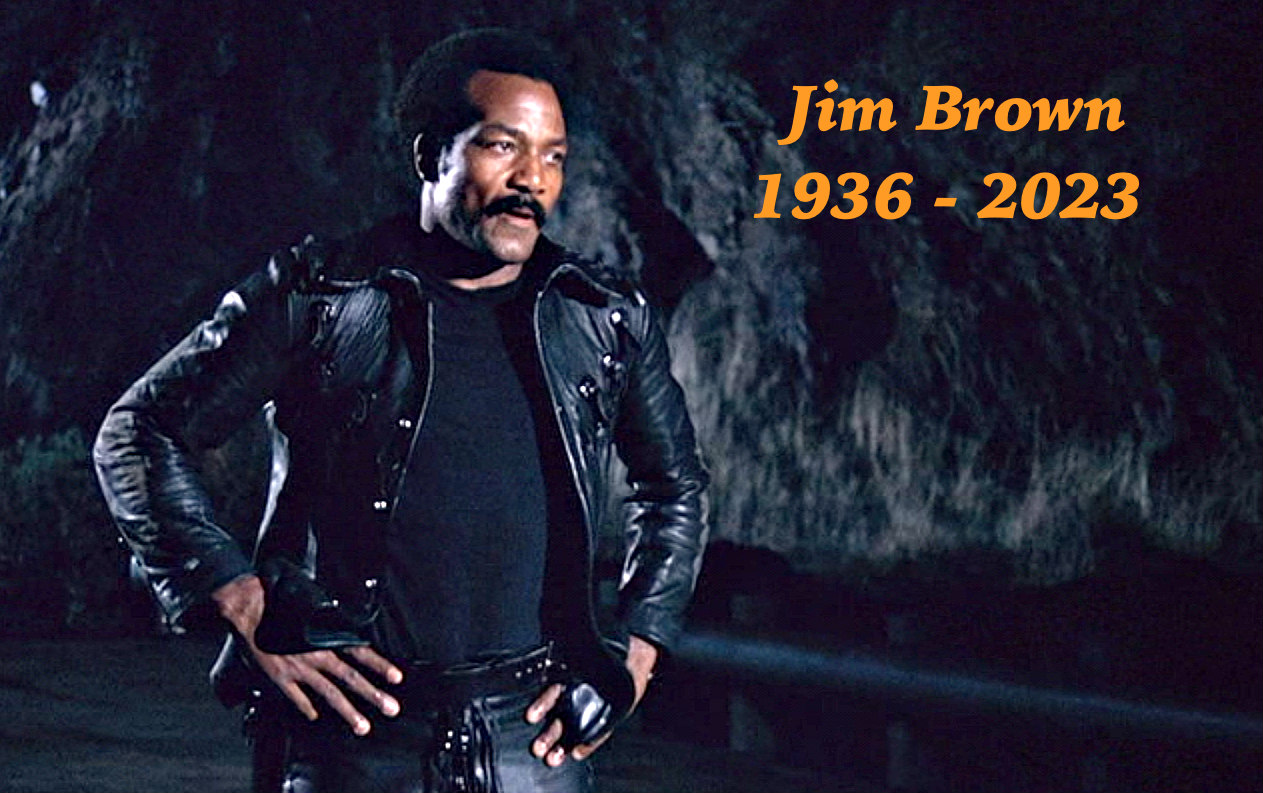
By 1974, Jim Brown was at the height of his movie stardom. He had already made all of his most notable films and, indeed, this film was his last major starring role in an American film. Likewise, Fred Williamson was at the end of an impressive run starring in major studio motion pictures but he was just getting started taking charge of his own career. Still to come were the many movies he starred in and either wrote, directed or both. If I’m honest, Jim Kelly had no “film career” to speak of. His greatest starring vehicle had already happened with Black Belt Jones, released only months before our film. So, not only is Three the Hard Way arguably the pinnacle of blaxploitation, it also marks the end of the golden age of the genre. Our three stars would appear together again in the following year’s spaghetti western Take a Hard Ride and then later Williamson would put the band back together for a film he wrote and directed in 1982 called One Down, Two to Go, a movie that also included Shaft himself, Richard Roundtree.
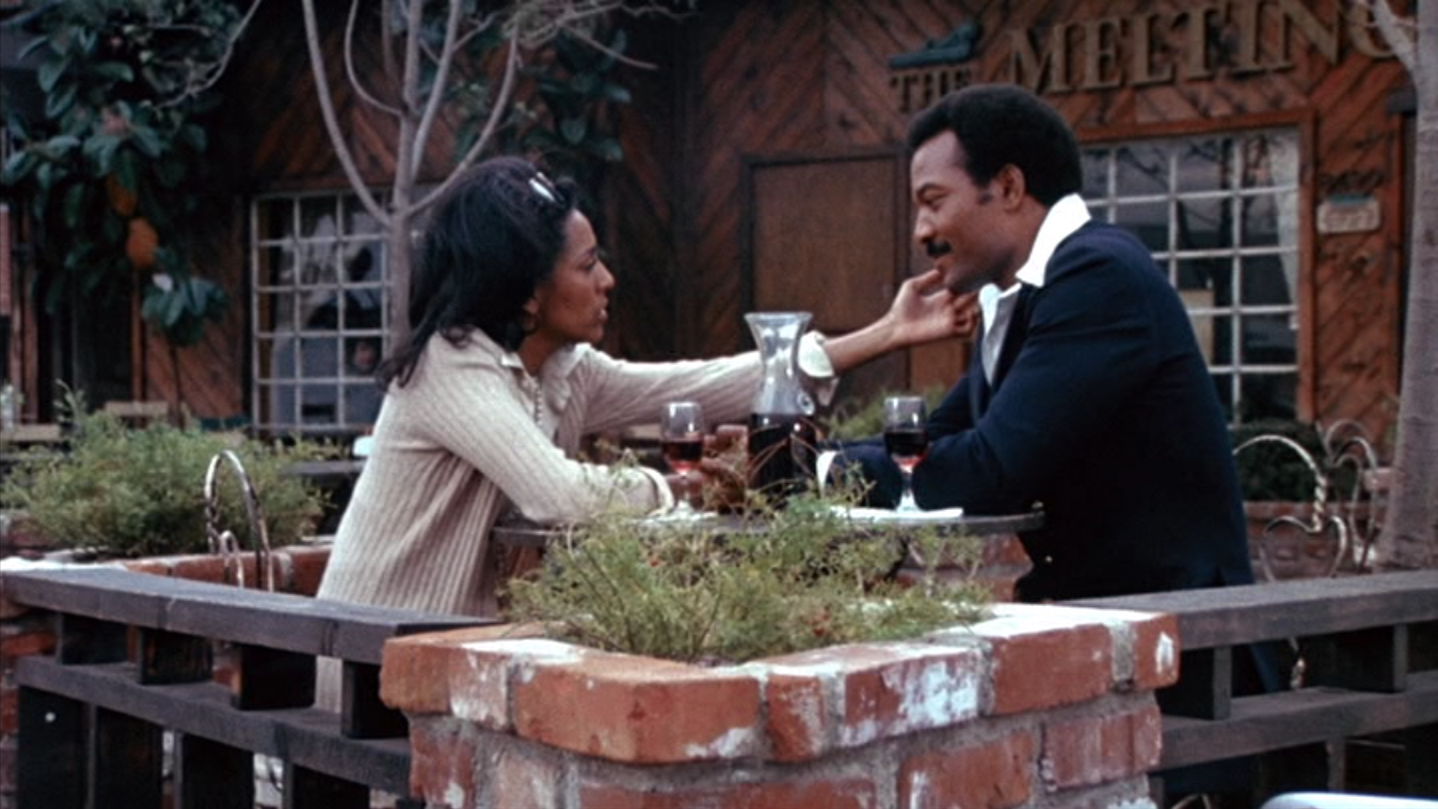
Also of the party is gorgeous Sheila Frazier. Sheila (b. 1948) had made her debut with Gordon Parks, Jr. in Super Fly and returned for its 1973 sequel, Super Fly T.N.T. She had previously followed the advice of Richard Roundtree and joined the Negro Ensemble Company where she overcame a stutter. Since 2008, Frazier has been married to hairstylist and evangelist John Atchison. You may recognize our villain, Jay Robinson. He gave notable performances playing Caligula in The Robe (1953) and its sequel, Demetrius and the Gladiators the following year. Jay’s sudden fame made him difficult to work with and he also struggled with drug addiction, spending time in jail for possession of methadone. Friend Bette Davis encouraged him to return to work and he appeared with Davis in AIP’s Bunny O’Hare (1971). He can also be seen in Shampoo (1975) and Bram Stoker’s Dracula (1992). Robinson died in 2013. Alex Rocco has little to do in two pointless scenes as a cop. Rocco also had served time. A small-time hood in the late-Fifties/early-Sixties, Rocco was involved in organized crime in the Boston area with the Winter Hill Gang. Many know Rocco as Moe Greene in The Godfather (1972) and I know him from Cannonball Run II (1984). Irene Tsu (b. China, 1943) plays topless dominatrix Empress. Tsu has actually been in several notable films; Flower Drum Song (1961), Under the Yum Yum Tree (1963), How to Stuff a Wild Bikini (1965), Paradise, Hawaiian Style (1966) and The Green Berets (1968) among others. She starred alongside Jim Kelly in his turkey Hot Potato (1976) and dated Frank Sinatra for two years. Irene has been a clothing designer and a realtor.
The soundtrack here is notable as was the case with many blaxploitation films. Featured as client’s of Brown’s character, Jimmy Lait, are the post-Curtis Mayfield Impressions. Curtis had left four years previous in 1970 and this spelled the end for the Impressions as a relevant group though they carried on recording into the 80s. The tunes are great even though they may be considered just typical soul/funk songs of the era. And perhaps the lyrics comment on the action too specifically for them to really live as songs outside of the film.
Provided to YouTube by Rhino
The opener, “Make a Resolution”, tells the tale:
"They kidnapped Wendy, they killed poor House
But not before they let part of the secret out
Fellas gonna find a way, fellas gonna stick together
They're not gonna quit until they catch the man called Feather...
They'll fight through the finish or they won't fight at all
Lait, Jagger, Mister, standing tall."
“Wendy” is a love song about…Wendy. “That’s What Love Will Do” is the groovy tune that the boys are working on in the film. Good thing they got their act together while recording; good tune. “Something’s Mighty Mighty Wrong” brings the funk but the highlight is “Mister Keyes” and it’s down to one thing; the mighty clavinet, my favourite instrument. The lyric, of course, sings the praises of Jim Kelly’s character – “judo, karate, kung-fu, he does it all with ease” – and advises the listener not to mess with him. This is a good soundtrack that is easily found on streaming services.
Provided to YouTube by Rhino
A tenet of blaxploitation films is the African American fight against oppression in their own country, oppression inflicted by their fellow Americans. Often the idiot rednecks in these films are blatantly racist but their superiors will be somewhat more subtle about it. In Three the Hard Way, this attitude is taken further. In fact, it’s taken to a place that could be considered quite shocking particularly in today’s world. Robinson plays it well as Monroe Feather. Feather is dispassionate about his hatred of blacks but his hatred runs deep – so deep that he wants to rid America of African Americans. Other of these films may feature corrupt white cops or a dumb cracker sheriff who has a death grip on the town. But this script goes to a dark place, one that could cause some discomfort for both white and black viewers, then and now.
The idea that Monroe Feather is not a cartoon but an erudite, charismatic man is unsettling. He is on the surface basically well-balanced and sane but he hides a horrible character defect. His extreme white supremacist views compel him so that he leads a movement and recruits minions to carry out a diabolical plot, one that will kill – actually murder – millions of black Americans; the pimps and pushers as well as the preachers and businessmen. What this does for the viewer – among, perhaps, other things – is set up Feather as the ultimate villain. One who doesn’t simply want to rule Bucktown but one who actually wants to see all blacks dead.
Conversely, then, this does not only set up the ultimate villain but it also elevates Lait, Daniels and Keyes to a status somewhere above simply heroes. They are going to save millions of lives, yes, but they are also going to subvert planned genocide – “the big three join forces to save their race”, the ad copy went. If black audiences were behind Sweetback to get one over on The Man or Foxy Brown to kill some honky dope pushers, then certainly they were likely to be heavily invested in the success of the three heroes of our film.

Monroe Feather and Dr. Fortero discuss their heinous plot with cold detachment. They talk of “cleansing” and “purification” via their serum that targets African Americans like sickle cell anemia and takes 72 hours to work. Conversely and significantly, Jimmy tells white cop Lt. Di Nisco “hey, man – I don’t need you” and he and his two buddies are equally dispassionate about going up against the white supremacists. They have a plan, are more than capable and simply go to work. When Wendy is rescued and the four of them can escape, they instead proceed to obliterate the entire enemy compound. Feather and Fortero meet appropriately violent ends; particularly the doctor.
In Three the Hard Way, you get everything you want in a blaxploitation flick. Its supremacy may come from the presence of three icons of the genre. You get to see Jim Brown, Fred Williamson and Jim Kelly at the height of their powers. You get explosive action, significant plotting and a great soundtrack. It all adds up to a dynamite package.
 SoulRide