“What have I got? No looks, no money, no education. Just talent. Where do I want to go? I want to be treated well. I want people to like me and be decent to me. How do I get there? There’s only one way I can do it with what I have to work with. I’ve got to be a star! I have to be a star like another man has to breathe.”
Why Me? The Sammy Davis, Jr. Story
by Sammy Davis, Jr. and Jane and Burt Boyar (1989)
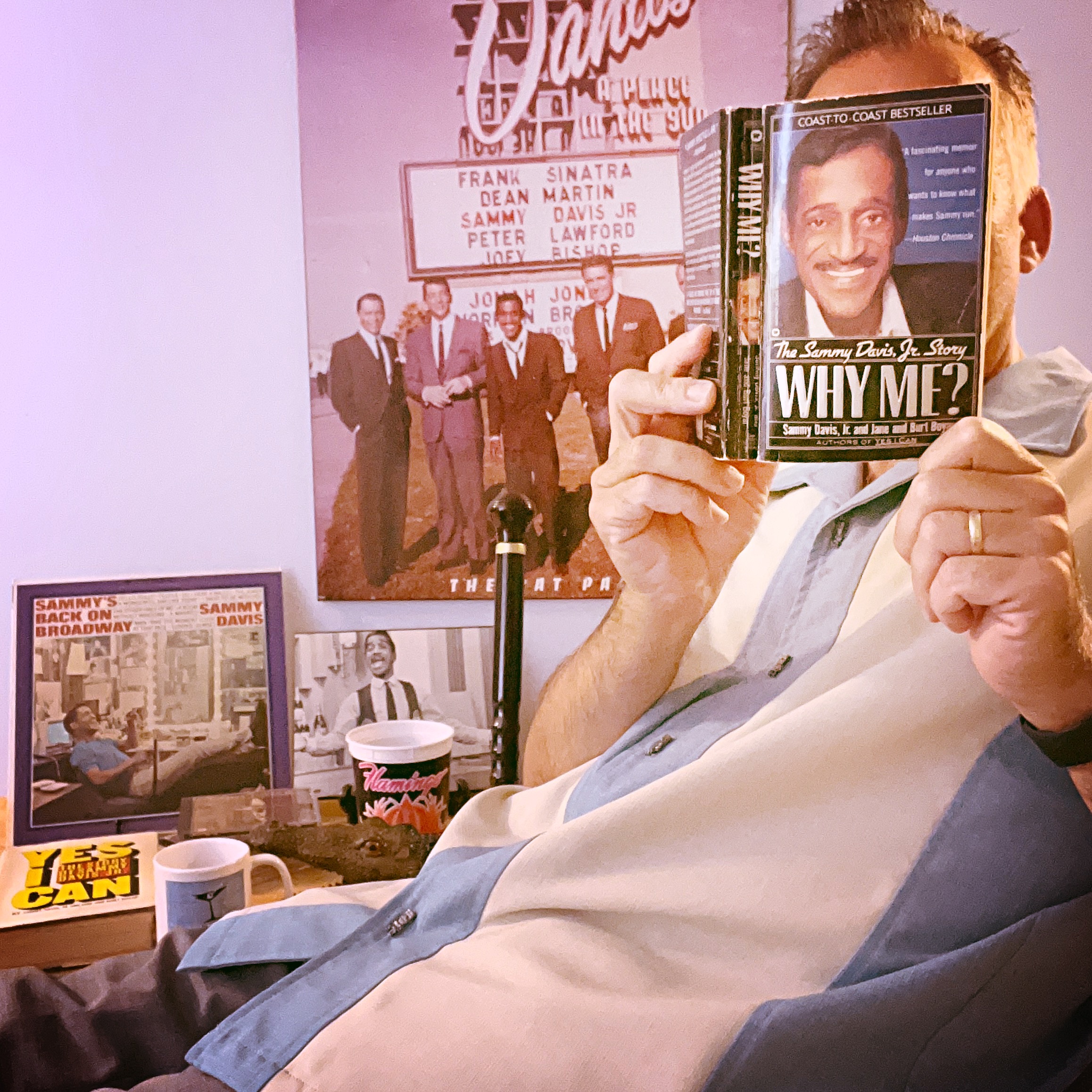
Why Me? is the third autobiography from famed entertainer Sammy Davis, Jr. His first was the popular Yes, I Can published in 1965. In my early days of exploring Easy Livin’ Classics and vocal jazz, I was pleased to find a first edition copy in a local thrift store. I read it and it graces my shelves today. In 1980, came Hollywood in a Suitcase, which was more a conversation as Sammy talked story about his time in La La Land. This book is a bit of a sore spot for me. I owned a hardcover copy back in the day and after I read it, I passed it along. Stupid. Be nice today to own all three of Sammy’s memoirs. Now that I’ve read Why Me? I’ll have to decide whether or not to keep it. It has its good points but… Well, let’s get into it.
Sammy teams again with the co-writers with which he penned his first two memoirs. And now that it is the late 1980s, perhaps Sammy felt free to fully discuss his struggles with race, struggles that began when he was but a child. Davis presents an honest and quite sickening portrayal of prejudice and what he calls his “dawning realization” of people’s hate. Early on, he explains that his father and “uncle”, Will Mastin, kept the hatred of others from little Sammy and this made it worse when Davis discovered it in his teens. The reader will have to contend with hearing stories of how horribly Sammy was treated while in the Army.
“A few hours earlier I hadn’t even known that I was going to propose to her, yet if she had turned me down, if she hadn’t wanted my little brown babies, I knew then, as sure as I stand on God’s earth, I would have hung up the phone and blown my brains out.”
Sammy spends much time talking about May Britt, the mother of his children and the one who raised them.
Frank Sinatra is given an exalted position in this book and a key point is made by Sammy. Frank befriended Sam in the 1940s and would invite Davis to join him at various clubs. But Sinatra would always tell Sammy to meet him there – FS was taking steps to change things and making Sammy, simply by his presence, demand entrée into the “white world”. Sinatra insisted that Davis must do these things himself, he must walk up to the door of the Copa and assume entry. The reader sees that Sammy Davis, Jr. was “chosen” to batter down walls in society. Sinatra, Buddy Rich and others wanted to see change but they needed a weapon to affect this. Poor Sam was this weapon.
“I was tired of opening doors…And had I accomplished something beyond the superficiality of having supper at ’21’? Might I have made the color of a man’s skin slightly less relevant? Would I come back here another time and find that I’d opened the door for someone else?”
Sammy understandably grew weary of even dinner out with May being a major cultural event.
So, here’s the thing; over a hundred pages in and I was wondering why I wasn’t really enjoying Why Me? See, I had read it at a time in the year when I would normally read a Sinatra book and revel in the whole world of 50s and 60s ring-a-ding-ding. I wasn’t getting that vibe from this book. The reason soon became obvious. Fully the first third of this memoir deals with Sammy’s battles with racism and it makes for tough reading. It’s always hard for us vintage types to deal with tellings of the way things were in the golden age. SD Jr. relates a tale of struggle and its not always an easy read. But these are truths that must be known and understood. Listen to me complaining about just hearing these things; imagine how hard it must’ve been for Sammy.
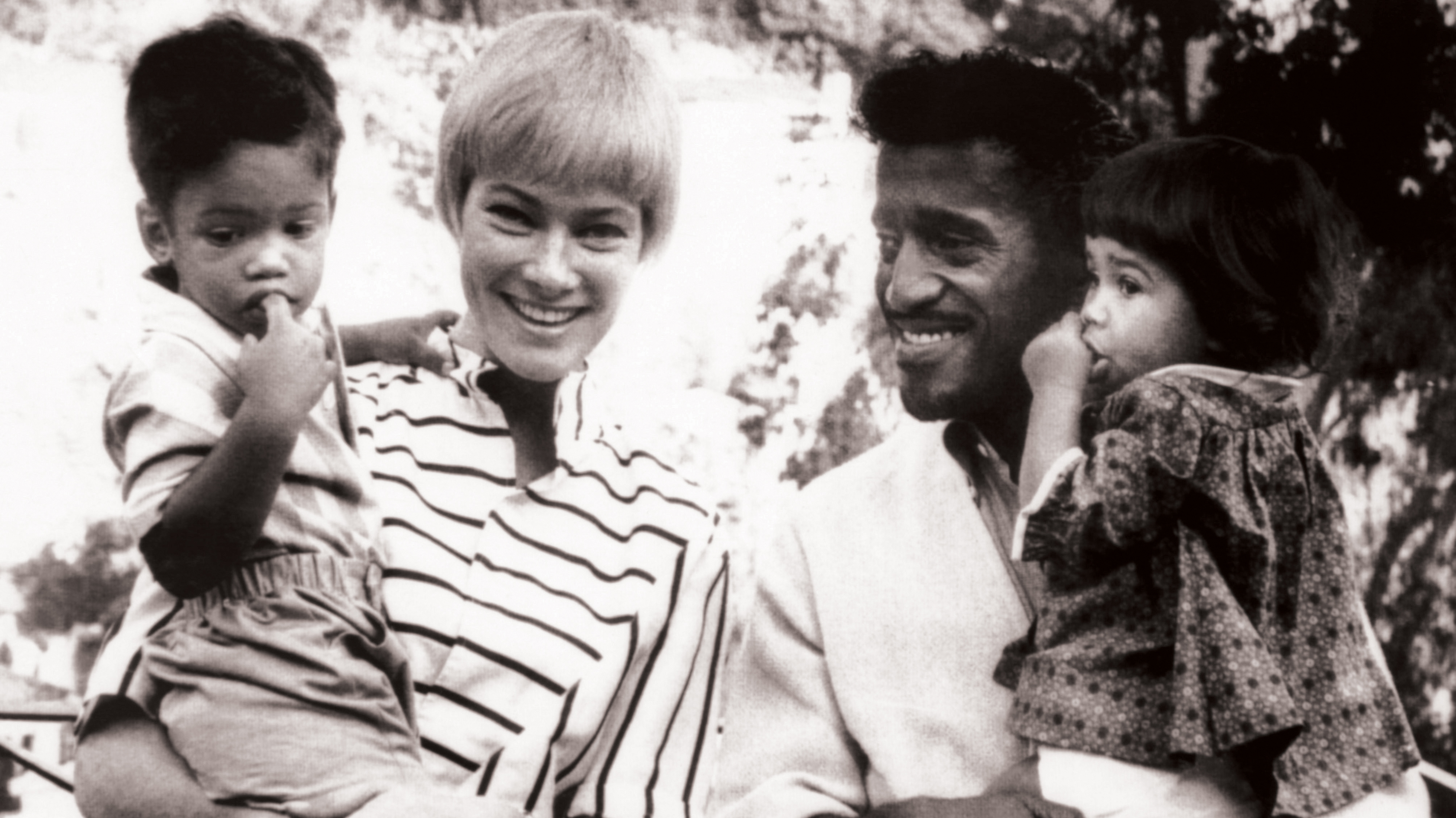
Sammy Davis doesn’t even mention the name of his first wife, Loray White, but spends much ink on second wife and mother of his children, Swedish actress May Britt. And here comes the other tough part about this book; Sammy – in his own words – paints a picture of himself as a lousy father. He comes clean about it but his reasoning is a bit tough to swallow. The reader may wonder how much he or she actually likes Sammy Davis after reading this. Davis makes plain his love of the swingin’ life and the fact that he felt marriage and fatherhood hindered his image. For example, Davis relates one instance when he reneged on taking his kids to a Dodger game when he got a call from Sinatra to come to Palm Springs. So Sammy goes to Frank. For a performance or a fund-raiser? No, to sit by the pool with FS and “work”. Sammy then describes their weekend of pleasure. His role as a father? “F*** it”, Sammy says. He describes often saying no to his kids for other “priorities”; he felt he needed to be Sammy Davis, Entertainer more so than Sammy Davis, Father. He celebrates the freedom gained after his divorce; “there were only three people in the world who counted: Sammy, Davis and Junior”. Add to this, if you can stand it, the ridiculous stipulations he gave his widow, Altovise, when they were first married. He also says that dressing lavishly, wearing jewelry and excessive spending were what was expected of him and so he vigorously pursued that lifestyle – to the detriment of his personal life. The only “out” one may give him is that, in his constant fight against prejudice, his most potent weapon was his career – his performances and his persona.
“I cannot let anything get in the way of ‘Sammy Davis, Jr’ – not me, the person – I mean the figure SD, Jr. He is what makes everything happen.”
It all leads, though, to a life of dissatisfaction for Sammy Davis, Jr. In Why Me?, Sam talks of his intense fear of fading from the spotlight and losing that “thing”. He fought against this by living large, including dabbling in satanism and cocaine. Davis relates in compelling terms going broke and here the reader may be particularly frustrated; Sammy had it all but was so foolish that he lost most of it. This, Sam says, is why he so disliked one of his signature songs, “Mr. Bojangles”. Sammy discarded it from his repertoire at one point, thinking it was bad luck to sing about a popular entertainer who ended up in prison, disgraced and with nothing. Eventually, Sam faces an impending medical procedure and has to finally come off of drugs and alcohol. At his lowest point, after hip surgery, Davis faces his stark situation saying that with “no buffers” he is forced to face life as it is. “Reality”, Sam says at this point, “is fear”. That’s sad.
Sammy spends much time talking about being black and operating in a white world. Oftentimes, black organizations would refer to him as an “Uncle Tom” and Davis was forced to defend and explain his showbiz life spent often being the only black entertainer in the room. Black Power-types wanted him to focus on entertaining his own people but Sammy fights back. He tells these men he married the woman he loved though she was white and he chose to live in the finest home he could afford which happened to be in a white neighbourhood. “As for working places like Las Vegas: nobody in Harlem and Watts has offered me a hundred thousand dollars a week”.
“I have always cared about clothes, and I will go to any length to look good. I have spent a fortune on shirts, shoes, suits, hats, jewelry, walking sticks, mink coats, and every possible accoutrement to make sure that even crossing a hotel lobby I look and feel at the top of my profession.”
Happily, Sammy Davis finally realizes that his fans love him even more than they love his image and this releases him from the caricature he had created, one that has seemed to imprison him for years.
Nuggets include; the story is true, this book being the source, that Sammy saw Frank Sinatra walking dejectedly alone down Broadway at Sinatra’s lowest ebb, here is where the idea of Sammy and Elvis Presley starring in The Defiant Ones originates. Sammy claims the two buddies wanted badly to make this film together but it was squelched by Col. Parker. I can only find corroboration of this in one of Shelley Winters’ two autobiographies. It was only defiance that united Sammy with Kim Novak, Sammy didn’t like the term “black” at first, Sam discusses the perception that he was Sinatra’s “lackey”, Davis was splitting his income with his father and Will Mastin long after the Will Mastin Trio stopped performing together and he speaks of a special relationship with Romy Schneider. Also, like Elvis Presley, “Sammy, Inc.” supported “around twenty families” with his earnings so taking time off to focus on health was not possible, in fact, Sammy says that since he was 3 years old, no 2-month period had gone by during which he was not performing and finally Sammy estimates that he had made $50 million in his career and then found himself broke.
“My talent for earning was easily outrun by my genius for spending…I regretted only never feeling I had time to pause to appreciate and enjoy what I’d achieved before I’d begun to fear I was losing it.”
In conclusion, this is a broad and far-reaching showbiz autobiography that includes much difficult talk about the realities of 20th century prejudice. It is a revealing look at a very flawed man who faced many and varied struggles in his life. And for us readers, the knowledge that Sammy Davis died not long after this book’s publication puts a damper on the positive tone on which the story ends. We still have the classic Yes, I Can to fall back on but Why Me? adds much to the story of the life of Sammy Davis, Jr.
 SoulRide