“He becomes…a synthesis…of verbal influences: Allen Ginsberg, Jack Kerouac, Louis Armstrong, some anonymous vaudevillian, a huckster, a pool-hall attendant, hobo, folkie, Mark Twain, Charles Bukowski, Dean Moriarty, or the anonymous singers of the Library of Congress folk songs recorded by Alan Lomax.”
Tom Waits on Tom Waits: Interviews and Encounters
edited by Paul Maher Jr. (2011)
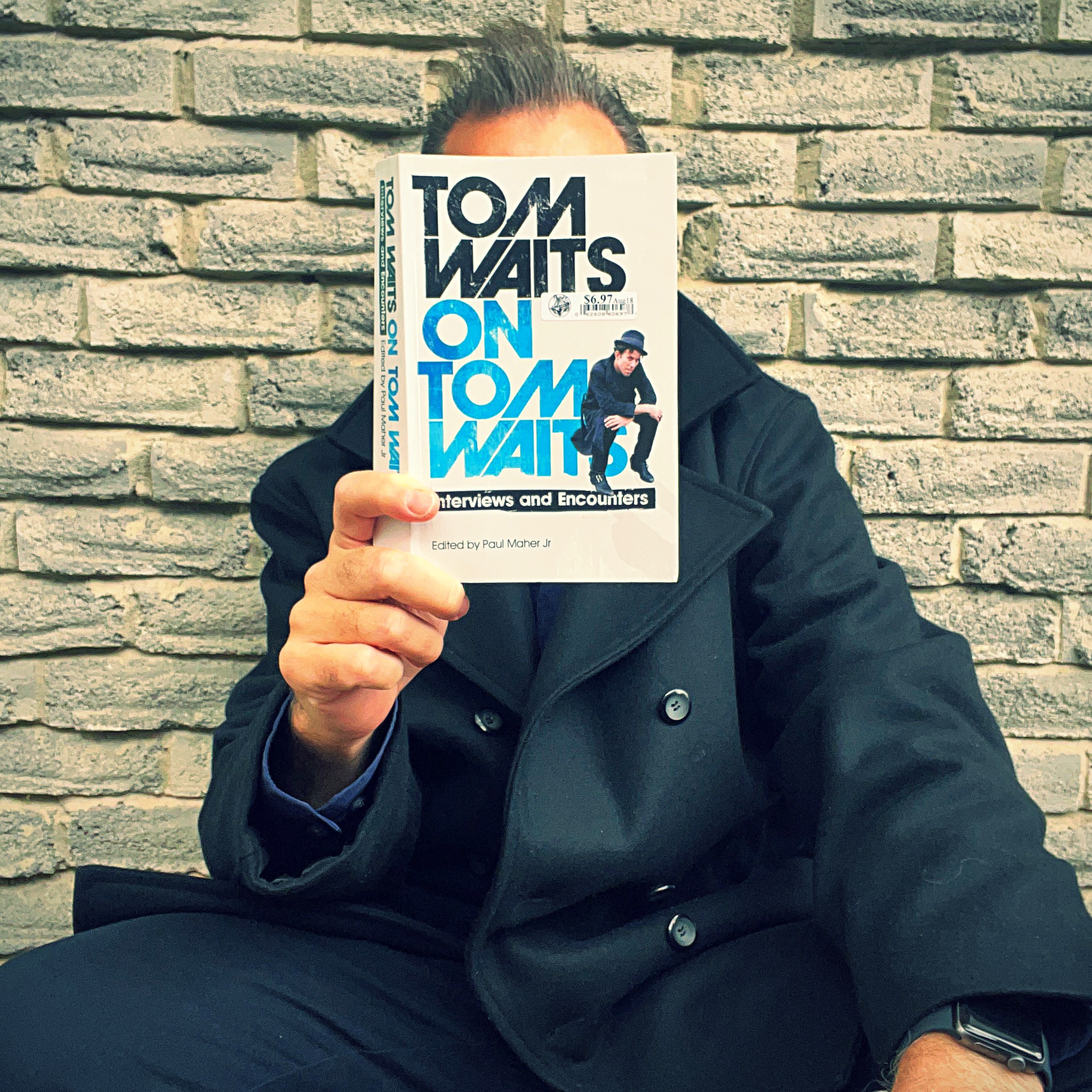
Through the course of one year, I read the memoirs of Alice Cooper and Bruce Springsteen. I enjoyed both immensely. The former thrilled me so that Alice has today become one of my favourite artists and the latter was a penetrating and wildly compelling insight into the psyche of one of my first heroes. I decided to not feature either of these books here at Vintage Leisure and both for the same reason; I simply felt that I had no audience for discussion of these books. Today I am still torn over this decision. Both books bore the wonderful things that I love to discover in books – the same things I love to pass on to you guys and it irks me to not have a record of these works in these pages. While it was freeing in a way to simply read and enjoy these books without necessarily dissecting them, I learned that it is becoming ingrained into me; I feel like the vast majority of the books I read warrant sharing with you, my readers.
I say all that to say all this; over the span of two autumns, I worked my way through the book we are looking at today, Tom Waits on Tom Waits. It was a unique book on an incredibly singular artist. Here again I was faced with the knowledge that the readers who regularly come to SoulRide to meet with Shelley Fabares or dive into Diner are not likely to be the same readers who are interested in Waits. But I’ve let two books go by without reporting on them and I don’t feel like doing that again. So, here goes.
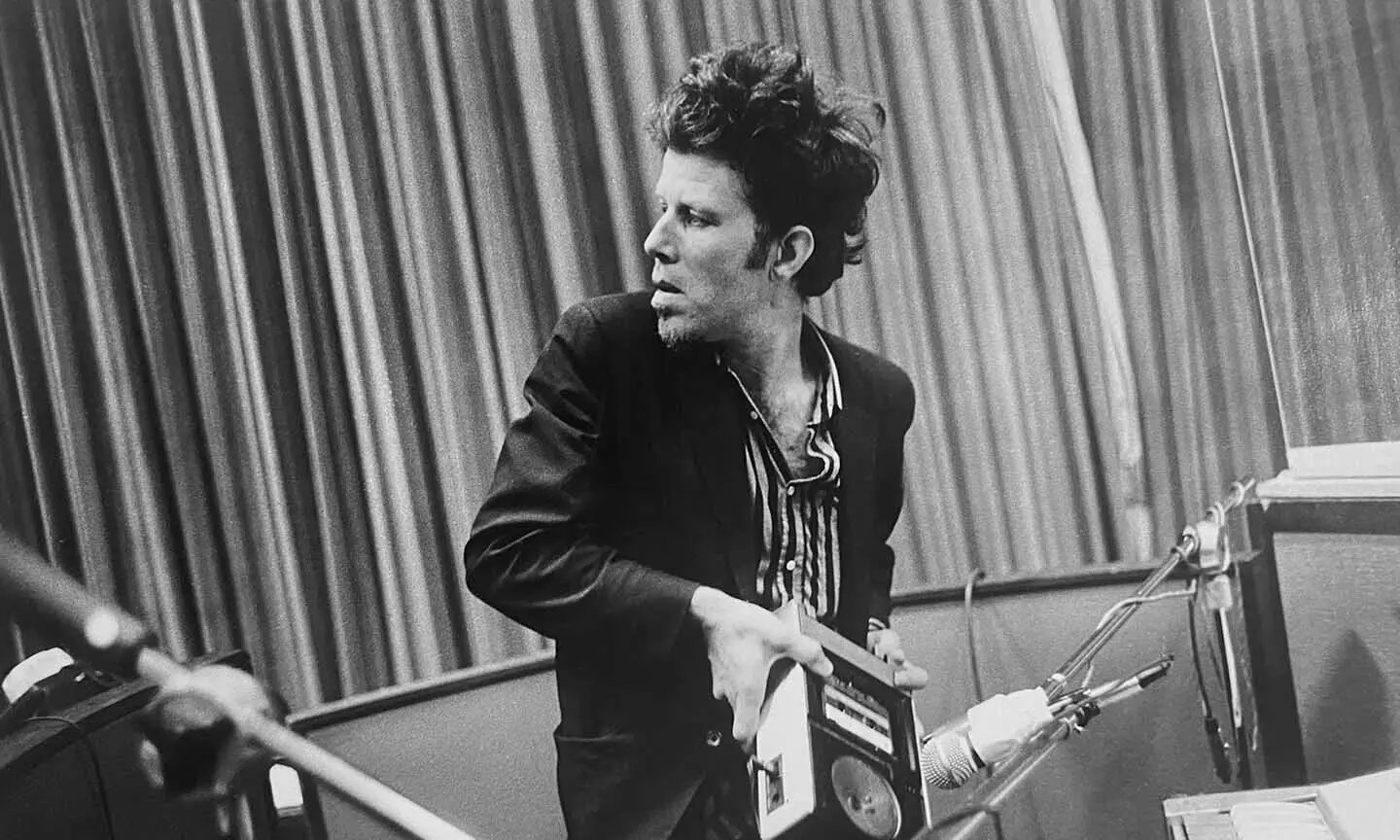
I refer to many cats as “my main man” but few deserve the appellation more than Tom Waits. What can I say about Tom? Few artists have spoken to me as he has. The atmosphere of his songs and the characters who populate them – from either of the two “halves” of his career – have enthralled me and his unique position outside the mainstream has always appealed to me. His music is audacious. This book is different from a biography or a study of a body of work in that it uses interviews with Waits spanning the entirety of his career up to 2011 to tell the story of the arc of his music. To hear things straight from Tom’s mouth – with all of his enigmatic gibberish – makes for compelling reading. Not only is Tom quick with thoughtful, witty and outrageous answers but I give credit to these interviewers, too. The reader learns that not any schmo can conduct an interview. One has to study one’s subject and determine to ask more penetrating questions and queries that will elicit fantastic, quixotic answers. Aspiring interviewers need to consider the art of asking someone questions and the talent and insight it takes to draw out your subject in a way that brings them to authentic life.
“If somebody doesn’t like what I do, I really don’t care. I’m not chained to public opinion, nor am I swayed by the waves of popular trends. I just keep on doing my own investigations.”
It’s interesting how Tom’s career is indeed charted using only interviews. As the book progresses, the reader will recall things learned in earlier chapters about Tom’s life and career – much the same way it would happen in a traditional biography. But do not think that in this book you will hear it all. Waits makes a good point that some things about an artist must remain hidden, that there are things we simply do not want to know about Tom Waits. That way, we keep wondering about him and to this end Waits admits to having given false answers to questions through the years.
Throughout the book, the indelible Tom Waits personality shines through in his quick and awe-inspiring answers to an interviewer’s more creative questions. For example, when Tom is asked if he has a recurring nightmare, he answers that he does and proceeds to describe the dream.
“I’m in this music store. There are these wooden masks, medieval ones from Upper Volta. This guy slams the door and nails it shut from the inside and puts oxygen masks over my face. I wake up at the Taft Hotel and all the clocks are turned back, all the magazines are from 1959. I climb out the window on an old bedsheet. I’m dangling there and there’s this little kid with a cigarette lighter flaming at my feet. I hang there and I swing and then I drop into a tanker car. It’s full of flowers and I ride it all the way up to Seattle, Oregon. I see smoke coming out of the train. I can’t seem to shake that one.”
In some cases, what are presented are less interviews and more conversations. Waits will end up chatting and telling of the time when, as a child, he sent away for a signet ring and wore it proudly – until a case of salve showed up at his door that he was expected to sell, as a condition of getting the ring, to his friends and family. And there is some interesting talk about Tom’s wife and collaborator Kathleen Brennan. Waits says she tends to ground him and will also often take him to task about who features in his songs and why they always have to be afflicted or troubled in some way. Tom says Kathleen will rant when she hears a song he is working on, telling him “if you write another song where you take somebody’s finger off, I’m going to leave you. If you lop somebody’s arm off, or if you make another guy blind in a song, I’m going to leave you…why does the German guy have to be a dwarf? And if he is, why do we have to know? It’s not a film!”. But Tom will retort – and explain much of his canon – by saying that sometimes you have to shorten people. Sometimes you have to lop off a limb.
Of particular interest to me was late in the book during a press release by his record label Waits’ listing of artists that shaped him and various songs that served as “beacons” to him. These range from the more obvious Kerouac, Dylan, Bukowski, Jagger and Johnny Cash to the perhaps more telling Rod Serling, Cantinflas, Lee Marvin, Frank Sinatra and Enrico Caruso. And from “Louie Louie”, “Ode to Billy Joe”, “All Shook Up”, “Good Time Charlie’s Got the Blues”, “Harlem Shuffle” and “For What It’s Worth” to “Pathétique Sonata”, “Rite of Spring”, “Strange Fruit”, “Moon River”, “Auld Lang Syne”, theme from Once Upon a Time in America, “O Holy Night” and “Mass in E Minor”.
Q: Favourite scenes in movies?
A: R. De Niro in the ring in Raging Bull. Julie Christie’s face in Heaven Can Wait when he [Warren Beatty] said, “Would you like to get a cup of coffee?” James Dean in East of Eden telling the nurse to get out when his dad has had a stroke and he’s sitting by his bed. Marlene Dietrich in Touch of Evil saying “He was some kind of man.” Scout saying “Hey, Mr. Cunningham” in the scene in To Kill a Mockingbird. Nic Cage falling apart in the drugstore in Matchstick Men…and eating a cockroach in Vampire’s Kiss. The last scene in Chinatown. Rod Steiger in The Pawnbroker explaining to the Puerto Rican all about gold. Brando in The Godfather dying in the tomatoes with scary orange teeth. Lee Marvin in Emperor of the North riding under the boxcar, Borgnine bouncing steel off his ass. Dennis Weaver at the motel saying “I am just the night man,” holding on to a small tree in Touch of Evil. The hanging in Ox-Bow Incident. The speech by Rutger Hauer in Blade Runner as he’s dying. Anthony Quinn dancing on the beach in Zorba. Nicholson in The Witches of Eastwick covered in feathers in the church as the ladies stick needles in the voodoo doll. When Mel Gibson’s Blue Heeler gets shot with an arrow in Road Warrior. When Rachel in The Exorcist says “Could you help an old altar boy, Father?” The blind guy in the tavern in Treasure Island. Frankenstein after he strangles the young girl by the river.”
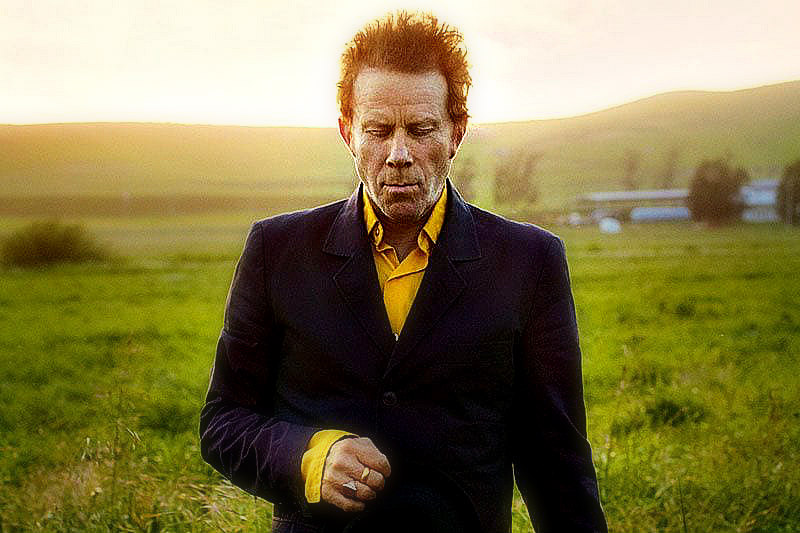
You’ll notice that when he is younger, Waits is playing ball and simply – and sometimes not so simply – answering questions but as he gets older, he pivots more to reflecting as the old sage he has become. In Tom Waits on Tom Waits you will hear Tom’s voice – and that is huge to us, his fans. Through interviews, press releases, magazine articles and conversations, the reader travels through one of the most distinctive and idiosyncratic careers of all-time. In this very revealing book, Tom Waits talks in-depth, album by album, and reveals a little about his character and creative process. For those of us who love him, this is nothing less than gold.
 SoulRide