Elvis: His Spiritual Journey
by Jess Stearn (1982)

The 2005 television documentary Elvis by the Presleys spent part of its time talking about Elvis Presley’s spiritual pursuits and the very title of the HBO doc Elvis Presley: The Searcher revealed that this “searching” was indeed part of the singer’s varied and far-reaching world. But beyond these segments in these otherwise engaged documentaries, Presley’s exploration of spirituality has been little revealed. When we talk of Presley and “religious” things, of course the topic often turns to his gospel recordings but this part of Elvis World extends far beyond the fundamentalist Christianity Elvis grew up with.
And when talking of Elvis’ search for answers to these questions the story basically begins and ends with Larry Geller. Called in from Jay Sebring’s studio to style the Presley coif in 1964, Geller (b. 1939) soon revealed to Elvis his own searching and his interest in religion and philosophy and the two bonded over these subjects until the end of the king’s life.
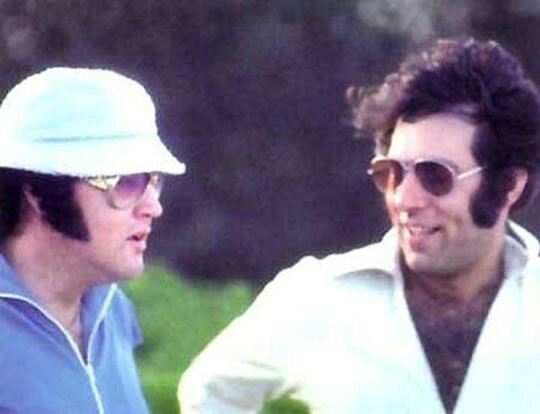
Oahu, March 1977
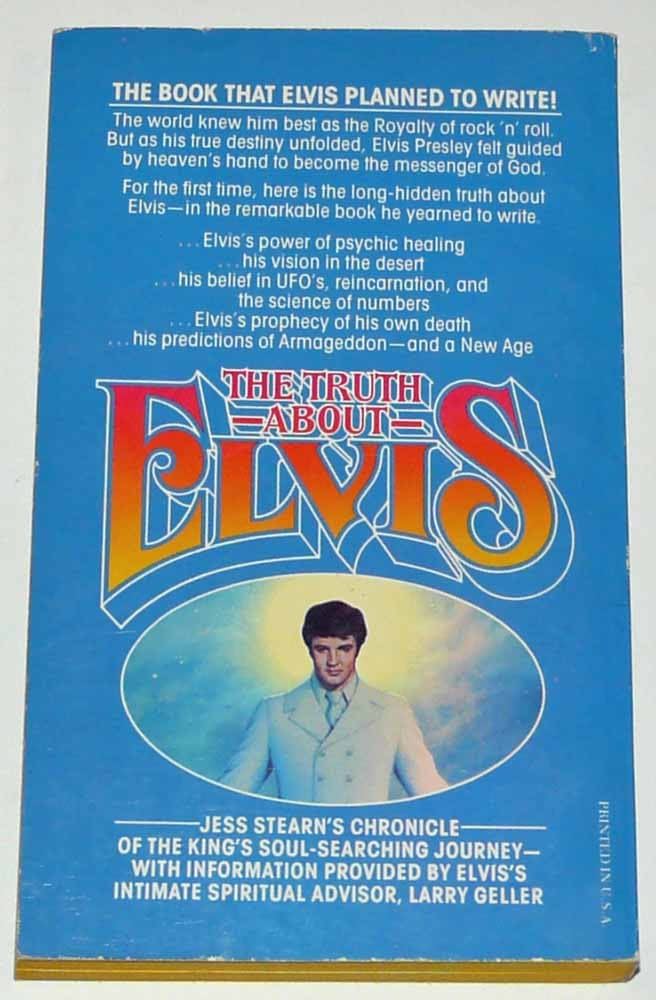
Many will be aware of Geller’s 1989 Elvis book If I Can Dream but an equal number may have missed the volume we are looking at today; I know I had. I had a time, actually, researching this book and it’s publishing history. It started life in 1981 as The Truth About Elvis, a book with a ridiculous cover (see below) and one credited to both Geller and Jess Stearn. Stearn (1914-2002) was a journalist and author of “sensationalist speculative non-fiction” and books on spirituality. He brought Eastern thought to America with his early book on the subject, 1965’s Yoga, Youth and Reincarnation. Then this Elvis book appeared as Elvis’ Search for God by Stearn and Geller. I saw one listing of this edition of the book with the description “a fictional account of Elvis as the new Messiah”. Comes 1982 and the issue that I own comes out. Geller’s name, oddly, does not appear on the cover but the back cover states that this is the story of Elvis’ relationship with Larry and inside there is a blurb on Geller and the copyright lists both men’s names.
Geller briefly mentions in If I Can Dream that he and Stearn wrote “a book that presented an overview of Elvis’ spiritual quest” and buried in the notes section of Careless Love, the second of Peter Guralnick’s two-part seminal Presley bio, is a mention that background information for the “Spiritual Awakenings” chapter comes from a handful of sources including The Truth About Elvis by Jess Stearn. But that’s about all I could find.

So, there is barely a mention of this book in Elvis World and that stands to reason. While it does gain some credit by being an early exploration of Presley’s studies of all things spiritual, sadly it is poorly written. In the early pages, Stearn tells of Geller calling him to say that Presley would have wanted Stearn to write this book, one described as a book Elvis and Larry had wanted to write together. But the whole book is sunk right from the outset because it does – as I mentioned above – come off like a work of fiction. Dialogue is presented presumably verbatim like you would see in a novel and this presents two problems. The first is the obvious contriving that this requires. Larry was indeed a confidant of Elvis but he is able to remember all the things that Elvis said all the time? And secondly, the words that are attributed to Elvis Presley do not sound like they could have come from his mouth. “‘Let’s cruise around for a while’, he said ‘maybe we can meet somebody coming out of an office’. He gave Larry a quizzical glance. ‘Do you think some nice girl would go out with me?'” Trying to recreate what Elvis actually said never works for me and it always comes off as disingenuous. But, I know – who am I to say Larry Geller doesn’t know what Elvis said?
His Spiritual Journey makes it clear that EP was alone – aside from Larry – in this pursuit. Priscilla and some other women seem to have been interested in the texts Elvis shared with them but – like with so many other aspects of his life – King had to walk alone. We have heard before, as we do in this book, that Presley wanted to join a monastery or at least hide away in one for a time but this book states that Geller had to talk him out of this as it would remove Elvis from his true calling which was entertaining the masses. Interesting that Elvis needed some guidance and restraint in this case. Perhaps as a substitute for the life of a monk was the time Elvis spent on his ranch. This was his hope of some sort of communal living with just Cilla, his buds and the land to sustain him. But, again, this was unsustainable. And Stearn suggests that Presley’s prolific giving was tied to his spirituality and was his way of giving back for all he had been blessed with and his way of helping others.
I give this book little credit but one thing it does get right is the fact that there was more complexity to Presley’s psyche than it would seem on the surface. It also understands King’s relationship with his mother was key to this complexity and to his make up as a person. And it’s not all corn, I suppose, as the first in-depth look at Elvis Presley’s relationship to matters of the soul and spirit and his exploration of differing spiritual philosophies.
“He was more complex than he realized. He knew the heights of exaltation and the depths of despair at almost the same moment.”
The book is filled with errors of research, improper speculations and many assertions that are suspect in light of what has been learned since this book was initially published. These are things of varying importance and ambiguity and they include; Barbara Stanwyck plays the mother of Joan Freeman’s Cathy in Roustabout? Not exactly. Elvis is in a wetsuit in the blazing sun filming a scene in Spinout in which he saves his leading lady from drowning? That scene is not in the Spinout I know and love. Elvis “turns down” A Star is Born because it would “confuse” his fans? No. Presley “felt no inclination” to perform overseas because “he drew his energy and strength from the American soil”? Rubbish. King is “glad” his father remarried? Not so much. And the book asserts that Johnny Rivers was a great friend to Elvis but Guralnick’s telling of “Memphis, Tennessee” suggests otherwise. And on and on. However, one needs to remember that this book is not about the facts of Elvis World. And don’t get excited by the dust jacket’s claim of “25 candid, previously unpublished photos”; they are almost all grainy, boring shots behind the scenes of Paradise, Hawaiian Style.
In Dirty Dancing, hotel owner Max Kellerman tells his college boy waiters to “show the godd*mn daughters a good time. All the daughters. Even the dogs. Schlep them out to the terrace, show them the stars…” I’m determined to read as many books on Elvis Presley as I can and give you the lowdown on them. All the books. Even the dogs. Like His Spiritual Journey. Stick with Larry’s If I Can Dream.
 SoulRide
I guess “sensationalist speculative non-fiction” is a polite way of putting it… 🙂