There is an article to be written about the “victory lap”. I’m always fascinated by the instances I run across that depict a performer “doing it again” one last time, years removed from their heyday. Here’s a flyer of an example but think Jack Lemmon in Robert Altman’s Short Cuts. You haven’t seen the film? Shame, shame on you. Music is full of victory laps, the most grandiose of all being that which was run by my man Tony Bennett. After a time in the valley, Bennett emerged to delight a whole new generation of listeners as he brought the Great American Songbook to the MTV generation. You could say Frank enjoyed a victory lap with his Duets records but I cannot bring myself to speak of those atrocities. Also, Frank was never in no valley. Tom Jones? In his late 70s, he got serious with his music, stopped dyeing his hair and made at least three quality records with Ethan Johns thus securing his position in the pantheon. Rock music has many, too; Rod Stewart around the time of Out of Order and Clapton cementing his return with Unplugged to name but two. Sometimes the victory lap may consist of a single album, as is the case with our topic for today.
Engelbert Humperdinck had a strong run of hits and major visibility in the late 1960s with his substantial, continental songs about love and his polished versions of hits of the day. Then the inevitable. At the dawn of the Seventies, music was changing yet again and singers like Hump were relegated to television and Las Vegas.
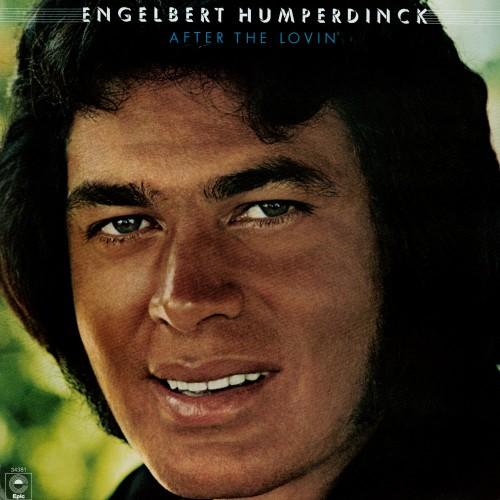
In 1976, years after his greatest successes, Hump made the jump to Epic Records and he scored with his first release. I mentioned in my piece on Jack Jones that Jack had recorded “After the Lovin'” for his 1975 RCA LP What I Did for Love. He pushed the label to release it as a single but they weren’t having it. Jack knew it was a fine song and he would be proved right.
Courtesy coockiestv
Ritchie Adams (1938-2017) was a minor doo-wop singer until he became a minor songwriter. But I’ll give him this – he did gift me by co-writing one of my all-time favourite songs, “Tossin’ and Turnin'” by Bobby Lewis. Adams then wrote “After the Lovin'” and another later recorded by Humperdinck, “This Moment in Time”. Engelbert released “After the Lovin'” as a single in October of 1976 and it became a huge hit, scoring in the Top Ten of several countries. It reached #8 in the US, becoming Hump’s second and last Top Ten hit Stateside. Oddly, “After the Lovin'” did not chart in the UK.
“After the Lovin'” is – dare I say? – perfect. It is perfect for what it is; a lovely, mid-tempo love song finely rendered by Humperdinck. Next up on the album is “Can’t Smile Without You”, written by a team of men who had written songs for Elvis Presley and while it was not a hit for Hump it was for the Carpenters and for Barry Manilow almost concurrently with Engelbert’s version – so Hump scores points for knowing a good, fresh song when he heard one. I just love this arrangement particularly when it modulates up for the final chorus. The wildly energetic “Let’s Remember the Good Times” has been classified as “disco”. I don’t know about that but it certainly borrows from the dance music so prevalent in 1976. It’s a great song with sterling chord changes. Dig the lyrics; you could spin them as depicting one of us husband-types asking the wife to just forget those times we screwed up. And I do believe I hear my favourite instrument, the clavinet. You know who wrote the song? Artie Schroeck. More about him and the other men who worked on this record later. For the first three songs, at least, this album is perfect.
Courtesy MsCatreona
The second side features the stellar “This is What You Mean to Me”, a smooth and elegant song, and “I Can’t Live a Dream”, a sonic cousin to “Let’s Remember the Good Times” that had been first recorded by Frankie Valli and then by the Osmonds. The closer is by Neil Sedaka and Howard Greenfield. “The Hungry Years” is a straight-up contemporary standard that Neil used as the title track to his 1975 release. In quick succession, it was recorded by Andy Williams, Johnny Mathis, Dinah Shore, Wayne Newton and many others, becoming a part of the repertoire of singers like Humperdinck.
Many producers worked on this record including the prolific Charles Calello. Born in ’38 in Newark, Calello has all my love for the works he has contributed to. I first ran into his name when reporting on the Four Seasons and – Jersey to the core – Calello worked on Springsteen’s seminal Born to Run album and Frank’s Watertown. In fact, he may have worked with everyone. Except me. His buddy from the neighbourhood, Arthur Schroeck – also born in ’38 in New Jersey; can’t keep these Jersey boys down – blessed me with the mind-blowing arrangement of “I’ve Got You Under My Skin” for the Four Seasons. Bobby Eli (1946-2023) also wrote and produced for Hump here. Funny but Philly’s Eli was a stone cold soul brother having worked with Teddy Pendergrass, the Jacksons, Wilson Pickett, the Spinners, the Delfonics, Isaac Hayes…and Engelbert Humperdinck. Eli recorded Hump down at legendary Sigma Sound Studios in Philadelphia, a studio closely associated with Philly soul, Kenneth Gamble and Leon Huff and Philadelphia International Records. Some 200 gold and platinum records were made there by artists like the O’Jays, the Spinners, Harold Melvin & the Bluenotes, the Roots and David Bowie made his Philly soul record, Young Americans, there.
Courtesy MsCatreona
After the Lovin’ is classy, mature, elegant pop vocal music from the late 1970s. There may have been no market for it at the time but that doesn’t dull its glow. Hump is in great voice, the songs are polished and there is enough story to the record and those who worked on it to warrant some discussion here on Talkin’ Tunes. Get your physical copy today.
After the Lovin’ (PE 34381 – 1976) from Epic Records
Side One: “After the Lovin'”, “Can’t Smile Without You”, “Let’s Remember the Good Times”, “I Love Making Love to You”, “This I Find is Beautiful”
Side Two: “This is What You Mean to Me”, “World Without Music”, “Let Me Happen to You”, “I Can’t Live a Dream”, “The Hungry Years”
Engelbert Humperdinck, lead vocals
Recorded at Media Sound Studios, New York, New York and Sigma Sound Studios, Philadelphia, Pennsylvania
 SoulRide
AFTER THE LOVIN’ is such a fantastic song!! The song fits Engelberts style perfectly, and I agree with you that it is just such a classy song! Excellent choice!
Thanks for reading and for your comment, Mike.
I could have talked for a few paragraphs about how much loved it is by Hump’s fans. When I have seen him live and if you watch concert videos, the people just love when he starts this one – a sigh almost goes up around the room. It is just so pleasant and so revered. It has a gentle caress to it and it will never get old.
This is one of the only Engelbert singles I have in my collection, but it definitely receives frequent spins on the ol’ turntable! Thanks for spotlighting it – it is definitely one of those frequently overlooked gems that deserves more attention!
Reading this an exact year later and listening to the songs you chose to place here, I now understand why my dear Aunt Jeanette was such a fan of Englebert Humperdinck along with her pure mania (understatement) for Elvis AND Tom Jones. He sounds amazing and of course being a dopey kid I would NEVER have even listened to this kind of music when it was popular but now I’m going to track that record (or CD) down. Thanks for turning me on to a truly talented maybe a little underrated performer!
When I was a dopey kid I wouldn’t have either. Appreciating these songs does take a certain maturity, perspective and understanding. Thanks for your comment!