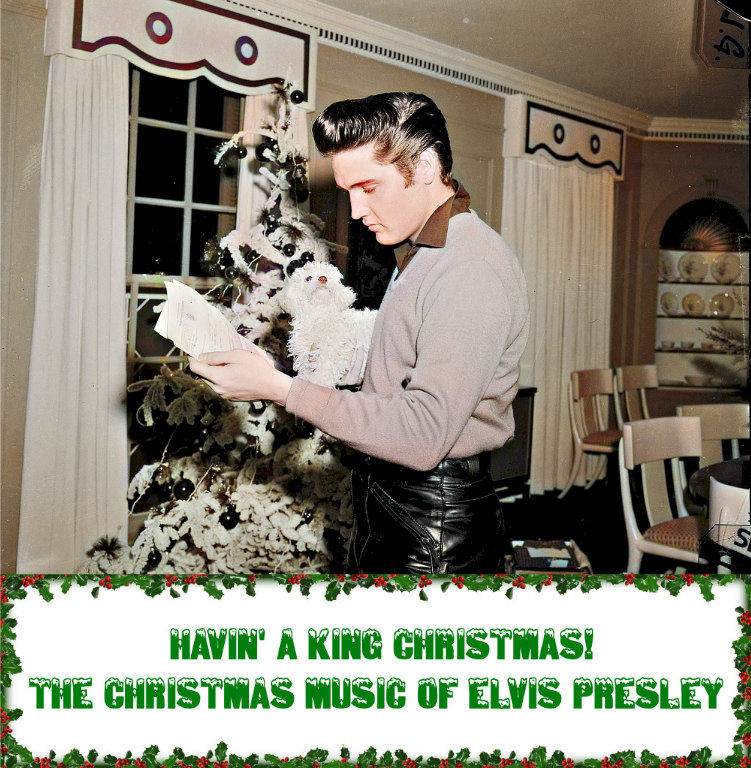
I have said before in these pages that from my very earliest memories of listening to music, Elvis Presley was there. And a lot of these early memories have to do with the Christmas season and Presley’s recordings in this idiom. So – and I’m sure many of you could say the same – Elvis Presley’s Christmas music is embedded in the very fabric of my memories and particularly where the joys associated with the season are concerned.
I’ve always said that Christmas music starts with King and Bing. And there is much truth in that statement. Bing Crosby is the uncontested pioneer and foremost purveyor of Christmas music but Elvis put rock & roll Christmas music on the map. He was so immensely popular in the late 1950s that when he released his first Christmas album it became a major statement. It was the first significant seasonal release from a rock artist and it opened the floodgates. And while Presley has released some of the finest, most enjoyable, most significant and most individualistic Christmas music ever, appreciating his two Christmas albums is not as simple as you would think.
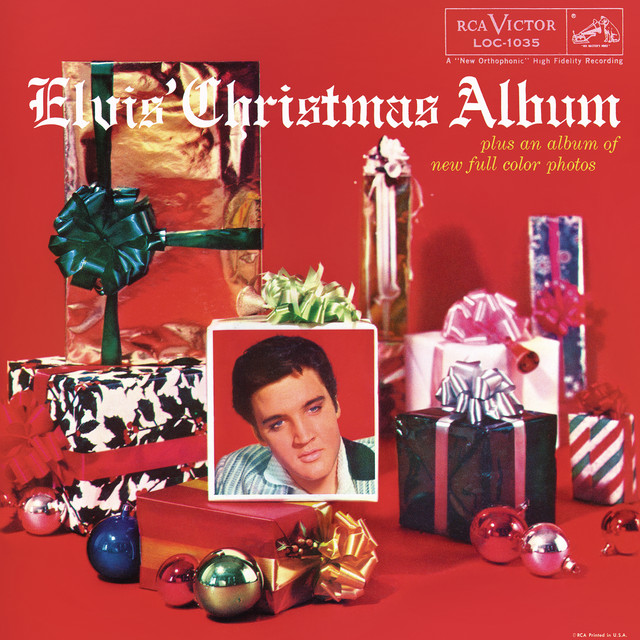
Elvis’ Christmas Album (1957) — There is something to be said for the fact that this Christmas record was only Presley’s fourth album release. The first two were little more than LP homes for the hit singles and the third was a soundtrack but this fourth one was more of a declaration and it marks a rare instance of Elvis stating an intention with a release. Normally not concerned with how his recordings were released, leaving such details to others, this time Presley desired to record songs for which he had great affection. But as Elvis Presley was the hottest and most visible entertainment property in the land in late 1957 and considering how he had set the establishment on its collective ear, he could not avoid controversy even with a recording of such obvious sincerity.
The album starts off with one of Presley’s greatest recordings in any genre. In fact, I have declared previously that “Santa Claus is Back in Town” is his sixth-best song ever. Only 5 of his over 700 recordings are better than this one. During the sessions for this album which took place in September of ’57, it was felt that they were one song short and so songwriters Jerry Leiber and Mike Stoller went to work. The two were already legendary in the industry and had written previously for Elvis. They adjourned to another room and in minutes – in minutes – came back with this blues workout which Elvis delightedly tore into with relish resulting in a searing, ferocious gem. The piano of Dudley Brooks and D.J. Fontana’s drumming both stand out with Dudley’s solo particularly pleasing. The song, loaded with double entendre and described as “slyly risqué”, is certainly delivered with a wink. Presley sings of himself as Santa Claus but y’know what? This visit is about gifts of another sort. “Hang up your pretty stockings, turn out the light. Santa Claus is comin’ down your chimney tonight” And there are few Christmas lyrics cooler than “got no sleigh with reindeer, no sack on my back. You gonna see me comin’ in a big black Cadillac”. Oh, to have been in the studio to see this being recorded. It is Presley’s second-best 50s vocal performance and the perfect curtain-raiser for this record and for the whole Christmas season.
Ridiculous to think that this passed for controversy in the 1950s. There are many examples you can site of Elvis Presley, Music Fan as evidenced by him directly copying a recording by another artist. When he decided to include the venerable “White Christmas” on this record, he went directly to the 1954 version of the song by the Drifters. But if you are a long-time and avid reader of what we serve up here at Vintage Leisure, you will know that the Drifters’ version borrowed from a 1949 version by the Ravens; so let’s give credit for this arrangement where it is due. But White America, which included the song’s storied composer Irving Berlin, would never have heard either of these first two versions as they were only played on “black radio”. But when Presley’s version came to light Berlin railed against it calling it “a profane parody of his yuletide standard”. Not content with this statement, Irving had his staff call New York radio stations demanding they not play the song. Thing is, though, Presley’s version is very warm and gentle and just as appropriate – in its way – as any other version to be played by the fireside.
Next is another chestnut, Gene Autry’s ode to the anchor of the Santa Claus Parade, “Here Comes Santa Claus”. Presley really gives the Elvis Touch to his rendition with his half-mumbled “a-well-a here comes Santa Claus, a-here comes Santa Claus…”. This is followed by another timeless favourite, “I’ll Be Home for Christmas” and then Side One ends with two songs that would remain indelibly linked to Elvis at Christmas.
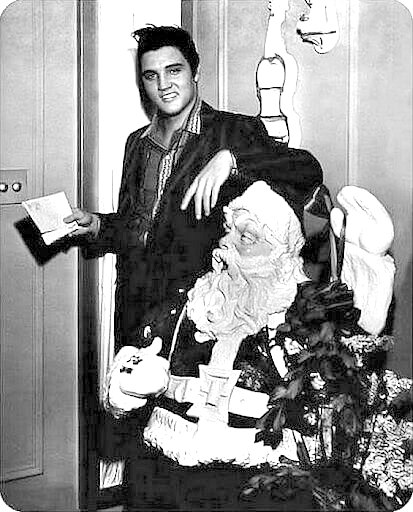
“Blue Christmas” is on a very short list of the most beloved, the most popular and the most often heard Christmas songs of all-time and I’ve talked about it here before. And then the first side ends with one of the Christmas songs that Elvis himself owns. “Santa Bring My Baby Back (to Me)” was written by a songwriting team that had penned many songs for Presley and others and this tune, really, is the quintessence of the rock & roll Christmas song. In Elvis’ hands it is pure bliss.
For this Christmas record, Presley devoted one side to fun, rock & roll numbers and one to gentler material. Side Two begins with the two carols chosen, both arranged by Elvis. “O Little Town of Bethlehem” is lovely and “Silent Night” is handled quite well. I have noted before that this venerable carol, among history’s most revered pieces of music, is essential to any program of Christmas music and really should be the last song on any seasonal album.
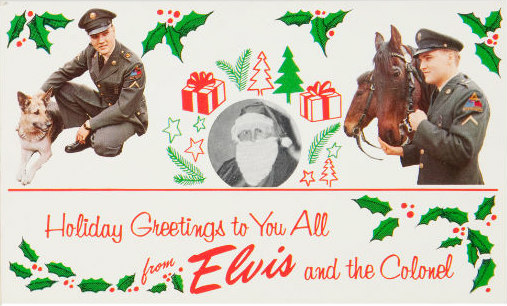
And it is the last Christmas song on this record. Elvis Presley’s love of gospel music is well known and he did not wait long in his career to record it. In March of 1957, he released an EP containing four of his favourites. Those four were included on Elvis’ Christmas Album. “(There’ll Be) Peace in the Valley (for Me)” is one of the most notable of Elvis’ recordings and also among the four is “Take My Hand, Precious Lord”, a song and a recording that has since come to symbolize Presley’s challenging final years and to be emblematic of his later desire for aid and, eventually, release.
Elvis’ Christmas Album was a real gift to fans when it was released in October of 1957. It was originally issued in a gatefold cover containing a photo album of full-colour images, some from Jailhouse Rock. As I noted in my Elvis edition of Christmas Caveats, the album has been incessantly mined and reissued upwards of 200 times with 13 different titles and 21 different covers. It is Presley’s best-selling album, having shipped at least 17 million units making it also the single best-selling Christmas album of all-time.
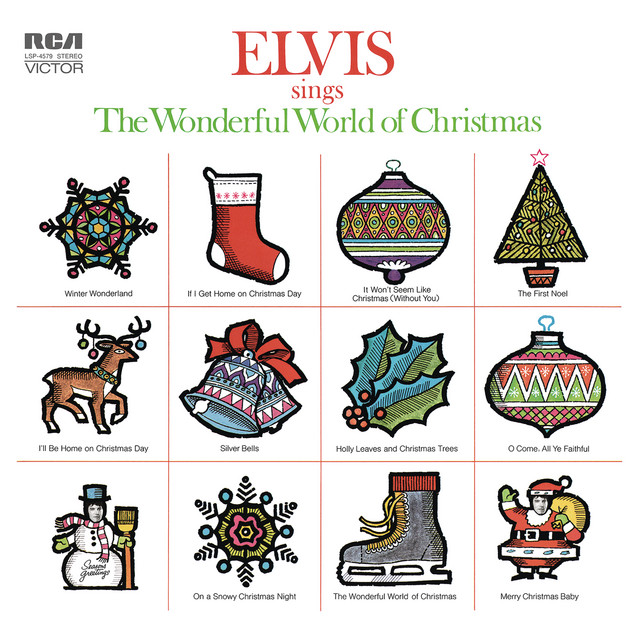
The recording methods of Elvis Presley would make a great topic for a future article; there is so much to discuss and to try to understand. In this case, it will have to suffice to say that, in early 1971, RCA “informed Elvis” that they wanted a new Christmas album, that it was a priority and they hoped for a September release. Elvis, I suppose, is the most successful artist in history for whom the details of recording and record releases mattered not one bit. He sang, that’s what he did. He understood the business and he knew that he needed to record and so he did. The End. Whatever, baby. Let’s go buy some Caddys.
Elvis and his crack band made it through the 11 masters needed for the Christmas record though it was not easy. Presley either had a cold or he was easily distracted, launching into the gospel songs that were also required from the sessions and that would turn up on the incredible He Touched Me album. It is one of the major wonders of Elvis World that, amidst the unceasing activity of his private life, the barely controlled chaos of his recording sessions and the methods by which material was provided by many less-than-stellar sources, it was more often than not the case that Elvis Presley continually issued stunning vocal performances. This is truly a testament to his way with a song and the power and character of his voice.
The record gets off to a reverent start with two carols arranged by King. “O Come, All Ye Faithful” is presented in a stunning and dramatic arrangement making it probably the most compelling version of that carol ever recorded. The drama of the crescendo with which the song gets underway after a piano intro is celestial and features wonderful group singing from Elvis & Co. Then comes another highlight of the record and of the whole Christmas season. “On a Snowy Christmas Night” is a perfect example of the type of song on this album. It is emotional and subdued but with a power that springs from the longing that one can feel at Christmas when one is not exactly where one would like to be, physically or otherwise. Perhaps this sound borrows from the more serious country music sounds coming out of the post-Kristofferson Nashville but there a few songs on this record that defy categorization and are hard to even describe. “On a Snowy Christmas Night” is one of only a few songs that are fitting to be played in the quiet of Christmas night after the festivities have died down and a mellow, satisfied and wistful glow pervades.
“It Won’t Seem Like Christmas (Without You)” is among these contemporary gems that Elvis delivers with impassioned voice. Again the longing is prevalent and the chorus is perfect. This is a good example of Elvis taking a song from an unheralded writer and making it into an event. What can I say about “I’ll Be Home on Christmas Day”? It is nothing less than one of the absolute finest songs in Presley’s whole catalogue and, I know, that is saying something. “Oh, too many tears have fell, my soul filled with yearning” is one of the greatest moments in his entire career. “Holly Leaves and Christmas Trees” is along the same lines and an excellent song. Funny to think it was written by Red West and that Red provided Elvis with better material than many of the more established writers. A song like “Merry Christmas, Baby” showcases the blues meandering that Elvis could do for hours and there are recorded versions of the song that are almost that long. It is a killer track that should have ended the record; “Silver Bells” is pleasant but the two tracks should’ve swapped spots.
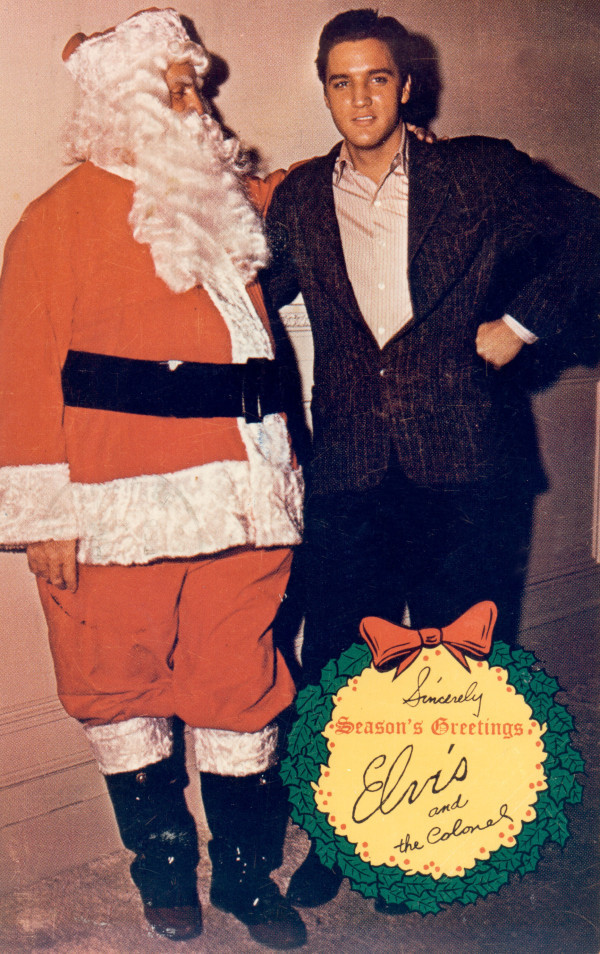
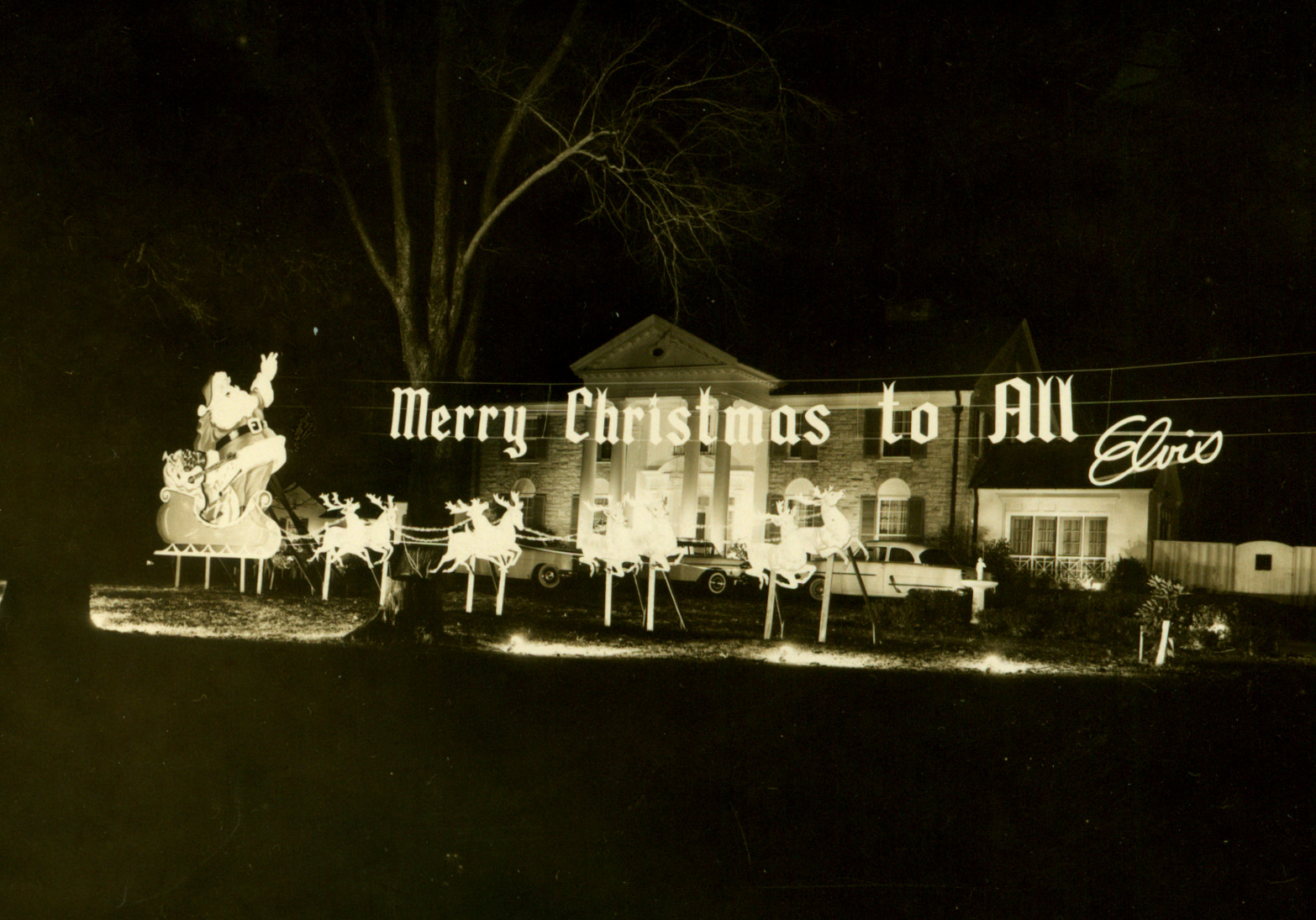
Excellent work here from Elvis Presley Central – notice King’s attire; never just jeans and a t-shirt around the house
Wonderful World of Christmas was not as commercially successful as King’s previous Christmas album but it would eventually sell more than 3 million copies and rank in the upper echelon of Presley’s best-sellers. And if we’re being nit-picky we could say that an artist of the stature of Elvis Presley putting out a Christmas album in 1971 is a bit of an anomaly. No one was similar to Elvis but were any singers anyway near like him doing this in the early 70s? And the title is a little from the lame end of Crooner Land and doesn’t quite fit King at this time, if you ask me and I know you didn’t. Doesn’t help that the title track itself is so slight. But this minor point doesn’t matter and now lets get down to what we are really here to talk about.
Elvis’ Christmas Album is a legendary record with phenomenal sales behind it. The Christmas songs on it are some of the best there is and at least one ranks among Presley’s finest performances. Elvis Sings the Wonderful World of Christmas is a classy record of stunning depth and at least one of the songs on it ranks among Presley’s finest performances.
I say this to drive home the point that Elvis Presley did Christmas music extremely well. Neither time did he phone it in and both times he nailed it. But when it comes to collecting and appreciating his body of holiday work, neither album really satisfies without the other. Neither record – on its own – is an unmitigated five-star album. They both need each other and when you combine them – with proper track selection and sequencing – it comprises the greatest canon of Christmas music outside of Bing Crosby.
The real lasting gift to us Elvis People is the fact that Elvis Presley recorded his Christmas albums at two different points in his career – and he made these records at the two flat-out peaks of his arc. 1956/57 and 1969-1972 represent the best he ever was. So, there’s that; the high points of both albums are spectacular as he is at the peak of his powers at these two different times. But I feel we are forced to remove the gospel tracks from the first album. I’ve said it before; gospel music for many people is every day music and is not specifically tied to Easter or Christmas. Some people – yesterday and today – go to church every Sunday; not just at Easter and Christmas. So for many, the inclusion of the gospel tracks seems odd. And let’s talk straight – they are not Christmas songs. The world’s best-selling Christmas album is only two-thirds Christmas music. And the fact that the gospel songs were previously recorded and previously released as an EP and then tacked on here also smells a bit.
Track for track, The Wonderful World of Christmas may be a better album. The title track and maybe “The First Noel” are pedestrian though pleasant; the rest of the record is stellar. But you can’t have a King Christmas with just this album – we need the 50s Christmas songs. And while we are at it, lest we forget the 1966 single “If Every Day Was Like Christmas” by Red West, a fantastic recording that also must be a part of your King Christmas experience. You could say that a better album than both of these two records is RCA’s 1994 compilation If Every Day Was Like Christmas, the first release to combine all of Presley’s Christmas music. But even here they have botched the sequencing and so, really, we must resort to that modern creation the playlist.
What you do is collect all of Elvis’ Christmas music – it is not hard – and get it on your computer or Mac. Sequence the songs chronologically using the order of the original albums with the ’66 single in between and you have 20 of the greatest Christmas recordings ever made.
And incidentally, it could also be argued that Elvis Presley’s two Christmas albums are his only album releases that make sense in terms of the relation between an artist and their album releases. Soundtracks were full of movie songs, obviously and others – think the 1970s albums – were compiled haphazardly by Presley’s producer, Felton Jarvis and others. Recording time would be booked and EP and his team would try to get as many masters in the can as they could. Then the record company took over and dispersed the songs over a number of LPs. The only times an “album” was the goal was with the Christmas songs and maybe a few others. In the end, I suppose, this could mean nothing but I tend to think that the recording of these two records was purposeful and I feel like this gives them an intangible glow and makes them stand out; this in addition to the immense quality of the recordings.
Few singers claimed ownership of songs the way Elvis Presley did. He has been successfully covered so infrequently because what is the point of such an endeavour? The rock & roll tracks on Elvis’ Christmas Album are his alone, even “Blue Christmas” which has been done a hundred times. And the greatest tracks from Elvis Sings the Wonderful World of Christmas haven’t even been touched and for good reason. Presley put his singular touch on the music of Christmas and when put together his 20 songs of the season are the gift that keeps on giving.
Sources
- Elvis: Back in Nashville liner notes – David Cantwell
 SoulRide