“How is it
people fear the dark?
Not me, I’m reconciled.
As every day I see
the blackness grow,
I’ve come to terms with it,
it knows I know.
Yet I wonder
if the darkness
ever hungers
or grows lonely
for the light
it’s left behind.”
Alone
by Rod McKuen (1975)

Alone is the second Pocket Books paperback collection of poems by Rod McKuen. The first was the previous year’s Seasons in the Sun but Rod had been releasing collections of poetry since 1954’s And Autumn Came. The poems collected here were written and published in various publications throughout McKuen’s publishing life which began in ‘54 and added to these were several new works that Rod copyrighted in 1975. McKuen’s forward notes that, though the poems in Alone touch on various topics, they all comment on the state of being alone. The book is broken up into chapters with titles like Solitaire, The Spectator, The Loner, Death…as a Beginning and each is dedicated to an individual pertinent in McKuen’s life; The Spectator is dedicated to Dusty Springfield and Night Crawler to Frank Sinatra.
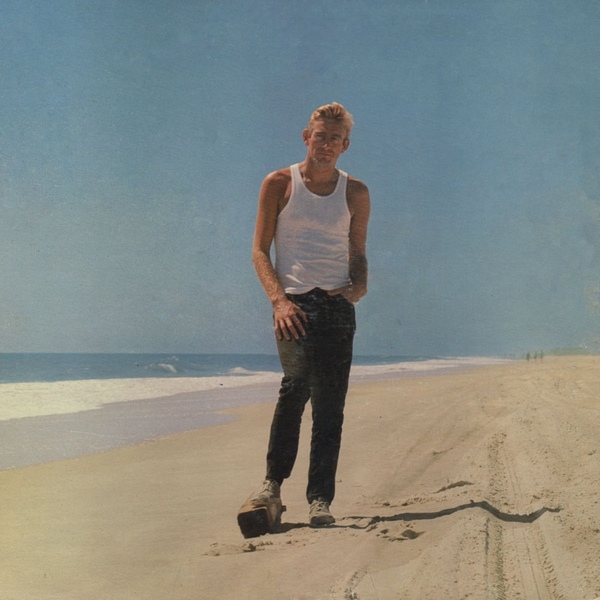
Rod McKuen was born in a Salvation Army hostel in Oakland in 1933. He came from a broken home and suffered sexual and physical abuse at the hands of relatives. He ran away from home to escape his alcoholic stepfather and worked along the West Coast as a lumberjack, rodeo cowboy, stuntman and DJ among other things, always sending money home to his mother. In the early 50s, he began writing poetry and lyrics and settled in San Francisco where he read his poetry in clubs along with Kerouac and Ginsberg. He released pop albums on Decca, sang with Lionel Hampton’s band and composed and conducted music for television.
In the early 60s, he moved to France where he discovered the Belgian singer Jacques Brel. McKuen translated Brel’s songs into English resulting in the contemporary standards “If You Go Away” and “Seasons in the Sun”. Returning Stateside in the late 60s, he began to publish volumes of poetry and enjoyed prolific sales.
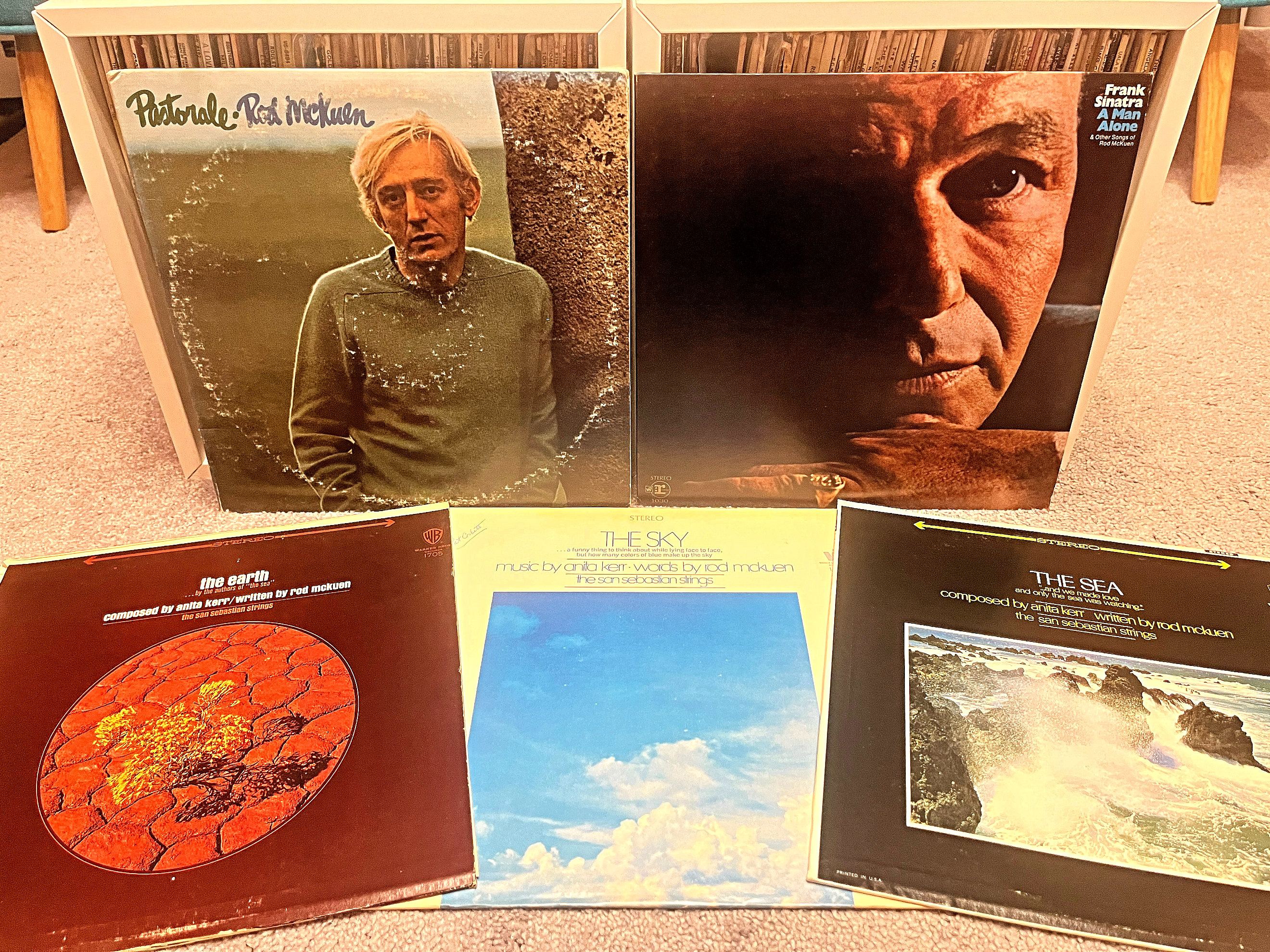
Us Vintage Leisure types will likely know of Rod McKuen mostly from his songwriting and album releases. Rod wrote over 1,500 songs and released some 200 albums that have sold upwards of 100 million copies worldwide; impressive numbers. Mostly though he’s known in this area from others interpreting his work, singers as varied as Johnny Cash, Waylon Jennings and Jimmie Rodgers to artists like Robert Goulet, Perry Como and Percy Faith. His symphonies and concertos have been performed by orchestras the world over and he was twice nominated for Oscars for his many film scores. Notably, in ‘67, McKuen joined with Anita Kerr and the San Sebastian Strings to create a series of nature-based albums featuring Kerr’s music and McKuen’s recitation of poetry. I’m happy to own the first three on vinyl. Interestingly, Rod also leant his voice to the 1989 animated musical The Little Mermaid.
“We come into the world
alone.
We go away the same.
We're meant to spend
the interlude between
in closeness
or so we tell ourselves.
But it's a long way
from the morning
to the evening.”
In 1969, Frank Sinatra gave Rod McKuen a stamp of approval of sorts when he recorded and released A Man Alone, an album with orchestrations by Don Costa and featuring Rod’s words and music. Sinatra recites some of the lyrics on this record that actually signalled the beginning of the end of Frank’s viable and relevant album releases. The album does, however, feature one of Sinatra’s best performances from this era, “Love’s Been Good to Me”.
Alone, the book we’re looking at today, is filled with understated and gentle verse. Some of the poems relate more obvious themes but others are less scrutable. And this is as it should be, I suppose, with poetry. Often, you will not know what it is exactly that McKuen is saying and this will leave room for the reader’s own interpretation. Like a painting, you will get from it what you will. But I also found that when the words are less than knowable, the reader can slip into a kind of half-conscious cadence in the reading that will prove soothing; as if the words themselves are less important than reading them. As if the mind and soul are taken on a journey that does not require literal understanding or even the acknowledgment that you are reading.
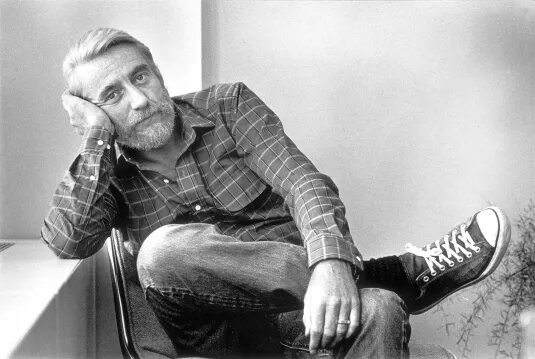
Sadly, Rod McKuen’s legacy has a certain stink on it. Even at the height of his popularity in the 1960’s, he garnered little or no respect in certain circles. He is probably the most popular poet of the 20th century who is least respected by either critics or academics. It likely has to do with the whole concept of selling out. Though McKuen did nothing necessarily crass or commercial, he did enjoy a large measure of mainstream success and as a highly visible poet he inevitably suffered a backlash prompting Rod himself to note sardonically “the most unforgivable sin in the world is to be a bestselling poet”. His work has been described as “treacle” and “kitsch” and he has suffered quite vicious criticisms. Writer and literary critic Nora Ephron said “for the most part, McKuen’s poems are superficial…and silly” and Pulitzer Prize-winning US Poet Laureate Karl Shapiro also gave it to Rod with both barrels saying “it is irrelevant to speak of McKuen as a poet. His poetry is not even trash”. But for those of us who allow for a lighter diet of poetry and verse, Rod McKuen’s work through the vintage era retains a certain charm and even an understated poignancy.
“the ocean’s all
that I have left.
There won't be anyone again,
but there will always be
sea water and sea things
to wash the memories
into one another.
That's a comfort
not to be taken lightly,
considering the sea
is all I have.”
 SoulRide
Second attempt to comment… Thank you for this insight into Rod McKuen. I had been writing poetry since I was a very young child, except I was writing it in mostly stanzas, the way Robert Louis Stevenson taught me in “A CHILD’S GARDEN OF VERSES.” I believe I was listening to late night radio on clear channel WLS Chicago (which I could pick up in Dallas), around 1967. They occasionally played McKuen’s poetry recordings. Hence, he taught me that poems don’t always have to rhyme. Enter free verse into my world. 🙌🏻 I recall an interview with McKuen where he said his voice made people want to clear their throat. What’s not to love about literary genius and self deprecating humor.
Writing poetry in high school is where I started as well. I did love the idea that you could rhyme and have structure when you wanted to and then just say stuff freely at other times.
Actually, I began this blog with the distinct and only purpose of publishing my poetry. An early poem I wrote was called “Soulride” as was the unpublished anthology I compiled. If one goes back to my very first posts here, one would see that it was all poetry. My early followers were here just for poetry and I often wonder if they are still following!