
Frank Sinatra was a most generous fella. Years ago, I conceived of an article with that title that would discuss the many musical boxes Sinatra checked in his long career. I wanted to point out the many different eras and genres he worked in and moods that his records created. The origin of this Suggesting Sinatra series was an attempt to help people understand the Chairman’s canon and to shepherd folks through his work highlighting what came when and what it means and meant at the time. Here we find ourselves at something of a transitional time in his career, a time when he was marking his 50th birthday and perhaps contemplating what path his recordings would take going forward through the late Sixties and beyond. Interesting to note that one of his most successful and iconic songs, “Strangers in the Night”, was still to come within the next year but what he sang and how his records were received was about to change. But there were still gems yet to come and one of my favourites of his albums has to be the one we’re talking about today, 1965’s September of My Years.
And it is not just down to the quality of the record but it is largely about mood. Sinatra – much like another Jersey boy, Springsteen – traveled through people’s live with them, through their romantic youth in the 1940s, the swingin’, world-on-a-string years of young adulthood in the 50s and now FS and many of his listeners found themselves facing significant changes with the arrival of middle age in the 1960s with sights beginning to reluctantly set on the rest of the trip, on the downward side of the hill with empty nests, retirement etc. Sinatra called on arranger Gordon Jenkins for this program after having worked with him on previous string-heavy affairs like A Jolly Christmas and No One Cares and perhaps the result is another case of the arranger contributing just as much to the record as the artist.

Will Friedwald in his book The Song is You states plainly for us what sets this album apart from just about any other in the Sinatra canon. Aside from the songs being about approaching middle age, none of them are missives of love from the singer to his beloved. Instead they are all meditations on life that Sinatra directs inwardly. They are ruminations. They are attempts to understand the changes becoming apparent in the mirror, in the body and in the spirit. The singer finds himself reminiscing and looking backward as opposed to the present or the future. Reaching the September of his years has caused the protagonist of the songs to wonder how much of it he got right, what he could’ve done better, the things he’d like another shot at or to experience once more. Once again then Sinatra has delivered us the gift of relatability as on this wonderful record he sings of the realities of life and the things so many of us understand. Or will soon understand.
Our program begins with a significant song in the Chairman’s songbook. The title track was written by the prolific team of Sammy Cahn and Jimmy Van Heusen and it continued a trend of sorts. Often, once Sinatra had chosen his theme for an album, he would gather popular and well-worn songs that fit what he wanted to say and then he would commission a title track which was often written by Cahn and Van Heusen. “The September of My Years” sets the tone for this album and it is a wonderful recording. The theme of the song and indeed the whole album is one of finality or at least transition and this tune serves as a signpost in the Sinatra trajectory. It is a declaration of age and having reached a certain point and this was being seen in his recording career as a whole, as well. Aside from the anomaly of “Strangers in the Night” still to come one year hence, Frank’s records would forever after be distinct from those that had gone before. Certainly there would be less hits but also his music’s essence would change and “September of My Years” then is something of a curtain-call. There is a definite austerity and majesty in the sublime Gordon Jenkins chart and in the Chairman’s typically impressive delivery of the poignant lyrics, words that end with a gentle, contented optimism –
“One day you turn around and it’s summer
Next day you turn around and it’s fall
And the springs and the winters of a lifetime
Whatever happened to them all?
As a man who has always had the wand’ring ways
Now I’m reaching back for yesterdays…
I find that I’m smiling gently as I near
September, the warm September of my years”

Jenkins next supplies his own “How Old Am I?”, complete with haunting intro. “Don’t mind these lines beneath my eyes, they’re well-earned souvenirs of a thousand nights of laughter and occasional tears. And I hope you won’t be jealous of the silver in my hair, it took many lover’s quarrels to put it there” “Don’t Wait Too Long”, as it’s title implies, is a warning. Fall can be pleasant – “fall is a lovely time of the year” – but autumn will lead inevitably to winter – “but soon fall is ending and winter is near” and here is a case where a younger man could not have pulled off the admonishment as does the mature Sinatra. This sentiment leads easily into the next track, “It Gets Lonely Early”; why mustn’t one wait too long? Because it gets lonely early and I know this from experience, the singer laments. This tune begins with the ominous striking of a clock and the significance is clear on this song from Cahn and Van Heusen that has a sharp, knifepoint sadness; “when you’re all alone, all the children grown, it gets lonely early, doesn’t it?”. Another Jenkins original follows, one he considered his finest composition.
“This Is All I Ask” is what I call a contemporary standard, one of those songs that debuted after the previous era of American Popular Standards that was quickly picked up by vocalists and easy listening bandleaders alike and recorded countless times down through the years. The song has a gentle fragility in its melancholy. I don’t ask much, just that time will slow down, something we have all desired at any point in life. Jenkins’ arrangement provides a wash of strings and a big finish from FS. There are similar string torrents in “Last Night When We Were Young” and it is interesting to note the differences as Sinatra revisits this song on a somewhat grander and more substantial scale after the lighter version he recorded with Nelson Riddle a decade prior on In the Wee Small Hours. “The Man in the Looking Glass” addresses the timeless theme of physical changes that inevitably occur in all of us but it ends on a positive note suggesting we all keep our senses of humour even if we cannot keep all of our hairs.
Perhaps even more so than the title track, the standout moment of the record comes with a song that started life as a folk song. Indeed, it has been suggested that the entire album is comprised of folks songs draped with the lush Jenkins raiment of strings. Gordon’s arrangement for “It Was a Very Good Year” is otherworldly, particularly in the way the same phrase or motif is stated with ever increasing intensity and emotional gravity. The song was written by Ervin Drake for the Kingston Trio. The clever lyric recounts amorous adventures through the years up until the present day when the singer thinks of his life as vintage wine; listen how Frank enunciates “fine old kegs”. His life has poured sweet and clear. Gordon’s final statement of the motif is somewhat passive – as if there is nothing left for singer, arranger or protagonist to prove. A stunning recording that won Gordon Jenkins a Grammy for his arrangement, for Frank the Grammy for Best Male Vocal Performance (duh), it became Sinatra’s first Number One on the Adult Contemporary chart and even reached the Top 30 of the US Pop charts.
“When the Wind Was Green” is another melancholy song of the passage of time. The wind will blow true through spring and summer but the autumn wind causes leaves to fall “flying, crying. In a brown wind dying”. “Hello, Young Lovers” is a venerable part of the Great American Songbook and hails from Rodgers & Hammerstein’s The King & I. I always think of young Bobby Darin’s version of this and reading that such a life novice could not hope to invest the lyric with any sort of authority or poignancy but here it is a perfect fit sung by Sinatra at this age and among the tracks on this record. Alec Wilder’s “I See It Now” is a wistful look through the old yearbook; “That world I knew is lost to me, loves have come and gone. The years go racing by, I live as best I can…”.
“Once Upon a Time” sits with “This Is All I Ask” among contemporary standards. The regal song has a title that says it all and it has been recorded in austere settings by most of the significant singers of the age; Bobby Darin, Perry Como, Tony Bennett, Bob Dylan, Vic Damone, Robert Goulet, the Jones Boys Jack and Tom, Andy Williams and others. “Once upon a time never comes again” The closer, “September Song”, may be the most revered and venerable song on the record. This final look back recalls the “long, long while from May to December” and the seasons of life that have provided achievement and some satisfaction but at the cost of time spent with family and a significant other. Looking back from this vantage, the singer declares much of life a “plentiful waste of time”. What matters now and most is the detachment from obligation and responsibility. There might be a morsel of optimism here for the listener as the lyric hints at a life well lived and leisure achieved; “Oh, the days dwindle down to a precious few. September, November. And these few precious days I’ll spend with you. These precious days I’ll spend with you”.
September of My Years reached Number 5 on the US albums chart. Frank Sinatra would only ever chart an album as high once more and that LP reached Number One on the strength of “Strangers in the Night”. Consider this only if chart placings really mean anything. What means much more though is that it could be argued that the Chairman would never again put together a program of such sterling quality, lyrical poignancy and stunning musical craftsmanship. If it wasn’t for my love of his album with Jobim, I would say it was his last great album triumph; in most ways, it is. Certainly it serves as a capper of sorts to a ten-year run of LP releases like no other in history and there is a stately magnificence to the record that truly sets it apart from the rest of Sinatra’s catalogue.
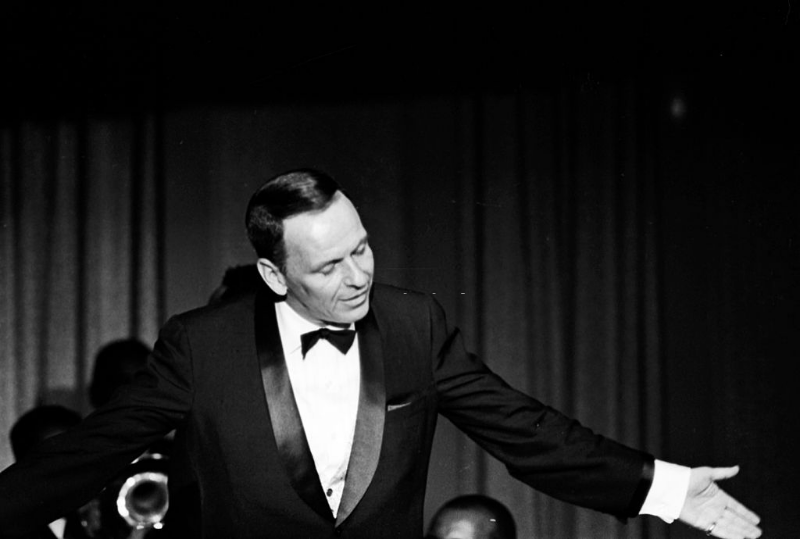
When one studies Sinatra’s output and his contributions – as we do so often here – one must look at his presence in one’s life and at Frank’s symbolic stature as a figure to aspire to in simple terms of living; attitudes and outlook. Despite the fact that Sinatra always operated in a realm literally no one else in history traversed, he still inspires us regular folk in so many ways and while we may not be able to live, live, live ’til I die like he did, we can still channel him, feel his influence and even learn from his life. With this album, he adds a poignant chapter to life’s owner’s manual.
If you are one of the fortunate ones who looks at love as just one small part of the life experience, then September of My Years emerges as the most weighty and the most fundamental of all Sinatra albums, more so than his treatises on unrequited love. You may have avoided amourous attachment all your life or you may have got it right the first time and maintained one relationship throughout all of your days. But regardless of how you assimilate matters of the heart into your life, if the Lord blesses you with a tenure on earth of any length, you will age. That experience is universal. Just as surely as we all made the significant pivot from child to adult, most of us will turn around one day and…it’s fall. Life has changed, health as become a concern, people have left your sphere, your responsibilities and your contributions to society have changed and lessened. We all will come to that point. And when we do, when frustrations and confusions set in or simply when you realize where you have arrived and you are marveling at how the world looks now in your September, you will have Sinatra. Once again you will have Frank Sinatra to commiserate with, you will have Sinatra to advise you and to confirm for you that you are going to make it. You will have him to tell you that he has been there, too. He has felt that. Revel in those feelings, he tells us in this record, but keep them in perspective. If you run the race well, if you live life to the full, there will come the reward. The time when you can look back and think of your life as vintage wine from fine, old kegs.
May it pour sweet and clear.
 SoulRide