Factory Girl (2006)
Sienna Miller, Guy Pearce, Hayden Christensen, Jimmy Fallon, Mena Suvari, Edward Herrmann, Mary-Kate Olsen, Illeana Douglas and Michael Post
Director – George Hickenlooper
From Metro-Goldwyn-Mayer

Heiress, socialite, model, actress, superstar Edie Sedgwick (Miller) is running. Her life is unraveling and – through voice over and flashback – we are told her story. A promising art student, she follows her dreams to New York City in the mid-1960s. Intrigued by the work and the mystique of Andy Warhol (Pearce), she meets him and the feeling is mutual. Andy begins to use her in his experimental films and the two become worldwide cutting edge celebrities.
As Edie’s substance abuse intensifies, her financial situation worsens. She meets a popular singer (Christensen) who points out to Edie how flaky Andy is and the shallowness of her life. The two become intimate and this irks Andy and he and his crew freeze Edie out. When her singer drifts away, Edie’s fortunes plummet and her flame sputters.
Discovering Edie Sedgwick in the spring of 2021 was a major event for me. Learning there was a major motion picture made about her excited me – even after I had heard some negative things about it. Director George Hickenlooper started as a documentary filmmaker releasing in 1991 his first feature-length doc, Hearts of Darkness: A Filmmaker’s Apocalypse. He then made a clutch of narrative films, none of any import. Hickenlooper died in 2010 at age 47 from an accidental overdose of painkillers.

Sienna Miller is an American-born British actress known for G.I. Joe: The Rise of Cobra (2009) and American Sniper (2014). She scores points with me for appearing in Ben Affleck’s period piece Live By Night (2016) and opposite my man Kevin Costner in his sprawling western saga, Horizon (2024 and beyond). Australia’s Guy Pearce is forever in my good books due to his portrayal of Ed Exley in the stunning L.A. Confidential (1997) and you can throw in the magnificent Memento from 2000. Vancouver’s Hayden Christensen was fresh off his star-making turn playing Anakin Skywalker when he appeared in our film. Interestingly, he has not appeared in anything of much note since. Mena Suvari was seven years removed from her acclaimed work in American Beauty and has been working steadily since though she has avoided much notice. She did, however, portray Jane Wyman in 2024’s Reagan, one of four films she made that year.
Factory Girl also features Mary-Kate Olsen playing the first of only three characters she would portray in a film without her sister. The twins both would retire from acting in 2012 to focus on their successful work in the fashion business. Mary-Kate has also been an accomplished equestrian. Illeana Douglas is Melvin Douglas’ granddaughter and has also been known as the long-time girlfriend of Martin Scorsese. To her credit, she has become a filmmaker in her own right and has appeared in some notable films; Goodfellas, Cape Fear, Quiz Show, To Die For and others. I have reviewed her star turn in 1996’s Grace of My Heart in these pages. In our film she portrays Diana Vreeland, noted fashion columnist and editor at Harper’s Bazaar and Vogue. And finally, keep your eyes peeled at the end of this film for an appearance by Edie Sedgwick’s husband, Michael Post as the taxi driver.

It is really a shame that Edie Sedgwick and Factory Girl are not more well known. That is not to necessarily say that here is an unequivocal triumph of a film and it deserves to be reassessed, reevaluated and better appreciated. The movie definitely has its problems but most of us who have fallen under Edie’s spell are happy it exists, happy that someone made an effort to share her compelling story. The movie succeeds in telling Edie’s tale and for the most part with accuracy and Sienna Miller puts in an admirable and engaging performance, without which the film would never have had a chance. And the cast is quite notable and that will also draw attention.
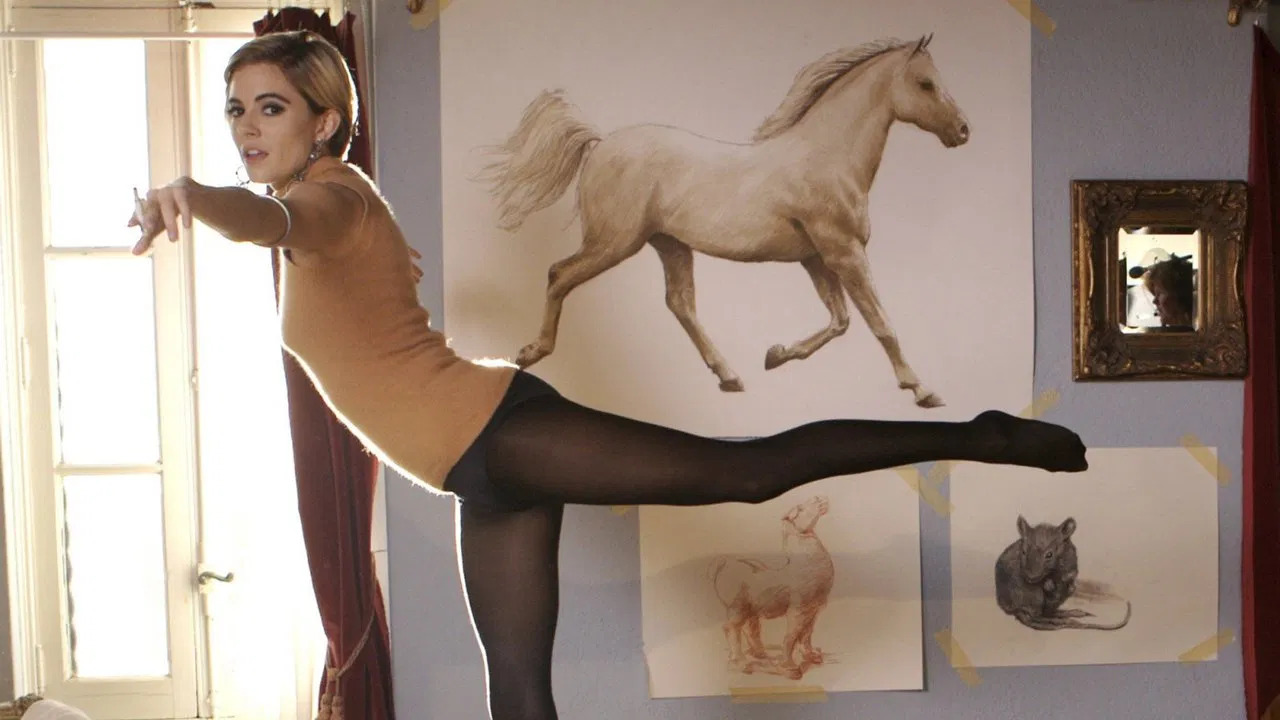
The movie begins with Sienna as Edie giving an interview looking back from 1970 and this is apropos. It brings to mind the “two Edies” from Ciao! Manhattan and helps to show Sedgwick later in life after the maelstrom of her heyday. There might be some cliché in the period depictions but that is something we can get over. Hickenlooper and his team do well making the movie glamourous and colourful and stylish often employing different exposures and film grains, using black and white when delving into Edie’s childhood. Many of the iconic images, poses and photoshoots we’ve all seen are recreated well and the pace is often frantic which mimics the cyclone that Edie’s life was.
The film brings up many talking points for people who love Edie. It may never have been explicitly stated as fact but in the film incest is assumed and Edie’s father, “Fuzzy”, is depicted as a one-dimensional monster, his character given full exposure in the scene showing his meeting Andy Warhol. The film also touches on the factual relationship Edie had with Bob Dylan and the triangle of Edie, Andy and Bob is given great weight in this story. There is much conjecture and debate – especially in Dylan circles – about Edie’s relationship with Zimmy. Perhaps Factory Girl‘s biggest failure is in its attempt to elevate this relationship to monumental romantic heights when some would say it was barely a relationship at all. It was crippling to the film’s stature, too, that they could not identify the character as Dylan. There is no attempt to hide who it is but Dylan’s name is not used – he threatened to sue – and the character is named Billy Quinn, though that name is barely uttered and the character is referred to as “Musician” in the credits.

It might be easy to snicker at Christensen’s portrayal of “Quinn” – he’s no Timothée Chalamet – but I would defend him saying how does one (not named Chalamet) portray Bob Dylan? It’s no easy task to play such an iconic figure. The uninitiated may think it is the height of cliché to have “Dylan” in this movie but the fact remains that he did know Edie Sedgwick.
The dichotomy between Warhol and Dylan is made quite clear in the film. Pearce succeeds as Andy – particularly his voice – and he does well showing Andy’s meandering, disaffected nature. Despite his debatable talent, Warhol was scornful of convention and civilized society and this comes through. Dylan was substantive and had much to say while Andy seemingly made a career out of saying little or nothing. Quinn/Dylan helping and advising Edie in the film is a bit contrived but there is a kernel of truth there in the differences between Andy and Bob. When Andy and “Billy” meet, it is like all the times you’ve tried to blend your two friend groups – very awkward and in this case quietly savage.
Quinn does urge Edie to get away from Andy, to do something mainstream and sensible and I am inclined to agree with Quinn in his assertion that Andy is a flake and a bloodsucker, that little if anything will come of her association with him. This aspect is believable but the idea that Bob Dylan actively counselled Edie while they bonded like we see in the film is a little far-fetched. What is true, though, is the fact that both Warhol and Dylan moved on abruptly from Edie Sedgwick. You could say they turned their backs on her. The final acts of the film are very blunt and at some points tough to watch. What is satisfying for the viewer, though, is Andy Warhol’s obvious feeling of guilt, though subtly expressed.
As a fan of Edie’s, you could get bogged down in analyzing each scene for accuracy but I’d advise against it. First because the depictions here are basically sound and secondly, what’s the point? It is, after all, a “biopic” and a dramatic narrative film that happens to be based on someone’s life. Keep in mind that there may be scenes that invite some debate but there are no real egregious errors.
Little Edie Sedgwick looms large in my life and here at Vintage Leisure; my article on her is one of the most-read and I have also reviewed the excellent biography, Edie: American Girl. Factory Girl is a highly flawed but still valuable way to experience her. Sienna Miller’s performance is quite remarkable and Guy Pearce also does well. But, as with any document that deals with Edith Minturn, it is sad and does not end well. Edie Sedgwick still glitters brightly in many lives but there is no escaping the tragic waste nor the devastating conclusion.
Further Studies
 SoulRide