“He thought of his desire to make a design, intricate and beautiful, out of the myriad, meaningless facts of life: had he not seen also that the simplest pattern, that in which a man was born, worked, married, had children, and died, was likewise the most perfect? It might be that to surrender to happiness was to accept defeat, but it was a defeat better than most victories.”
Of Human Bondage
by W. Somerset Maugham (1915)
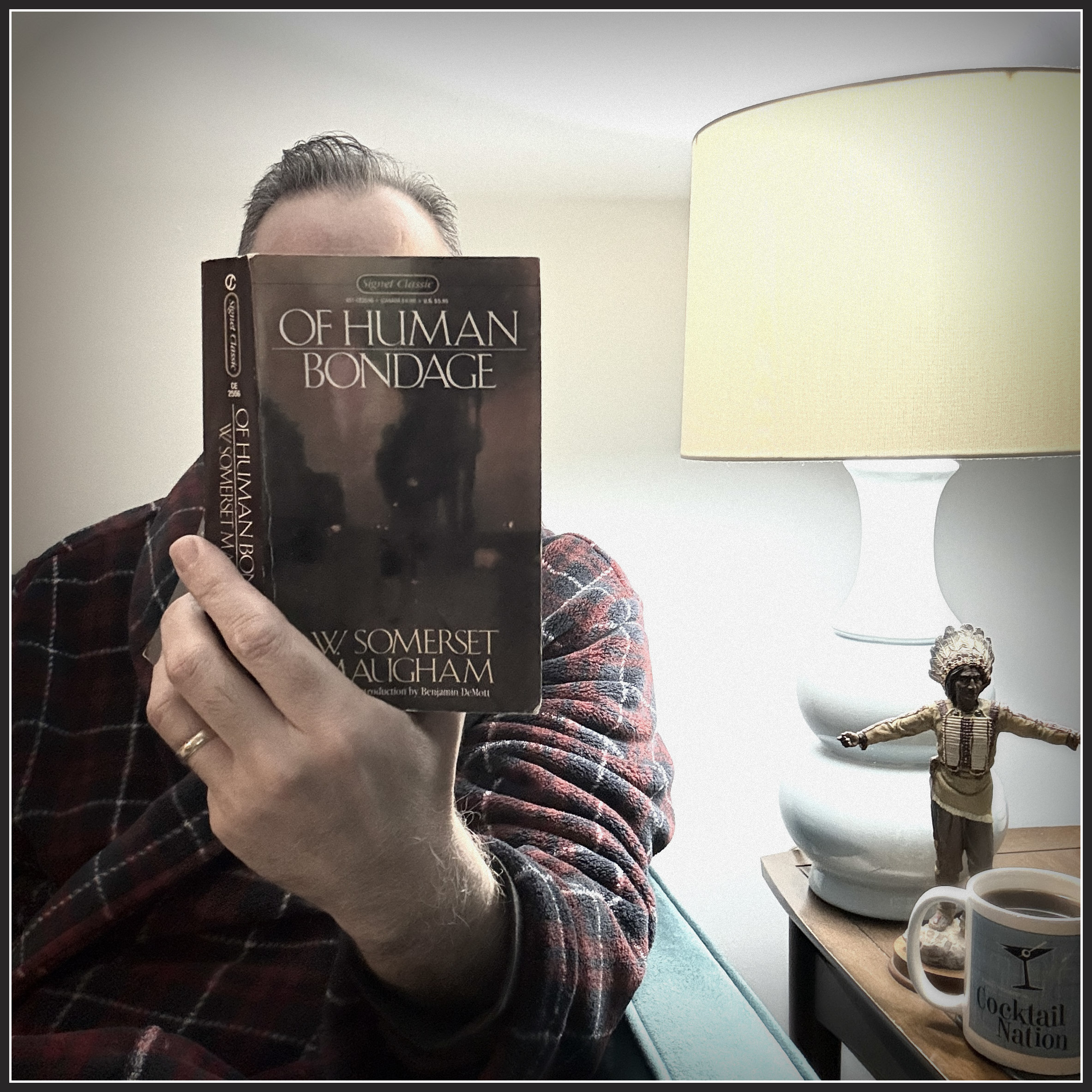
Now, sit back, everyone and you’ll hear a tale of book-reading. I have spoken before about my embrace of the practice of the ancient Japanese art of tsundoku – the act of collecting more books than you could read – and here is a prime example. I distinctly remember the thrift store and the day I bought Of Human Bondage thinking that thought I don’t really like to think; this is a legendary book and I really should read it. But am I interested in reading it or do I just think I should? Like Shakespeare. Even though its length was daunting I did buy it and took it home where it sat on my shelf for some years. I have often liked to read really long books in the winter as I feel it somehow aligns me with book-readers of old. I remember hearing once that books written at the dawn of the 20th century were often very long as they were partly intended to be a person’s leisure and entertainment for vast stretches of time particularly during an era where there was little else to vie for one’s down time. And the idea of curling up in a cozy spot with a substantial novel while outside the snow falls has a definite appeal.
Finally after owning the book for a few years, I took it down one winter and it went up against a Sam Cooke bio for the honour of being my winter book. The Cooke book won and incidentally proved to be a turning point of sorts in my reading life. Then, two winters later, it was time for Of Human Bondage. In the past I’ve been concerned with not enjoying a book but feeling compelled to finish it but I have slayed that dragon and I was left with a comforting thought; if I love the book, it could never be long enough. And if I hate it, well, I’ll just stop reading it. Additionally, this whole experience was the very essence of tsundoku; a book may sit on the shelves for years until one day the feeling you knew would come arrives and the book seems supremely right, the timing perfect to explore its secrets. This is why we buy books, people.
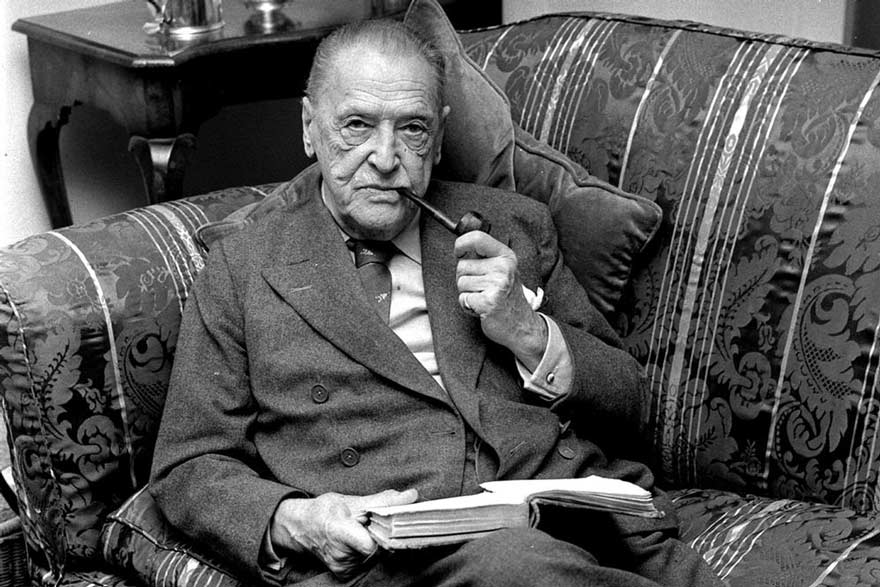
My long preamble here mirrors this edition’s introduction which was a bit long-winded but did give some context. It is noted that nothing else Maugham wrote comes close to this in terms of quality and impact but I am keen to read The Razor’s Edge as I do love the film. I don’t think I realized until after I finished Of Human Bondage that it is quite old, having been published in 1915 but I was happy to find it mercifully easy to read, the sentence structure and the passages easy to understand – unlike that word sorcerer, Faulkner, who I have struggled with.
Keep in mind before reading further that I won’t hold much back and there will be spoilers. This is the story of Philip Carey who lives life with a clubfoot and with having lost his parents when he was young and having to live with an uncle and aunt. He lives a solitary life feeling intense embarrassment over his handicap and tries to navigate his way to manhood without really knowing what he wants to do and without the means to do much of anything. Poverty is a theme that runs throughout the book and this brought home to me the importance money plays in one’s life and how the lack of it and the pursuit of it can impede one’s pursuit of one’s hobbies, interests and dreams. There is a particularly harrowing sequence in the book depicting Philip in the direst of straits without a job, money and even a home.
“One profits more by the mistakes one makes off one’s own bat then by doing the right thing on somebody else’s advice.”
The only thing I ever knew about this story was the 1935 film version starring Leslie Howard and Bette Davis – and particularly Bette’s savage “wipe my mouth!!” scene. So when reading the novel I was waiting for this character and this storyline to appear. About a third of the way in, Philip has reached manhood and is looking for love so he is susceptible when the character Davis portrayed, Mildred Rogers, shows up. Here Maugham has created a truly disgusting and reprehensible character and at the same time he makes Philip a terrible sap. This resonated with me as I have in my distant past been such a sap but Philip takes it to such gargantuan levels that he made me physically ill more than once.
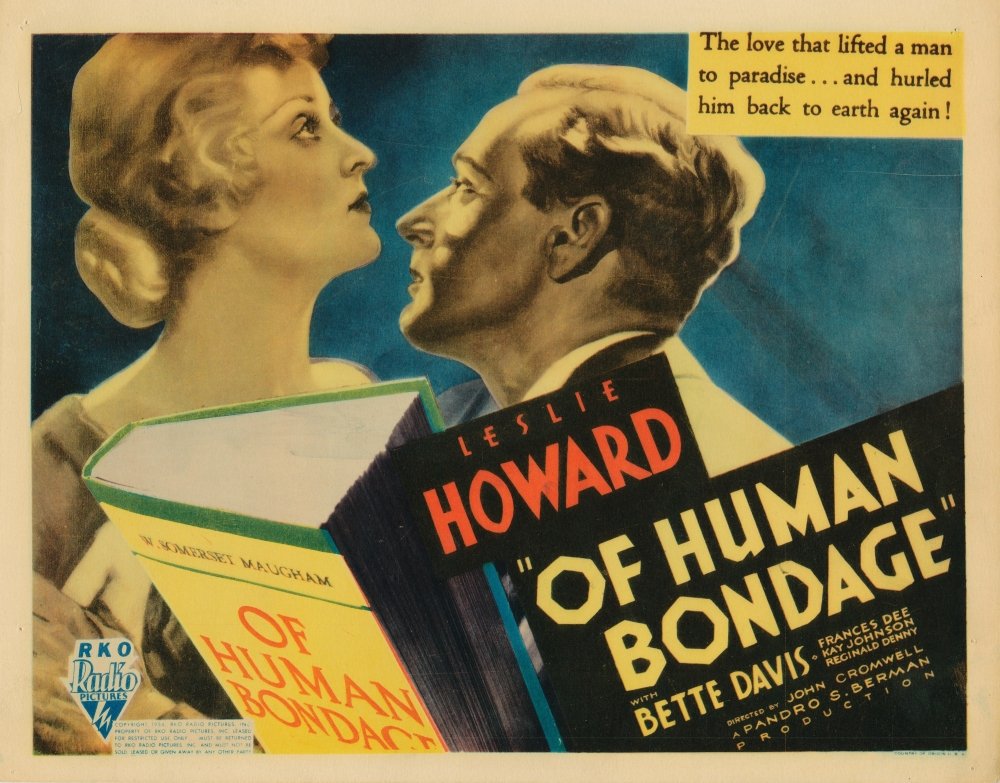
Mildred is a waitress who thinks highly of herself and looks down her nose at Philip. She would much rather give her attentions to a more masculine personage of obvious means. Mildred is described as a frightful, skinny hag who treats Philip with bitter contempt which makes it seem ridiculous that Philip should fall in love with her; “He thought of…the greenish pallor of her skin. He wanted to kiss the thin, pale mouth with its narrow lips. The truth came to him at last. He was in love with her. It was incredible”. Mildred is described multiple times as having skin tinged green. Charming. Philip had thought that love would be ecstasy but this was not that. This was torture and despair, the “ceaseless anguish of his soul”. All this makes the book tough to read as Philip gives himself more and more to this hateful shrew. Crazy Philip goes so far as to compare Mildred to the Madonna, feels that he’s never been happier and feels gratitude towards Mildred. She even goes off with another man, has his baby but has to return to Philip when it turns out that man already had a family. It gets worse.
The Best of Philip & Mildred: A Love Story
- “He looked at her neck and thought how he would like to jab it with the knife he had for his muffin. He knew enough anatomy to make pretty certain of getting the carotid artery. And at the same time he wanted to cover her pale, thin face with kisses.”
- “The greenish pallor of her skin intoxicated him…Her anaemia made her rather short of breath, and she held her mouth slightly open. It seemed to add somehow to the attractiveness of her face.”
- “He abased himself. ‘You can go out with whoever you choose. I’ll be only too glad if you’ll come with me when you’ve got nothing better to do’.”
- “‘Have you forgotten that when you were in trouble I did everything for you? I planked out the money to keep you till your baby was born, I paid for your doctor and everything, I paid for you to go to Brighton, and I’m paying for the keep of your baby, I’m paying for your clothes, I’m paying for every stitch you’ve got on now. Oh, for goodness sake, shut up. If I were a gentleman I shouldn’t waste my time with a vulgar slut like you. I don’t care a damn it you like me or not. I’m sick of being made a blasted fool of. You’re jolly well coming to Paris with me on Saturday or you can take the consequences’.”
- “He hated her, he despised her, he loved her with all his heart.”
- “He was disgusted with himself. He felt that he was a little mad.”
- “It was not very comfortable to have the gift of being amused at one’s own absurdity.”
Philip introduces Mildred to one of his buddies and the two of them hit it off. Amazingly, Mildred and Griffiths fall in love with each other and knowing this, Philip still intends to carry out his plan to take Mildred on a trip to Paris. When she breaks down in hysterics Philip actually insists Mildred and Griffiths go to Paris instead and he will pay for it. Its madness! It doesn’t last with Griffiths and again Mildred calls on Philip for help with her and her baby. Philip takes them in but for once declares that it is only out of courtesy and will not result in a conjugal relationship. He even proves strong enough to rebuff her advances and here is where she snaps as Davis did in the film. The coup de grâce of the Mildred of the novel, though, is to wound Philip as deeply as she can by calling him a “cripple”. Finally, our boy casts her out. She turns to prostitution and dies of syphilis. Buh-bye.
After all this, some relief for the reader comes when Philip finally becomes a doctor and befriends Thorpe Athelny and his enormous family. After a harrowing look at poverty and homelessness it is charming to read of Philip being taken in and cared for by the family as he finally begins to see his life in the proper light and with a measure of stability.
“It was one of the queer things of life that you saw a person every
day for months and were so intimate with him that you could not imagine existence without him; then separation came and everything went on in the same way, and the companion who had seemed essential proved unnecessary. Your life proceeded and you did not even miss him.”– an interesting and relatable observation
The main thing about this book for me is something that made it challenging to enjoy reading. There is a marked absence of light in the tale. Philip as a youth feels abandonment, shame and misery. Most of the people he encounters – and, in fact, he himself – are terribly flawed and lacking in any virtue. No one is conquering or has it all together and Philip is disgusted by most of them at one time or another. It is often noted that he is repulsed by someone, feels loathing towards them or abject horror. He longs for his uncle’s death so he can claim his inheritance but reasons that if his uncle lives on or doesn’t bequeath him anything he can always commit suicide; “It encouraged him to think that if things became unendurable, he had at all events a way out”. Well, that’s good. Philip though does at one point come to a healthy conclusion, one I could appreciate. He had been too intent on relinquishing control and throwing his life into the hands of fate but eventually comes to an epiphany about one’s own will being as powerful and just as passionate as leaving one’s life to passion and impulse. And that the inward life could be just as rewarding as a life of travel and adventure.
I think perhaps the main thing I got from reading Of Human Bondage is Maugham’s discourse on a man’s dreams as opposed to his reality. What he plans for himself compared to what possibilities his current life allows for him. Consider this passage –
“But he had the unfortunate gift of seeing things as they were, and the reality which was offered him differed too terribly from the ideal of his dreams. He did not know how wide a country, arid and precipitous, must be crossed before the traveler through life comes to an acceptance of reality.”
There’s the idea that, sure, you should live your dreams but the sad reality is that costs money and how does one get money? By being a slave to the working life. Maugham then adds a significant observation that can be hard to hear; “Money is like a sixth sense without which you cannot make a complete use of the other five. Without an adequate income half the possibilities of life are shut off.” Hard to hear but sadly true.
The journey of Philip Carey is wrapped up wth some satisfaction for the reader as seen in the main quote used at the outset of this review. I took some solace from the ending as I myself have often looked over the horizon and seen myriad worlds of fascination and intrigue. But often it is the case that one must capitulate to real life. And maybe that real life holds all the satisfaction one needs.
In the end, I enjoyed reading Of Human Bondage more than I enjoyed the novel itself. It was a great lesson in tackling the extensive buildungsroman, a term I remember from school when reading Great Expectations and one that refers to a story that tells of a protagonist’s journey of education in life. I learned that reading a book of this length can free me up a bit from diving in deeply to every single segment of the book, my thinking being that, because the book is so long, that I need not fully understand a passage or enjoy an episode as it is not liable to break your understanding or enjoyment of the book as a whole. Which begged a question; is every chapter necessarily part of the whole theme and tenor of the book? Or, in this case, is much of it just “The Adventures of Philip”? Does everything serve to express the author’s whole intention? Or is much of it just vignettes? Is every episode saying the same basic thing in certain ways? Or is it just a series of tales about a young man’s life? If you were to skip the studying art in Paris part, for example, would you lose the basic gist of the overall novel? This whole experience left me feeling satisfied with reading an at least serviceable story with some poignant observations and also getting a real education in the consumption of books in general.
So, to wrap, I’ll say goodnight and good reading and share a quote from the book that digressed from the tale itself to say something significant about the joys – and realities – of exploring the written word.
“Insensibly, he formed the most delightful habit in the world, the habit of reading: he did not know that thus he was providing himself with a refuge from all the distress of life; he did not know either that he was creating for himself an unreal world, which would make the real world of every day, a source of bitter disappointment.”
 SoulRide