“I have often thought…that if I had changed my name earlier from Gerry Dorsey to Engelbert Humperdinck, I would doubtless have arrived much sooner on the showbiz scene, but I have no regrets. My life as a singer who (has) sold 130 million records, had four Grammy nominations, and earned a place in the Guinness Book of Records, was – and still is – magic.”
Engelbert – What’s in a Name? The Autobiography
by Engelbert Humperdinck and Katie Wright (2004)
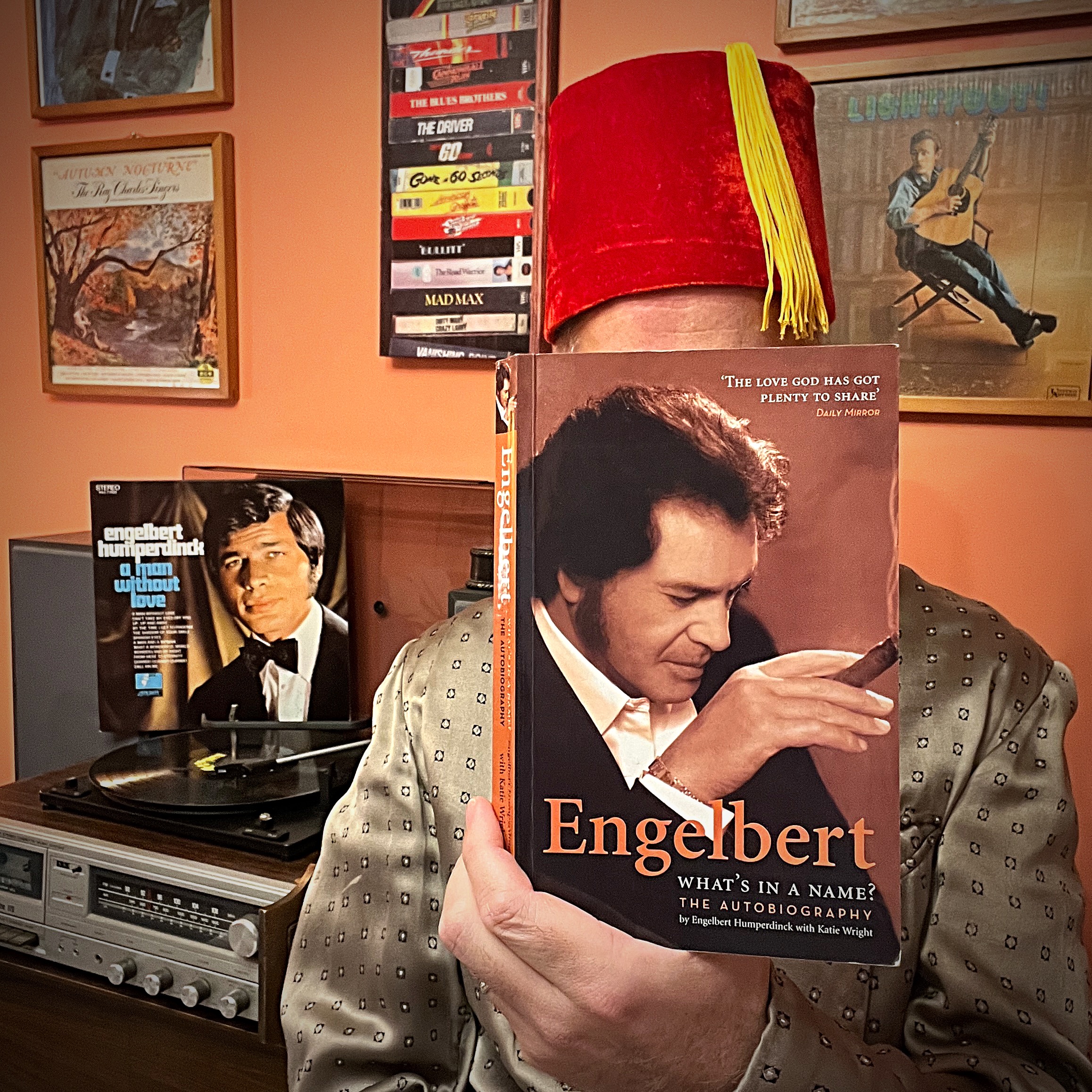
I couldn’t not buy this book. Early in my days exploring the Vintage Leisureverse, I discovered Engelbert Humperdinck and collected his early records – as one must. Exploring his career, I came across the fact that he issued his autobiography in 2004 and simply had to buy it. It remains the best – and only – full telling of the life story of one of the most significant vocal stars of the 1960s.
In his memoir, Humperdinck tells a simple tale – if the life of a major star can be considered simple. But Hump keeps it simple and starts off by talking about his father’s death and how it prompted him to look back on his life. After discussing it with his family, he decided to tell his tale and to come clean with details of his private life. Engelbert describes his early life as one of 10 children of a British Army officer stationed in Madras (now Chennai), India, where “Enge” as friends and family call him was born. He tells of the unrest in the region at the time and of seeing carnage around him including beheaded bodies. He also dealt with more everyday issues like an intense self-consciousness regarding his physical appearance.
Engelbert was born George Arnold Dorsey. Early on, he discovered he could sing and do impressions. His impersonation of Jerry Lewis earned him the nickname “Gerry” and it was as Gerry Dorsey that he began his singing career. The reader will learn of Hump’s contraction of tuberculosis which put his early career on hold. He was out of commission for over a year and was even at one point given Last Rites. In 1967, the break-out success of both “Release Me” and his appearance at the London Palladium finally put Hump over the top.
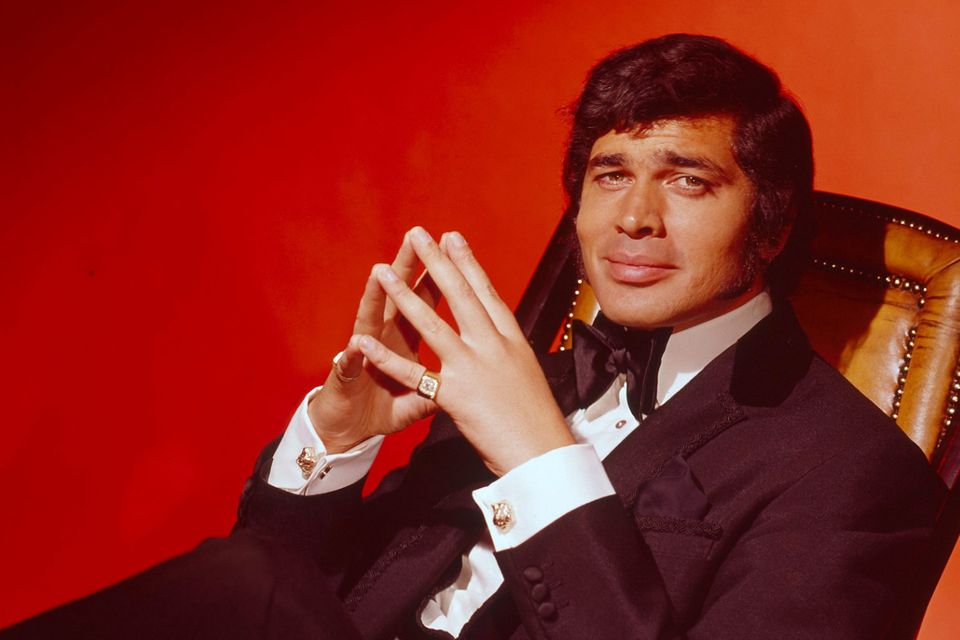
What follows is a conversational story of an entertainer’s life that has a certain charm while it is lacking in detail and any discernible research. Fun to learn about Hump’s Vegas years and his residencies at the Riviera where part-owner Dean Martin took the Englishman under his wing. Later, Hump shares experiences like a kidnap attempt in Chicago, hanging with mobsters in Westchester County and the time in Toronto when he lost his voice and couldn’t go on. Hump was coerced, though, by a shady character with a gun. Engelbert dishes on living in Jayne Mansfield’s old mansion, the Pink Palace, relaxing with Lana Turner and Tom Selleck in Hawaii, learning karate from Mike Stone, singing to integrated audiences in South Africa and getting arrested in Caracas. Also interesting to learn of Engelbert’s move to Los Angeles in the early 1970s to avoid the tax situation in the UK where he was expected to pay a steep 98% income tax.
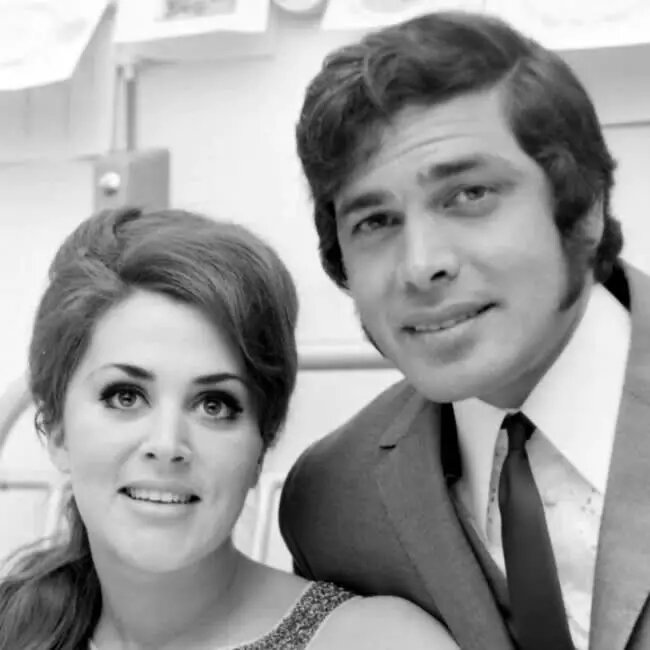
Perhaps the most intriguing part of What’s in a Name? is the fact that Humperdinck has chosen to come forward regarding his many extra-marital affairs. He even at one point gives up a chapter to his wife, Patricia who he calls “Popea”, in which she tells her side of the story as it relates to her husband’s infidelities. Might be hard for some readers to comprehend that Popea says she “understands” about her husband’s affairs and just wished he had been honest about them. Popea says that Hump did not read what she had written until the book was published and she and Hump have never talked openly to each other about this part of their marriage.
Later on, Hump talks briefly about falling out with his original manager, Gordon Mills, over what Engelbert perceived as mismanagement in the areas of finance but also by favouring Gordon’s other star client, Tom Jones, over Humperdinck. Enge mentions that – much like in the case of Tony Bennett – he had a son take over his career and aim him more towards hipper material and cooler album settings. And speaking of my man, TJ, a quick perusal of his own memoir, Over the Top and Back, paints a different picture of Engelbert than Hump presents in this book.
Now, here’s the hard part for me. This book is not great. It is not well-written and it includes some errors that may make the reader doubt the veracity of other things. For example, Hump talks of meeting Presley at the Riviera in 1973 which is true enough. But he claims King had an aide with him named “Fred West”. Surely he’s not misidentifying Red West as “Fred”. Seems he is and so when you hear that Jimmy Page (spelled “Paige” here), John Paul Jones and Elton John played on the Release Me album, you are skeptical. Sounds like too much of an all-star/before they were big line-up. I did look this one up and I can confirm that Page played on the album so perhaps the others did, too. But I doubt it. Throw in Humperdinck’s mention of Jimi Hendrix dying at age 38 as opposed to 27. You know – the 27 Club?
Engelbert says his 1973 single “Love is All” “became No. 1 in the UK charts” but that song stalled at #44. He also says he was the “innovator” of “sideboards” or sideburns and Elvis Presley copied his look. Well, no. He says his fine After the Lovin’ LP went “double platinum” which it did but he also says it earned him a Grammy – he fails to clarify that it was a Grammy nomination. Later he claims that two of his albums released in the 2000’s rose to Number One but I don’t see that. I feel like I’m nitpicking but why publish things that aren’t accurate? And he doesn’t need to embellish; after all, it’s pretty impressive that he placed three albums in the Top Ten on the UK charts between 2000 and 2017. And come to think of it, look at the lead quote I used for this review. Humperdinck scored two Grammy nominations in his career, not four. And lastly is this passage; “On 13 January 1967 ‘Release Me’, the record that was to become a No. 1 hit – and retain that position in the charts for an amazing 56 weeks – was launched”. Does that not sound like “Release Me” was No. 1 for 56 weeks? When I read that, I scoffed. I looked it up and learned that “Release Me” – a massive hit, no mistake – was, indeed, a Number One song – for 6 weeks – and was on the UK charts for 56 weeks. It’s goofy passages like this – and Hump playing fast and loose with chart placings – that make the book frustrating.
This book may be the very best example of a case of the necessity of owning something for the sake of owning it being greater than owning something because of its grandeur or its quality. I simply don’t think that it is OK not to own this book. If you are an adherent of the vintage lifestyle, if you are a lover of the popular singers of the Fifties and Sixties then it is my opinion that you need to own Engelbert Humperdinck’s first four or five albums and – because it exists – you need to own his memoir. File What’s in a Name? among other biographies that are less professional, less detailed and less accurate than more serious dissertations but that are still worthy of a place on your shelves. This is just chit-chat but it does provide a look in at the life of a bona fide legend.

 SoulRide
In your defence (from yourself), I don’t think it’s nit-picking at all to call out some glaring factual issues (interesting that he didn’t ‘accidentally’ UNDERestimate his success), but your point about there being actually no need to embellish upon what was a very successful career anyway is a great one. It’s not as if this book was out in a time before the research benefits of the internet were freely accessible, when facts and stats were much more elusive and he might have just got away with it. It begs the question though, why someone of his status, or his publisher, wouldn’t have employed a research assistant in the way that Mike Love relied on his cowriter James Hirsch for that very purpose in Good Vibrations.
Maybe it was as simple as the book was pitched at a different audience, who didn’t care one way or the other and were more interested in the Pink Palace, which is fair enough. 🙂
I spent some time looking for his co-writer here, Katie Wright, but with no luck. Such a common name. I joked with myself that maybe she went into hiding after this book came out.
If I could dig up some info, surely Hump could have employed someone to do so. That being said, I liken this book to an oral history or a story “spoken”. Often in interviews, a person will mention things off the cuff to help make a point or to explain the enormity of something. Funny but just last night I heard Schwarzenegger do something like that in an interview for the documentary Sly. I guess we “get it” and no one cares – except when it is the more controlled environment of a book, pages and chapters that are created over time and for all time, maybe there’s no excuse not to do the work.
And your point is well taken about the audience for this book. Was it initially sold as a program of sorts at his concerts where they are all geezers who don’t care? In the end, I feel like I did a good job explaining that all these things need not be deal-breakers when it comes to reading and owning this book. Hump is still going, he looms large in the world of vocal music of the 60s and this is his book – for better or worse. The “broken” nature of his memoir is preferable to one like, say, Eddie Fisher’s second where the whole point was to be gross and detail excesses and graphic bedroom stories. Sensation in order to move units. Hump is just “talkin’ story” and that’s OK.
I take your point about some poetic licence not being a deal-breaker. Perhaps a loose point of comparison might be David Niven’s Hollywood memoirs, The Moon is a Balloon, and Bring on the Empty Horses. I think it’s since been noted that some of his anecdotes might not have withstood any kind of forensic fact checking, but he still gave a great and affectionate account of Hollywood in the golden age, and they were a hugely entertaining and enjoyable read. I guess if you want a reference book there are plenty of other options. And I seem to remember that Mike Love’s book copped criticism for having too many facts and stats in amongst his editorialising, so I guess finding the right balance is never going to please everyone.
I loved the book…I want him to do the sequel that he hinted at. He remains a fascinating man who has scores of loyal fans. That voice! God given, for sure. I know he has many stories left to tell….
He is a real storyteller, that is for sure!
Do you mean storyteller as in fibber? I don’t think he did any truth stretching on purpose….we’ll give him the benefit of the doubt!
No, I don’t mean fibber. I was referring to his propensity to share a remembrance from his life while on stage. Like Wayne Newton’s been doing recently, Hump is good at sharing moments from his life sprinkled in among the songs.