“Acting became more and more a way of escape. The studio soundstage was her surest emotional refuge where she pleased her mother (so warm and loving when pleased), was surrounded by affection and approval and acquired the sense of pride so important to a child. And as an actress, (Natalie) found herself living in a world where sorrows and danger eventually dissolved and tears were always fondly wiped away.”
Natalie Wood: A Life
by Gavin Lambert (2004)

There are very few Hollywood bios I will not buy. And while Natalie Wood is a star I may simply lump in with many others, she does stand out to me in a couple ways and they are obvious. First would be her successful transition from child to adult star, next would be her role as Judy in Rebel Without a Cause, then there is her place in Elvis World and finally would be her mysterious and untimely death. Then of course there are her two marriages to RJ and I will admit to also being drawn to what I have heard about her various physical interactions with many of her co-stars and other Hollywood players. And she’s gorgeous; oddly, I think it is her lower lip that really gets me. All this interest added up to be enough to buy and read the book we’re looking at today and to report my findings.
Interesting to note the author. Gavin Lambert – who died but a year after publication of this book – was an English writer who had served as an assistant to Nicholas Ray who directed Nat in Rebel. Lambert though really got to know Natalie when she starred in Inside Daisy Clover, which utilized a Lambert screenplay based on his novel and the two became lifelong friends. This has to be taken into account when reading this book. The presentation of Wood’s life here may be gentle and sympathetic because of the author’s closeness to his subject. That is not to say that the particulars are to be discounted because they are shaded a certain way but it also does not delve too deeply into certain things. The goal of the book I suppose is simple and obvious; to tell the story of Natalie Wood, how she contributed greatly to Hollywood history while struggling though life with familial and personal obstacles. And that is noble and must be deemed acceptable. This is not a puff piece.

Lambert rolls out Natalie Wood’s lineage and discusses her Russian mother, Maria, who played a major role in Nat’s life. Maria was a spoiled child who would throw fits to get her way and this technique – to varying degrees – she would employ throughout her life. She also was noted for fabricating her life story, a meandering tale that included many and varied romantic escapades. And at this juncture the author spells out the first key point in the life story of Natalie Wood; Wood’s paternity was always in dispute never to be known for sure. Another significant point is detailed with Lambert’s assertion that Maria, like many Russian exiles who fled the homeland at the onset of revolution, had lost much and planned to get it all back and to be “someone” again; this Maria would achieve at all costs through the acting talent of her daughter, Natalie.
Gavin Lambert employs fine technique and very concise storytelling to get the reader from Maria’s birth to Natalie’s discovery as a child actress. This stretch is very well plotted. The reader will sympathize with Natalie Wood when they read about Maria’s ability to pivot from loving mother to “emotional terrorist”. Also detailed is the apparently true story that when Natalie was a child, Maria was cautioned by a Gypsy to “beware of dark water” and Maria would instill this fear in her daughter.
One thing that struck me from this book was the description of how Natalie was paid by Warner Bros. As a child, her salary averaged $3000 per picture and among the divisions was a 10 percent cut to her mother and a 5 percent share to Natalie with much of the balance going into a trust until Nat turned 21. Later it is reported that Natalie would be loaned out from Warners to make Kings Go Forth with Frank. Jack Warner was hesitant to do so as he was reportedly loathe to see a contract player of his find success in another studio’s film. But Warner was offered $55,000 for Natalie’s services while he would only be paying her her weekly salary of $750 netting Warner a 500 percent profit on the deal. This is a prime example of the servitude that lead to the abolishment of the studio system. To think that the head of the studio would make that much more than the star of the film boggles the mind. They really were dealing in flesh.

Next Lambert notes that Natalie was less in demand during her awkward years until she made Rebel Without a Cause. The author says that this film presents a confluence of Wood’s personal life and film life. In it, she will portray a teenage girl who rebels against her family and that is also what she was doing in her own life. It will also introduce her to her first two lovers, release her sexual drive and “unlock the door to her future as an actress”. Her sexual rebellion at this time was the perfect way for Natalie Wood to break free from her mother.
But she was not truly free. Lambert notes that Natalie went from one authority figure – her mother – to another in Jack Warner and here is another sad story of a studio’s idiocy. Even after Rebel, Warners couldn’t figure out what to do with Natalie Wood, placing her in second-rate productions she was ill-suited for and often casting her in “exotic” roles as “half-breeds”. Lambert’s position as a Hollywood player allows him to provide good behind the scenes info on the business of filmmaking.
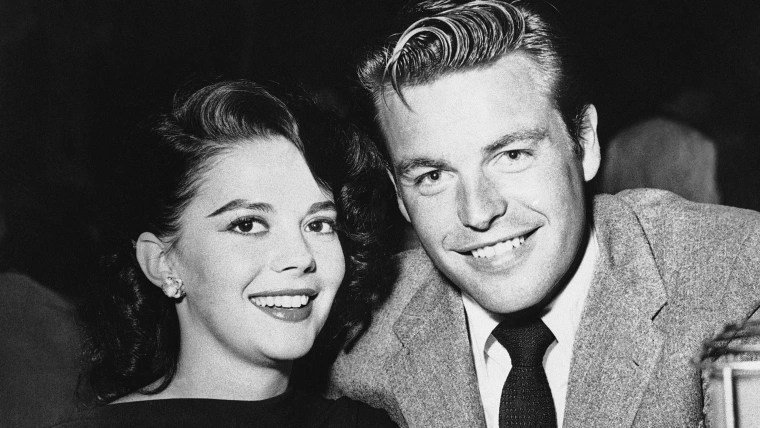
You will get much discussion of Natalie’s two marriages to Robert Wagner, whom Lambert interviewed for his book. Lambert reveals RJ’s dark side and his resistance to Natalie undergoing analysis which lead to the dissolution of their first marriage, a break-up that left RJ devastated.
The tale stretches into the Seventies when Natalie struggled to find good parts even though she had evolved into an excellent actress with much to invest in just the right role that never really came. And then sadly there is a detailed and dispassionate description of Natalie Wood’s final 48 hours and her ill-fated small craft voyage with RJ and Christopher Walken. The way it is presented here, one can easily believe that foul play did not play a part in Wood’s untimely drowning death at 43. But I came away looking a bit askance at Chris Walken. Maybe he was having an affair with Nat and maybe not (Walken was married, too) but it seems to me like he was poking a bit during that time on the boat. He perhaps knew that Robert Wagner’s suspicions were driving him nuts and he maybe took pleasure in causing a row between the married couple creating an atmosphere that lead to some drinking, some fighting and eventually misadventure and “other undetermined factors”. Why did he even go on that trip? He must’ve known it would cause friction.
“But although it wasn’t only Walken who encouraged Natalie‘s career drive, his talk of ‘freedom and dedication to art’ encouraged her to undervalue her role as wife and mother; and Walken’s voice was obviously the most persuasive for someone disturbed, overmedicated and attracted to him.”
Natalie Wood was an early celebrity to have an entourage and hers was made up of some really true and lifelong friends, Gavin Lambert among them. Sad to hear of them having to do her hair and make-up after she had died. This friend angle allows Lambert to fluctuate between companion and confidante and journalist but this may make this bio a little solicitous. For example, I expected to hear of Natalie’s voracious sexual appetite and the adventures she had in this area but there was none of that on offer. It is clear though that she was quite young when she became sexually active and with much older men.
I employed a practice going into this book of not doing any outside research on Gavin Lambert or this book. After I finished, I read that Lambert had made errors of fact when describing Natalie’s mother’s birth and marriage and that he was off by a handful of years; Nat’s mother is the origin of this discrepancy, though, having made herself younger by shaving these years off her bio. I think too much is made of these errors and while getting a birth year wrong is no small thing it is preferable to reading a hatchet job – like the one Natalie Wood’s sister, Lana, wrote in 1984.
Nuggets include; Natalie’s parents lived for a time in Vancouver, Nat would have to hide when her father, Nick, was in his cups and raging around the house, its true that, as a child, Natalie took ballet lessons with classmates Jill St. John and Stefanie Powers, despite the Gypsy’s warning about dark water, Natalie was refused a stunt double for a water plunge in a film she made as a child. The stunt left Nat with a distended wrist bone, a lifelong condition she always somehow camouflaged. Also, Wood’s story is one of the obsessed stage mother. Maria was manipulative and persisted in presenting fantasy instead of reality and despite her love for her mom, Nat was forced to “put a terminal distance between them”. A little unsettling to hear of how Nicholas Ray set upon Wood when they met to make Rebel Without a Cause when Ray was 43 and Natalie was 16. Lambert relates the black comedy of Ray’s hopeless drunkenness that helped to end the affair and the fact that, having missed a period, Natalie feared she was pregnant. The night before taking a test, she placed a urine sample in the fridge in Nick’s bungalow. In the middle of the night, a staggering Nick Ray went to the fridge and mistakenly drank the sample. Natalie at first shut down Frank Sinatra’s advances but later they became friends who sometimes slept together, for you Elvis People, there is but two pages devoted to Nat’s trip to Audubon Drive in Memphis and no new revelations are shared, Nick Gurdin, Natalie’s father, battled alcohol abuse and once killed a pedestrian while drinking and driving, a transgression the studio fixers managed to quash, there’s fascinating discourse on Warren Beatty and we all must read a book on this Hollywood legend; Natalie turned down the female lead in Bonnie & Clyde because the location shoot would separate her for too long from her analyst. And finally, ABC offered Natalie and RJ the TV movie The Affair which they accepted. Part of their contract stipulated that they’d get 50 percent of the next series ABC developed. That series became Charlie’s Angels and the Wagners made a pile of money when that show succeeded.

I learned in the days after finishing Natalie Wood: A Life that Suzanne Finstad also wrote a bio of Wood and that one warrants a read, for sure, particularly in light of Finstad having essayed the lives of Priscilla Presley and Warren Beatty; Finstad is even on record denigrating Lambert’s book. But Gavin’s bio is certainly worth a look. The final chapter, while I understand and can appreciate it’s inclusion, seems anti-climatic and he may have fallen down on a few dates shrouded by the mists of time but these things are outweighed by the sincerity and the detail of the book. And one must consider the author’s standing in the Hollywood community and the access this gave him to a long list of those he interviewed for his book. This starts with family members like Robert Wagner who once said to Lambert “when you tell the truth about Natalie as you see it, I shall be at peace” and Gavin also spoke with Nat’s daughter, Natasha Gregson Wagner and a virtual who’s who of Hollywood royalty. Perhaps more paramount than the author, though, is the subject. Beyond her beauty, Natalie Wood was a significant player in Hollywood history and her life’s journey parallels the evolution of filmmaking. Despite her troubles and her tragic death, her life and her art both have a definite glow that deserves discovery.
“She was charming, generous, beautiful – and haunted.”
– second husband Richard Gregson
 SoulRide
I was fascinated to see Gavin Lambert as the author – I always remember him fondly as a contributor to a brilliant 1990s documentary by British director, Stephen Frears; it was an instalment in the ‘personal journey through cinema’ series, which was a kind of lightbulb moment for me. (I think Martin Scorsese did the American version). Lambert was a particular advocate for the British ‘new wave’ of social realism cinema that emerged in the 1950s, and had a hilariously intense dislike of the old British style of repressed, middle-class cinema with little overt emotion and where the cure for any kind of disaster, no matter how apocalyptic, was to have a cup of tea. He had no shortage of courage as a film critic, and his outspoken criticism of sacred British classics like Brief Encounter (middleclass repression again) and The Blue Lamp made him a controversial figure at times, especially as the British film industry as a whole was in a constant battle for survival. Fascinating to learn about his work in Hollywood; it got me thinking that there have been so many scandalmongering, talentless hacks writing trash bios for greedy publishers since the earliest days of the movies, it’s nice to think that a work that was, as you put it, not a puff piece but at least more sympathetic and well-meant, could still get commissioned. Given the difficulties of research in a non digital age, as you noted, perhaps the odd factual error can be forgiven when balanced against the work as a whole.
Well, fascinating. I knew that Lambert had been a player of some note but you bring out some pertinent details of his career – you’re good at that. And I agree that it is nice to have a bio that is simply informative and, in a way, compassionate.
Lambert’s book is worthless. Maria Gurdin (aka Marusia Zoudilova; aka Mary Tatuloff; aka Marie Tatuloff; aka Marie Zacharenko) was born in 1908 and married her first husband Alex Tatuloff in 1925 …..but Lambert falsely states that she was born in 1912 and married Alex in 1928. A book this far off the mark has no credibility!
Natalie’s parents never lived in Vancouver; only her father did. Her mother arrived in San Francisco from Harbin by ship in December 1930, several months after then-husband Alex Tatuloff came over. Most people don’t even know that Natalie and Lana had an older maternal half-sister named Ovsanna (later changed to Olga) or that their mother was married for 11 years to another man before Nick.
Mary/Marie/Maria started lying about her age on legal records during the mid-’30s. Early documents prove she was born in 1908, and it always made common sense anyway. She was 4 years older than Nick, so that’s presumably why she lied. The birthdate etched on her tombstone is a lie. Olga had to’ve known it was a lie, but I’m not sure if Natalie or Lana knew.
I’ve read every book about Natalie Wood and they ALL contain errors of some kind, but the errors in Lambert’s book are inexcusable. Sam Perroni’s “Brainstorm: An Investigation of the Mysterious Death of Film Star Natalie Wood” (2021) is by far the most researched account. Mainstream media refuses to acknowledge it. Perroni’s book is not perfect but it has a lot more answers than Finstad’s or Rulli’s books.
Thank you for reading and for your comment!
I enjoyed this book. I was able to get over the one error Lambert made, one that originated with a lie perpetuated by Maria herself. I won’t be keeping this book but it was a good read and made me appreciate Natalie all the more.
I highly recommend Sam Perroni’s book. In the years since it came out he’s done several podcast interviews worth listening to. This story isn’t done and the 3 men on the boat aren’t the only people in the know. You can bet Georgianne Walken and Jill St. John have known all along.
I wonder if it was a whole lotta nothing, if there is nothing really to know. Just a tragic accident, you know?
Ooooh definitely not. Perroni is a retired prosecutor who spent 6 years investigating the case at his own expense. All profits from his book go to charity. Unlike Finstad who times the release of her books to coincide with special anniversaries, Perroni was motivated to write one out of sheer frustration over the LASD’s willful incompetence. You’ll have to read it. He not only explains what happened, he lays out how the so-called reopening of the case in 2010s was all a decoy.
Wow! Sounds VERY interesting. Thanks for the info.
Finstad’s book tells an ENTIRELY different story as to why the first marriage with R.J. ended. I won’t get into the details here (anybody can look it up), but according to Finstad, Wagner to this day is more upset by that particular accusation than he is by the murder accusations. He’s never sued her for defamation so she must’ve had unassailable evidence to back up her claims.
Wow. Sounds interesting. I really respected Finstad’s book on Priscilla Presley that I reviewed here and I own her massive book on Warren Beatty but have yet to read it.
You sure know a lot about Natalie Wood! I’m happy to chat with you.
Finstad’s a good writer but not a perfect one. She can get out of line. Her biography of Priscilla is merciless and defames Elvis too a bit, with multiple instances of unfair exaggeration. Anyway, in a 2020 podcast interview Finstad said she was working on a new edition but here we are in 2025 and it still hasn’t come out. I’m guessing she wants to wait until Priscilla’s various ongoing litigious dramas are over so she can consolidate everything.