The Irishman (2019)
Starring Robert De Niro, Al Pacino, Joe Pesci, Ray Romano, Bobby Cannavale, Anna Paquin, Harvey Keitel and Steven Van Zandt. Directed by Martin Scorsese. From Netflix.
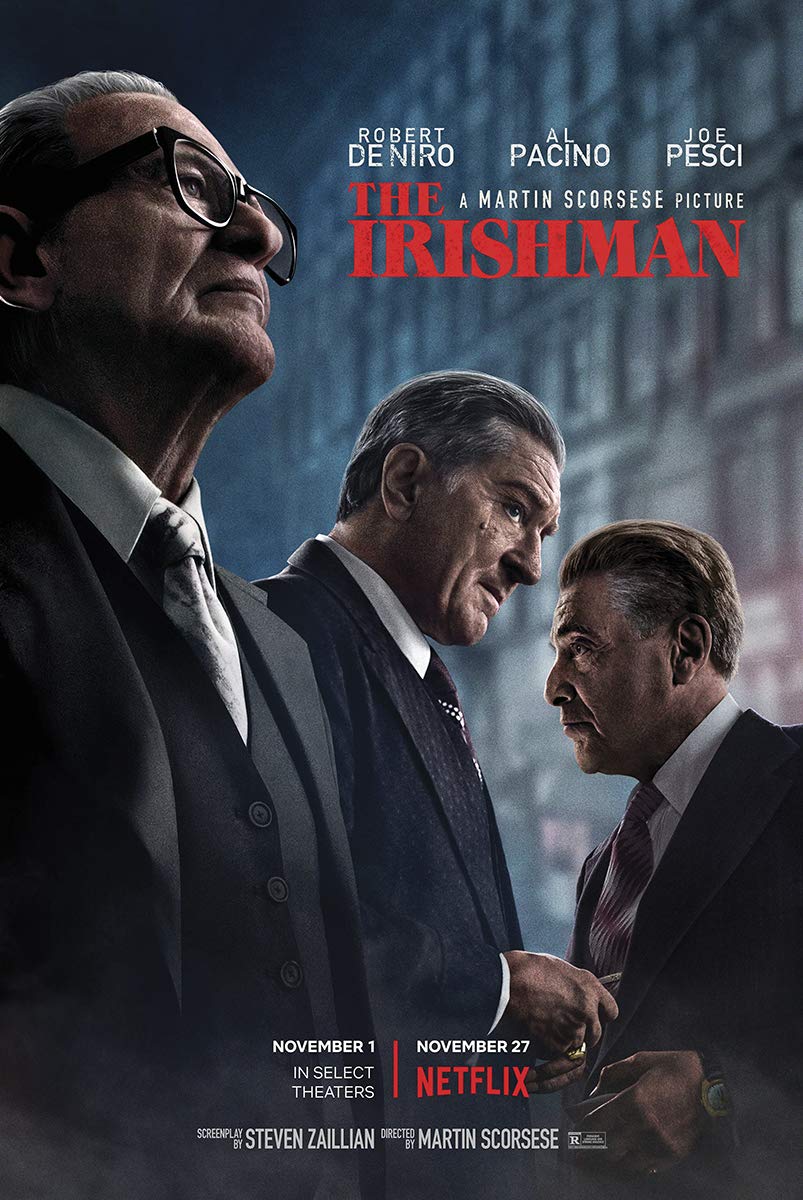
Martin Scorsese’s epic gangster film, The Irishman, tells the story of Frank Sheeran (De Niro), a real-life hitman and labour union official and of his relationship with crime boss Russell Bufalino (Pesci) and union leader Jimmy Hoffa (Pacino). But really, the film tells the story of America; this is a tale of the American century seen through a criminal lens.
I was blessed to see this movie in my local art house cinema when it played briefly in theatres in November of 2019. I recall being one of only two or three people in the place and I remember that – by the end of The Irishman‘s 209 minutes – I was freezing. And quite overwhelmed. While this is by no means the type of film I look at here at Vintage Leisure, a recent re-viewing did inspire me to share a few thoughts.
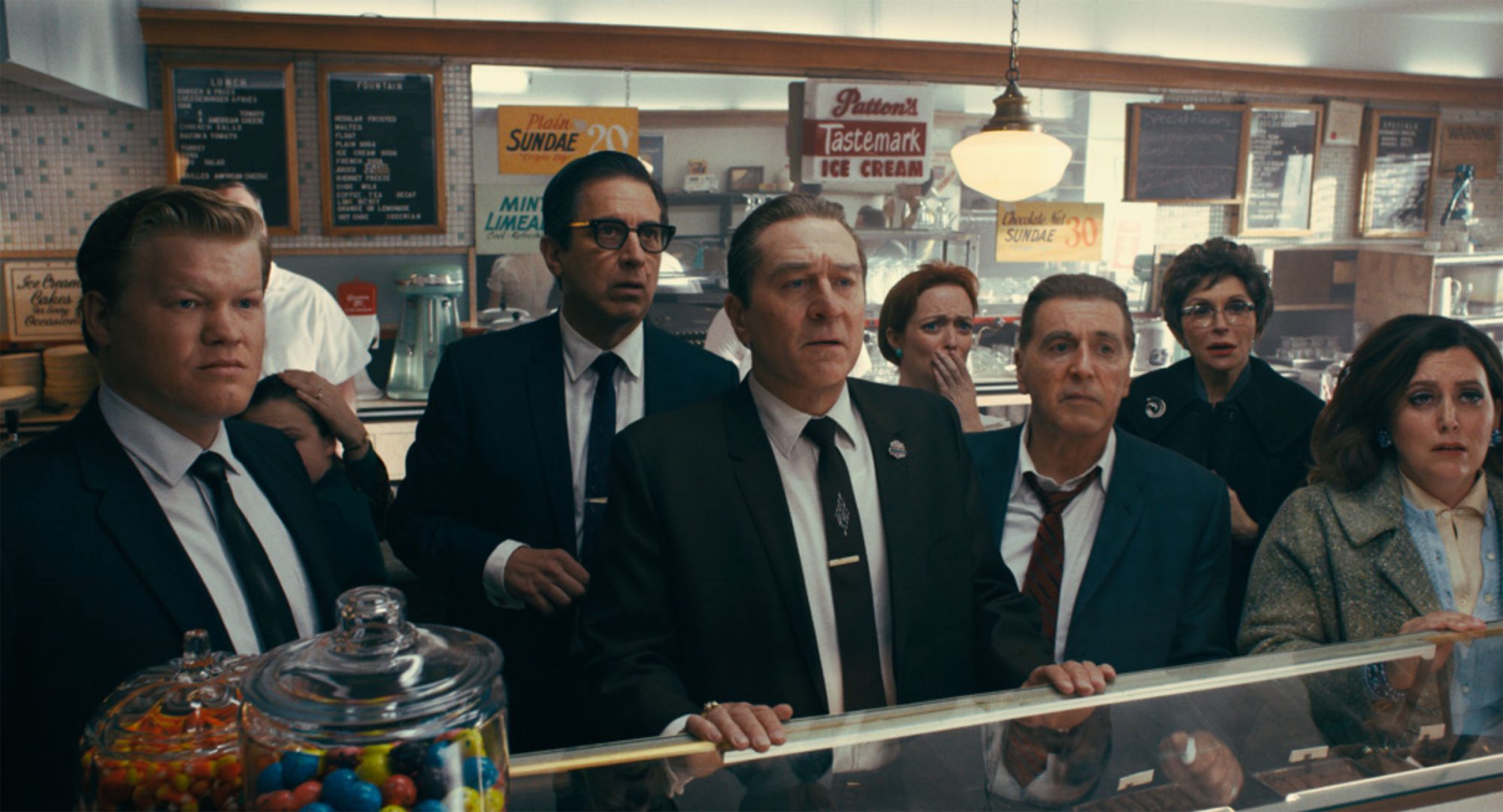
The movie looks at many major events of the American 20th century. One of the most fascinating scenes depicts reactions to the assassination of JFK. We are all able to in some ways comprehend what this killing did to regular Americans and many in this scene are shown crying and hugging each other. When Jimmy Hoffa and Frank Sheeran watch the news on TV in an ice cream parlour, it is riveting to watch their faces. Working joes and housewives are aghast and it shows on their faces. Watch the faces of criminal-types like Hoffa and Sheeran. Though not a word is spoken, you can see all the understanding in their looks. De Niro does well showing Sheeran’s sad knowledge mixed with his shock that things have gone this far. Regular Americans are stunned; these men are not altogether surprised.
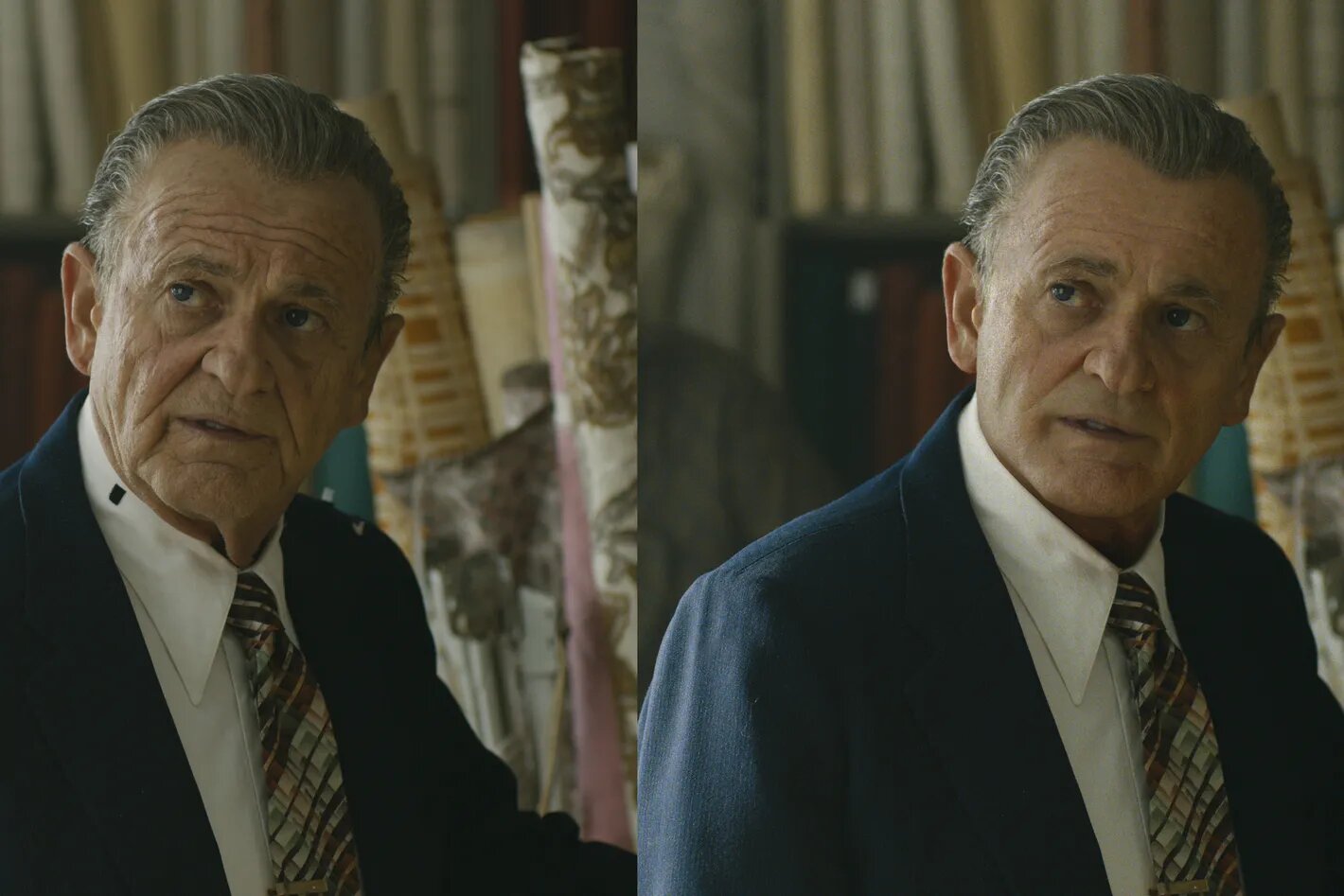
Robert De Niro had just turned 74 when filming began and he carries much of the film, appearing in almost every scene. This is yet another subtly brilliant performance from Bobby who does so well in such a quiet way that his genius here is almost unnoticeable. The same can be said about Joe Pesci. Joe had gone into casual retirement when he got the call from Marty. Pesci also puts in a subdued performance filled with nuance. But there is an appropriate amount of menace in his portrayal of mob boss Bufalino and Pesci’s manner in the role makes it clear that Russ maintains control without ever blowing his stack. Any stack-blowing in the film is handled by Pacino as the volatile Jimmy Hoffa. Al portrays Jimmy as a real-hothead, a man bent on controlling “his” union by any means necessary, a man who will not bend for anyone. All these performances and so many others are of the highest quality. Though they have recognizable faces, the actors recede and the characters come to full-blown life.

I was so pleased to see among the cast Harvey Keitel, Bobby Cannavale (“the guy from Sex and the City!”, I always say when I see him) and Ray Romano. Not that he necessarily needed it but what a feather in Ray’s cap to be called upon by Scorsese to appear in this epic as union lawyer Bill Bufalino, cousin to Russ. And it was clever and comical to bring in Miami Steve Van Zandt who is now so firmly entrenched in the celluloid mob world by his work in The Sopranos. And to have musician and singer Van Zandt lip synch as Jerry Vale was inspired.
Canadian Oscar-winner Anna Paquin plays Frank Sheeran’s daughter, Peggy (six words in 10 minutes of screen time!) and here is one of the most compelling aspects of Steve Zaillian’s script (Steve of The Falcon and the Snowman, Schindler’s List and Gangs of New York). Young Peggy (played by Lucy Gallina) gets in a beef at the local grocery store and says the proprietor pushed her. Frank takes her with him to the store and delivers a brutal beating to the man behind the counter. Little Peggy watches as Frank finishes up by stomping the man’s hand against the curbstone. She is obviously affected by the sight – why on earth did he take her down there? – of her father “at work”, meting out justice in this violent fashion.

As the story rolls on, we see Peggy growing up, all the while watching her father warily. In difficult scenes, she is reluctant to relate to “Uncle” Russ, to look him in the eye or to thank him for a pair of skates at Christmas. This makes Frank very uncomfortable and he makes his apologies to Russ who seems unfazed. By contrast, Peggy and Jimmy Hoffa hit it off like gangbusters. Jimmy loves the girl and they share a special relationship – and many ice cream sundaes. Frank explains this poignantly; Jimmy, he says, really does seem like an uncle. “For one thing, Jimmy didn’t have a nickname like ‘the Razor’ or ‘the Hunchback’ or ‘the Weasel’ or ‘Whispers'” and also, Frank reasons, Peggy felt Jimmy was working to make people’s lives better; “he wasn’t stomping on somebody’s hand”.
Peggy looks with dead eyes at her father as the family watches news reports about Hoffa’s disappearance. Like many great scenes in this film, the actors say so much with only their eyes and expressions. Peggy knows; she knows who her father is though it is never spoken of. Previously, she had likely battled with feelings of love balanced by revulsion at what her father does. After Hoffa disappears, her repugnance wins and she never speaks to her father again. This human element of this larger-than-life story is significant.
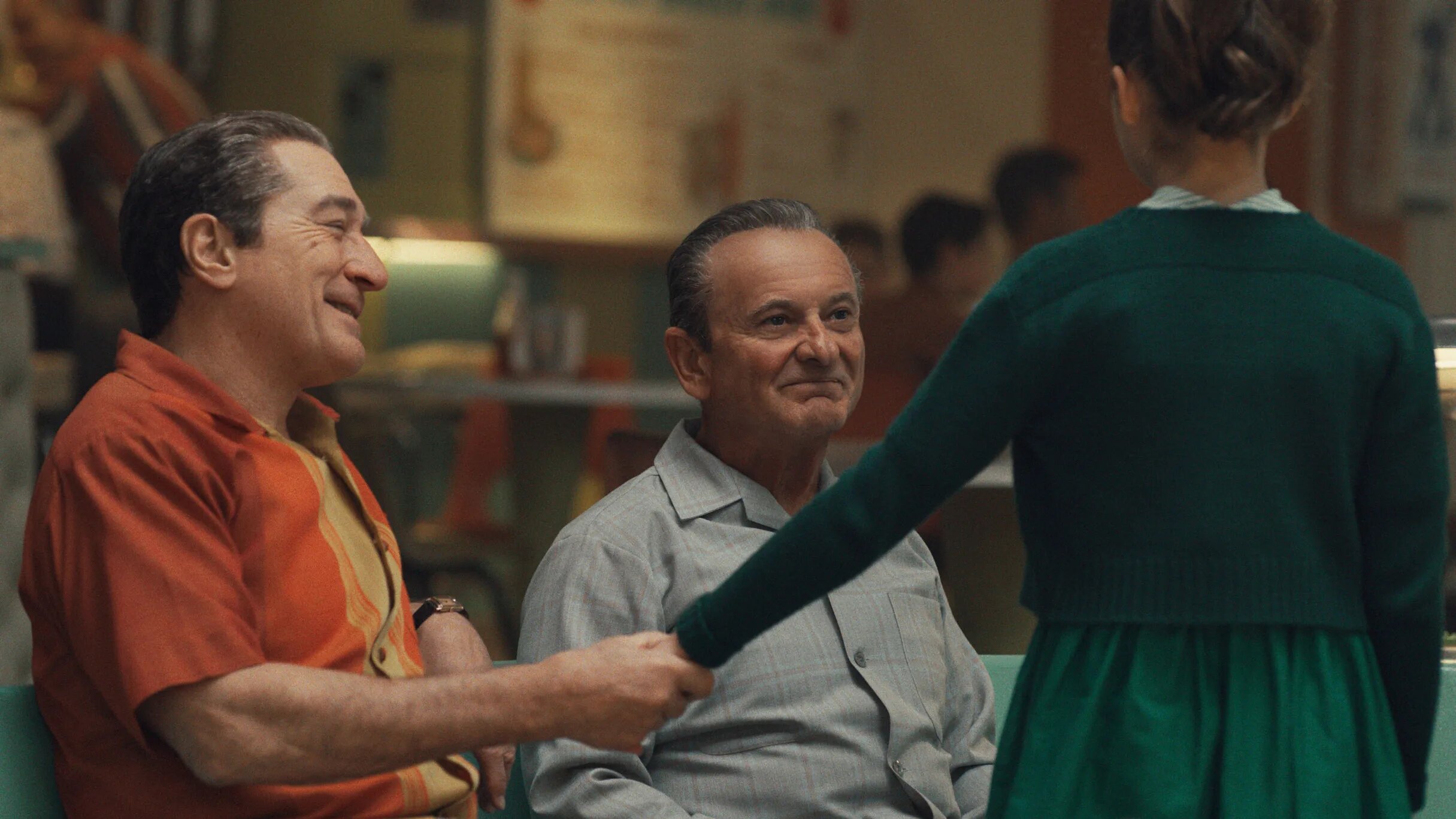
Frank does not express remorse when talking to a priest late in his life. But when he desires a meeting with Peggy and is asked why, he says he wants to say he is sorry. For what, I wonder. Just for being a bad father? Or for killing people? Will that be his confession? He knows that Peggy knows what he has done. Peggy Sheeran represents all of civilized society. This plot line really humanizes the story.
And this is part of another thread I found running through this movie about criminal American history and that is the idea that Frank is a “good guy”. Well, not really, but… I have read Nicholas Rapold of the Lincoln Center Film Society say that Frank is not psychopathic but sociopathic which refers to someone with “impaired empathy and remorse”. Frank Sheeran was wired in such a way as to not be able to comprehend the horror of what he does. While this does not excuse his crimes it helps to explain them. While I may go too far calling Frank Sheeran a “good guy”, I think what I mean is he is very chill. He is just a mellow guy who only has one setting. He is respectful to Russ and tries hard with Jimmy, attempting to reel him in without crossing a line. Frank’s wiring, though, is challenged when Hoffa is marked for extermination.
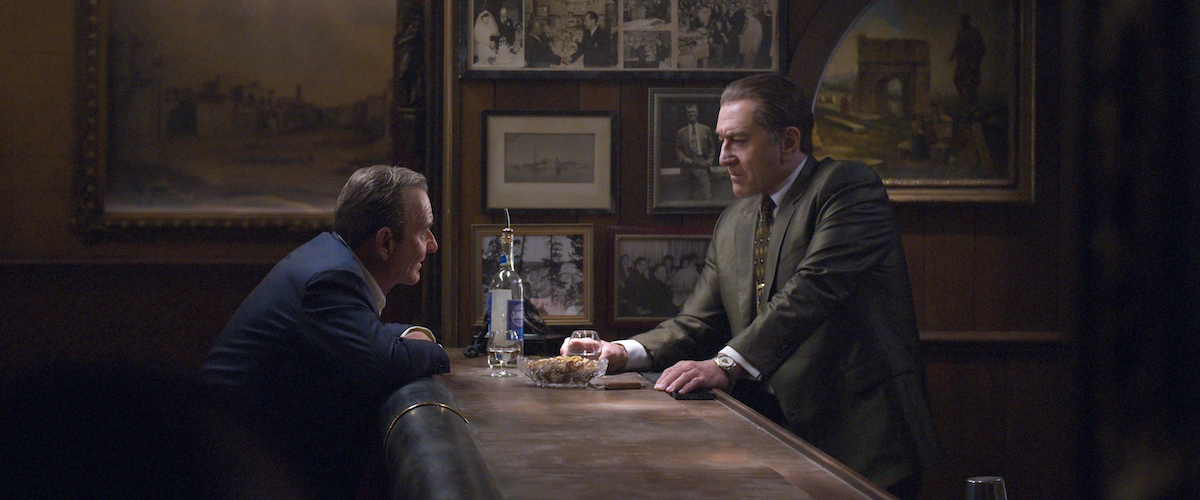
Russ “suggests” to Frank that Hoffa’s time has run out. Again, it is played so well by Pesci; the saying things without saying things. Sheeran at first scoffs saying Jimmy is too big. One of the key lines in the film comes when Russ answers that if “they” can kill a president, they can kill the president of a union. Here De Niro begins a series of expressive scenes in which he – and this is seen only in his face, in his eyes – struggles with the idea of eliminating his friend, Jimmy Hoffa. When Frank gets back in the car after the deed is done, there is silence. I felt that Sheeran was saying to Bufalino here “he was my friend”. And I think Russ understands. But business is business. What may be De Niro’s finest scene is when he calls Jo Hoffa to offer his help. Tellingly, years later with the priest, Frank says “what kind of man…makes a phone call like that?”
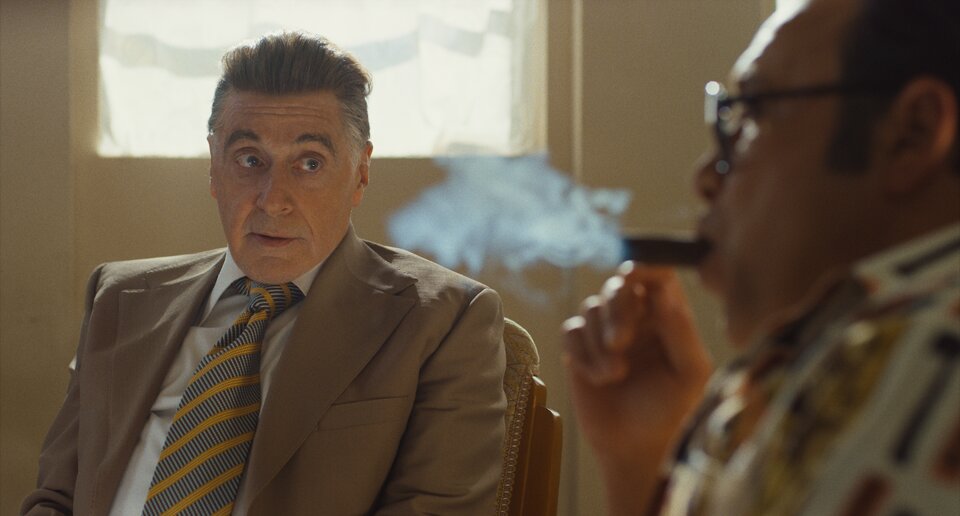
The Irishman is a mammoth achievement. The film is long – almost 3-and-a-half hours – and spans 50 years of the American century. The production covered 117 filming locations, 319 scenes with 160 actors. The scope of its tale is staggering and it is loaded with tour de force performances from many in the cast. Now, there is likely many of you out there who gauge a film’s success by the awards it has won so let’s talk a bit about that. Joe Pesci and editor Thelma Schoonmaker were singled out for some awards – Pesci earned love and hardware from the film critics circles of Florida, Georgia, San Diego and New York among other citations. And what of the venerable Academy of Motion Picture Arts and Sciences? Glad you asked.
Few films have been nominated for more Oscars without winning one than The Irishman. The film garnered 10 nominations; it was so good that it was worthy of that many nominations in a variety of categories but it wasn’t good enough to win one, losing to six different movies in total. It lost Best Picture and Director to the “big” winner that night, Parasite from director Bong Joon-ho.

It is my opinion that the Academy sent a message that night. They signalled their intent going forward. No longer will their objective be to honour the “best” in film from the previous year. The whole purpose of the Oscars will irrevocably change; indeed, it has already done so. I even expect that soon they will change their verbiage away from “Best”. On February 9th, 2020 at the Dolby Theatre in Los Angeles, the Academy made a statement, indicating their pivot away from rewarding films strictly for greatness. Martin Scorsese and The Irishman were the sacrificial lambs as if the Oscars needed a film to BAR to show where they are going. Now, this is not about films being unworthy. I am not saying that the films that have won Best Picture Oscars at the last three awards – and those that will win going forward – are not worthy of being honoured. I’m just saying that the criteria has changed; by the Academy’s own admission. If The Irishman won no Oscars – especially after 10 nominations – that should tell us all that the Oscars have changed.
So, how good is The Irishman? It’s too good. It’s too prodigious. And, in today’s world, it tells an old story and it’s told by “old” men; old Hollywood-type men. People that represent the old Hollywood and the old ways. And it’s another story from Scorsese & Co. about Italian (and one Irish) criminals and murderers. A film like that is not likely to be honoured in this day.
Conversely, for many of us, Marty and his film killed the Oscars that night. Who emerges triumphant in this battle between old school filmmaking greatness and the ideology of the current governing body that bestows awards on films? Again for many of us, The Irishman wins. It whacked Oscar that night and out of all the murders represented by this movie, that is its most significant hit. Even if you’re a fan of classic film, you may have, over the years, still kept up with the Academy Awards and Oscar night and all that it entails. But – and I really don’t think I speak for only myself here – the Oscars are officially dead to, if not all, than at least to many of us retro-types. What’s the point for us? If The Irishman – a film who’s cast and crew and subject matter harken back to the days of The Godfather and previous even to that – is snubbed by the Academy, that should tell us something. They might have been less “cruel”, less obvious, less sensational if they hadn’t given it so many nominations. But to say “look! 10 noms – could be a big night for the legends!” and then to totally shut it out – that speaks volumes. So, good. I needed an excuse to finally wipe the Oscars off my radar.
Martin Scorsese and The Irishman – each alone or both together – are bigger than the Oscars. And that’s the end of that.

 SoulRide
Fascinating stuff. I remember quite a few years ago, probably late 90s / early 2000s, watching a BAFTA awards night with serious and thoughtful speeches by Richard Attenborough and David Puttnam. Without actually knowing much about either of them at the time time, I remember feeling a huge amount of admiration for them personally, as well as for their work. It kind of felt like the end of something then, and I was actually reminded of that looking at the two images of The Irishman cast; the last gasp of a great generation of filmmakers. If a New Yorker critic can call Tarantino ‘obscenely regressive’ for his honest portrayal of of the 1960s, where does it leave filmmakers who wish to authentically portray the speech and attitudes of times past? You can understand how some ‘old school’ auteurs might be a little disillusioned with the current state of the industry, and where it might be going.
Having said that, to my intense surprise and having been dragged kicking and screaming to watch it in the first place, I thought Top Gun Maverick was one of the best major studio films in a very long time, perhaps because it had a bit of an old-school feel. There might be hope after all…
Yes, there is cause for alarm for some of us old schoolers but every once in awhile there will hopefully pop up a filmmaker or a film that just seems “right” to us. Besides, there are still many classic films I have yet to see!
Agree about Top Gun. It may be the exception but, dang, that’s good filmmaking.