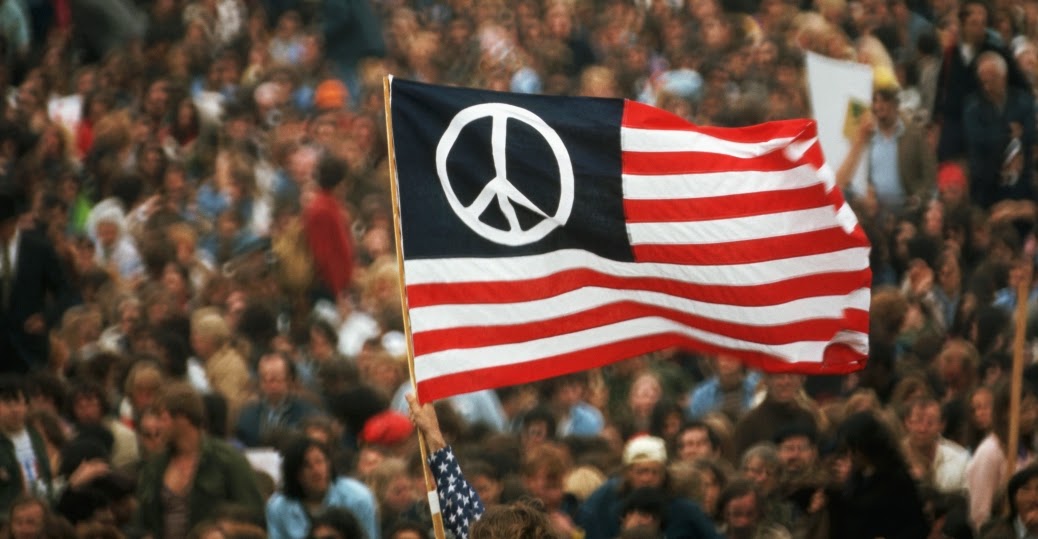
“The anti-war movement during the Vietnam era is important not because it stopped the war, which it may or may not have done; rather, it is important because it existed. It is a reminder to Americans that times come when citizens can and, indeed, must challenge their government’s authority.”
Who Spoke Up? American Protest Against the War in Vietnam 1963-1975
by Nancy Zaroulis and Gerald Sullivan (1984)
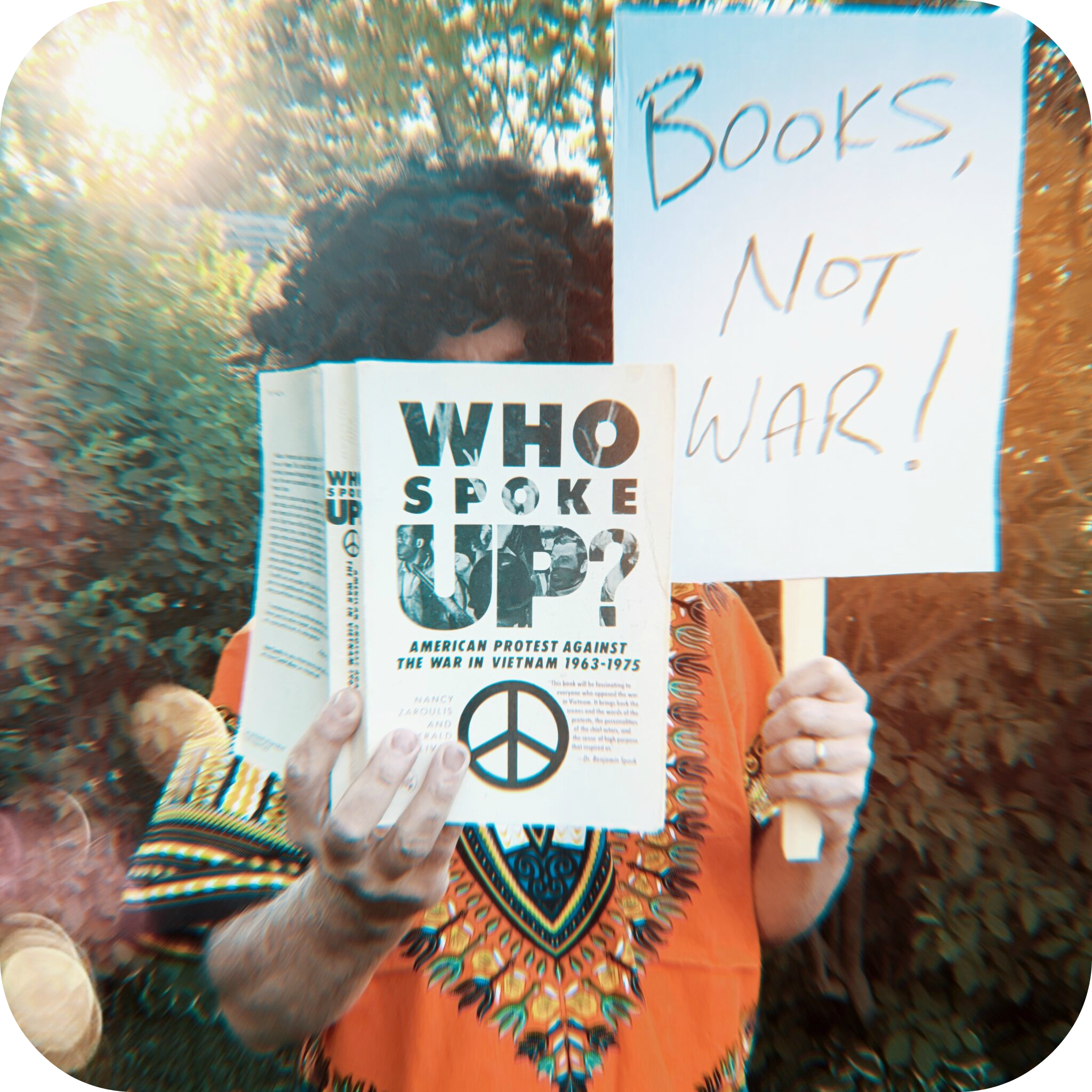
Reading this book has been quite an experience for me. I employed a method getting through it that I don’t think will be something I will continue to do going forward; I read it in installments over the course of four years. I remember the garage sale at which I bought this book. My wife was talking to the girl about her air fryer and I was eyeballing this book. It looked a little academic but I couldn’t deny the pull I felt as the subject matter has always interested me. Due to my Seasonal Interest Syndrome, I find I am drawn to all things “hippie” in the spring and this book fit into that. I took the pressure off myself by allowing myself to read it while my interest held and then to put it down. It had enough to continue to draw me in over the course of four springs. I found it absolutely fascinating.
Nancy Zaroulis is a novelist who also writes under the name Cynthia Peele. Nothing else in her bibliography gives a clue as to how she came to write this book as she has predominantly issued books of historical fiction. Similarly, Gerald Sullivan seems to have little on his CV though he has published books on the political legacy of Joseph Kennedy and on the Amityville murders.
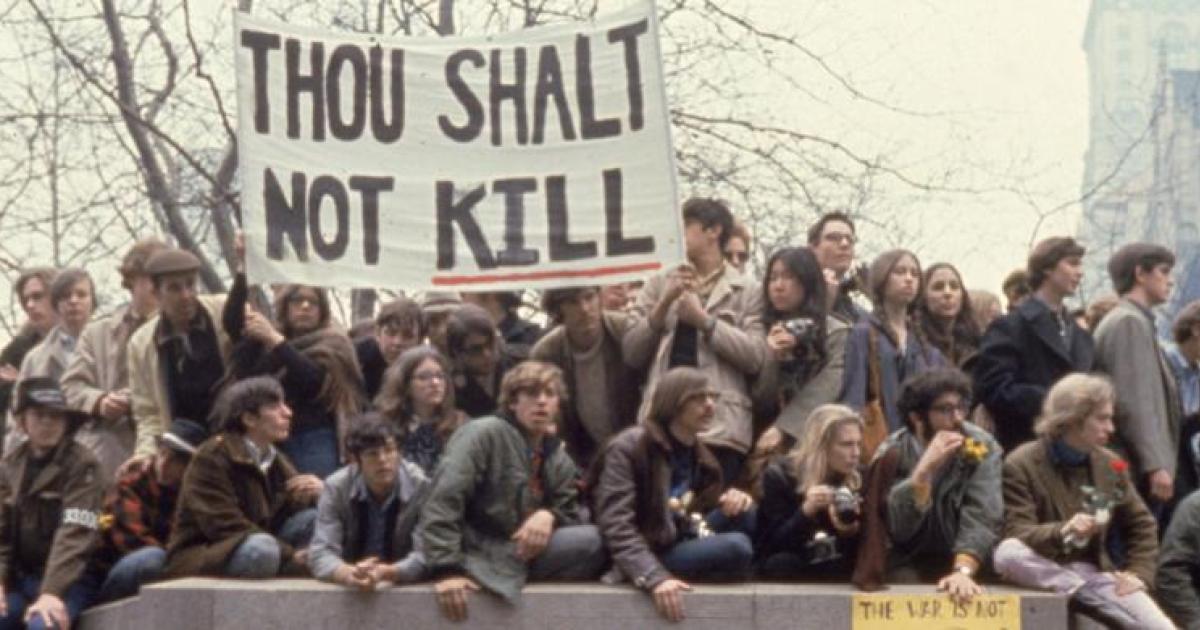
Many of us have likely seen films and documentaries and read books on the Vietnam war but I wonder how many of us have really drilled down on the details and timeline and on the players in the antiwar movement. For myself, much of what I learned here I was hearing for the first time and getting this side of this horrific and elongated conflict I found extremely compelling. And while the book was not as academic – in a bad way – as I had feared, I did have to stay focused to keep tabs on the people I was learning about and on the sides at war in Vietnam. But my feeling is that, even if one is well versed in this topic, there is still much to be gleaned from these pages.
“The 13,000 Americans who died in Vietnam died because they were sent there under the orders of politicians and generals who sacrificed them on behalf of their own ambitions.”
– this from 1967
The reader will appreciate the authors’ method of linear storytelling and the fact that they lay the groundwork of the movement in the early 1960s and then travel through telling the tale year by year. One sees the progress or lack of as time went by and the war dragged on. The tale starts with brief mention of the “lonely dissent” that began in August of 1963 when a few pacifists who had been active since the mid-50s fighting for nuclear disarmament had been reinvigorated by the nascent struggle for civil rights. It is mentioned that, at this time, Secretary of Defense Robert McNamara actually predicted that US troops would be home from Southeast Asia by December of 1965 and the New York Times countered with an editorial that spoke of the government’s distorting facts and deceiving the public. When antiwar activists perceived what all these differing reports meant, the movement was effectively begun.
Activists convened in Michigan in the early days of the struggle for peace and issued the Port Huron Statement, a “seminal document”, a manifesto detailing what the antiwar movement saw as the nation’s problems and spelling out the means by which they could be remedied. And while this galvanized the movement, there was at this time an uneasy balance between the peace-seekers and the communists, the trouble being that the public at large equated the two groups and thought them to be the same. This is emblematic of the tenuous nature of the protest groups with much time being spent in discussing what including communists in their ranks would mean to the various groups’ efficacy. There would also be time wasted in disagreements over seemingly simple things like what to put on a sign to be carried by a protester. What slogan should be adopted? Should they demand the US abruptly cease and pull out of Vietnam? Or negotiate an exit strategy? The varying opinions had the groups teetering back and forth as it was thought that the wrong slogan or a close alliance with communism could undermine the movement. This went so far as different groups engaging in “close-order combat”, fighting each other “for the allegiance of activist youth”. Later, a fierce debate raged over what shape a negotiating table should be; round? Square? Two curved tables? This means that – ironically – there was much fighting between factions of the peace movement. Another group the antiwar movement did not want to be aligned with was the civil rights movement, the thinking being that the American people might accept peace in Vietnam but never racial equality.
The reader will learn of the Fulbright hearings. Held in 1966 to assess US involvement in Vietnam, the highly respected Senator J. William Fulbright made clear the folly of the American presence in Southeast Asia and the authors note that “the importance of (these) hearings cannot be overstated”. The hearings were televised and so for the first time millions of Americans came to understand that opposition to the war was not some “pinko” stance held only by radicals but was coming from sane, well-informed, well-intentioned, intelligent people and that the protests taking place on college campuses had merit and were not simply collegiate hijinks.
“Along with thousands of our fellow students, we campus leaders cannot participate in a war which we believe to be immoral and unjust…we publicly and collectively express our intention to refuse induction and to aid and support those who decide to refuse. We will not serve in the military as long as the war in Vietnam continues.”
– students letter to President Nixon, 1969
As the fighting in Southeast Asia escalates and student protest ramps up, the reader becomes intimate with the players in this drama like A.J. Muste, David Dellinger, Dr. Benjamin Spock and Tom Hayden who worked for peace with his wife Jane Fonda and, on the other side, the likes of Robert McNamara, Presidents Johnson and Nixon and Henry Kissinger.
We get to 1967 and we learn of the protests centered on the Dow Chemical Company, the only company that made and supplied napalm to the Defense Department. The reader must sit through a harsh lesson on napalm and a vivid description of what it could do to human flesh. Women Strike for Peace became the “napalm ladies” and took up the cause of letting people know about the horrors of this chemical. The ladies tried to block shipment of napalm cannisters and were arrested. On another occasion, during a time christened Stop the Draft Week, fully 10,000 protesters descended on an induction center stopping the progress of busloads of inductees. Other groups converged on other induction centers to simply stage “sit-downs” and were arrested for non-violent civil disobedience. Here again varying factions in the peace movement did not want to be grouped with others as there were disagreements on how the statement should be made; militance, civil disobedience, marching, etc.
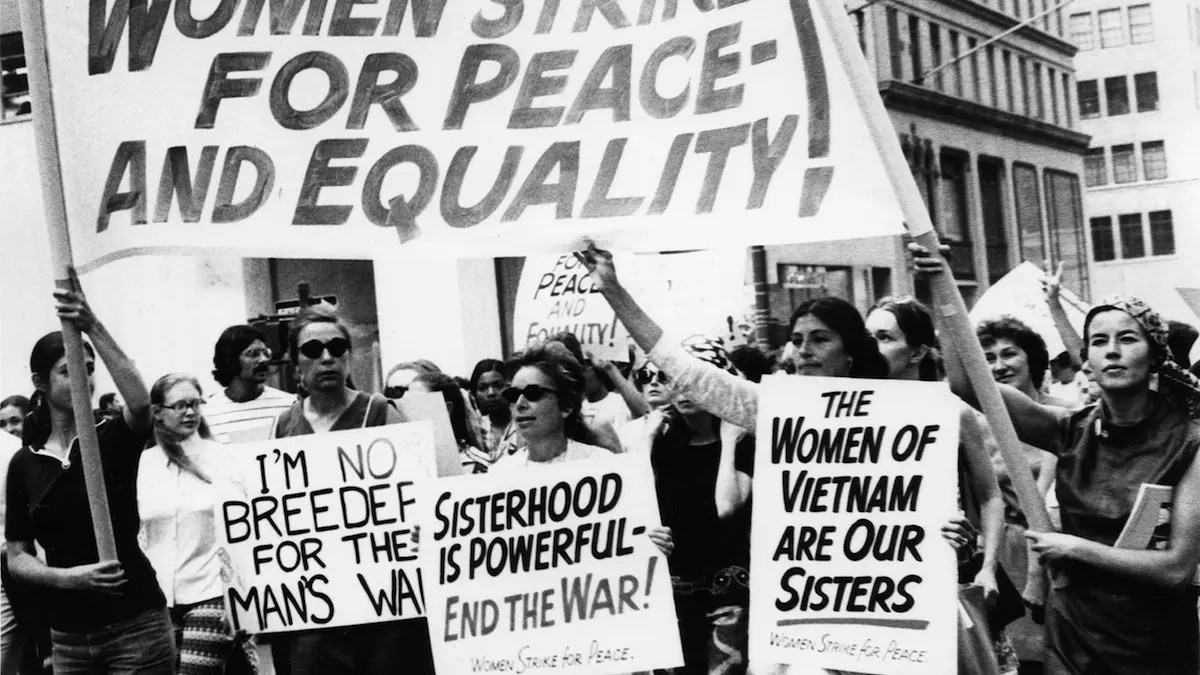
Who Spoke Up? reports that, at the dawn of 1968, the antiwar movement had failed to gain ground in the minds of those in the general public. It is reported that 58% of the American people favoured seeing the war through and 63% supported the continued bombing of North Vietnam. But the authors refer to 1968 as the fulcrum year, the year that saw the scales tipped against US efforts in Vietnam. Reports of the Tet Offensive on the nightly news gave citizens a “terrifying glimpse” of how far removed the reality of the war was from official reports. In addition, the respected newsman Walter Cronkite visited Vietnam in this year and his report made clear the inability for the US to emerge from Southeast Asia as victors and this gave voice to the antiwar movement. That March, advisers met with President Johnson and confirmed that the bombing must stop, the American public no longer supported the war, that they could not win and that they must extricate themselves. Amazing to think that after the blunt realities brought forth at this meeting, the war still raged on for years. But the authors do well to note that global events also affected things in the US. The Soviet Union – ruled by a communist party – invaded Czechoslovakia in August of 1968 so it was no time for any politician to appear soft on communism which no doubt added years to the fighting in Vietnam.
“Going to Vietnam is a war crime, refusing to go is a domestic crime and just sitting still…is a moral crime. It is a terrible time today to be an American and young. In fact, it apparently is a crime.”
– Jan Barry, founder, Vietnam Veterans Against the War
Of course, 1968 is also the year of the assassinations of both Martin Luther King, Jr and Robert Kennedy. While many of us have learned much about these two tragedies, they are brought into sharp relief and afforded much more sobering significance when seen in the harsh light of this book’s depiction of the political and social upheaval in the country that had been building in the preceding years.
In fact, it’s hard to believe the United States survived 1968. There is a riveting and detailed discussion of the chaos surrounding the Democratic National Convention in Chicago that August including descriptions of the tear gas let loose in the streets that made it into the hotel where politicians were staying, bringing the fighting going on in the streets right to their own nostrils. Non-violent protestors tried to pull away shouting at police through bullhorns “we are not violent…we are sitting down” but police swept in, beating people indiscriminately. And we’ve heard this before but it is quite chilling to read of the chant that went up from the crowd; “the whole world is watching!”.
“Indeed it was (watching): and what it was watching, the chaos in the streets, was ultimately more significant and more crucial to the outcome of the election than what (was happening at the Democratic convention).”
– troubling but historically fascinating times
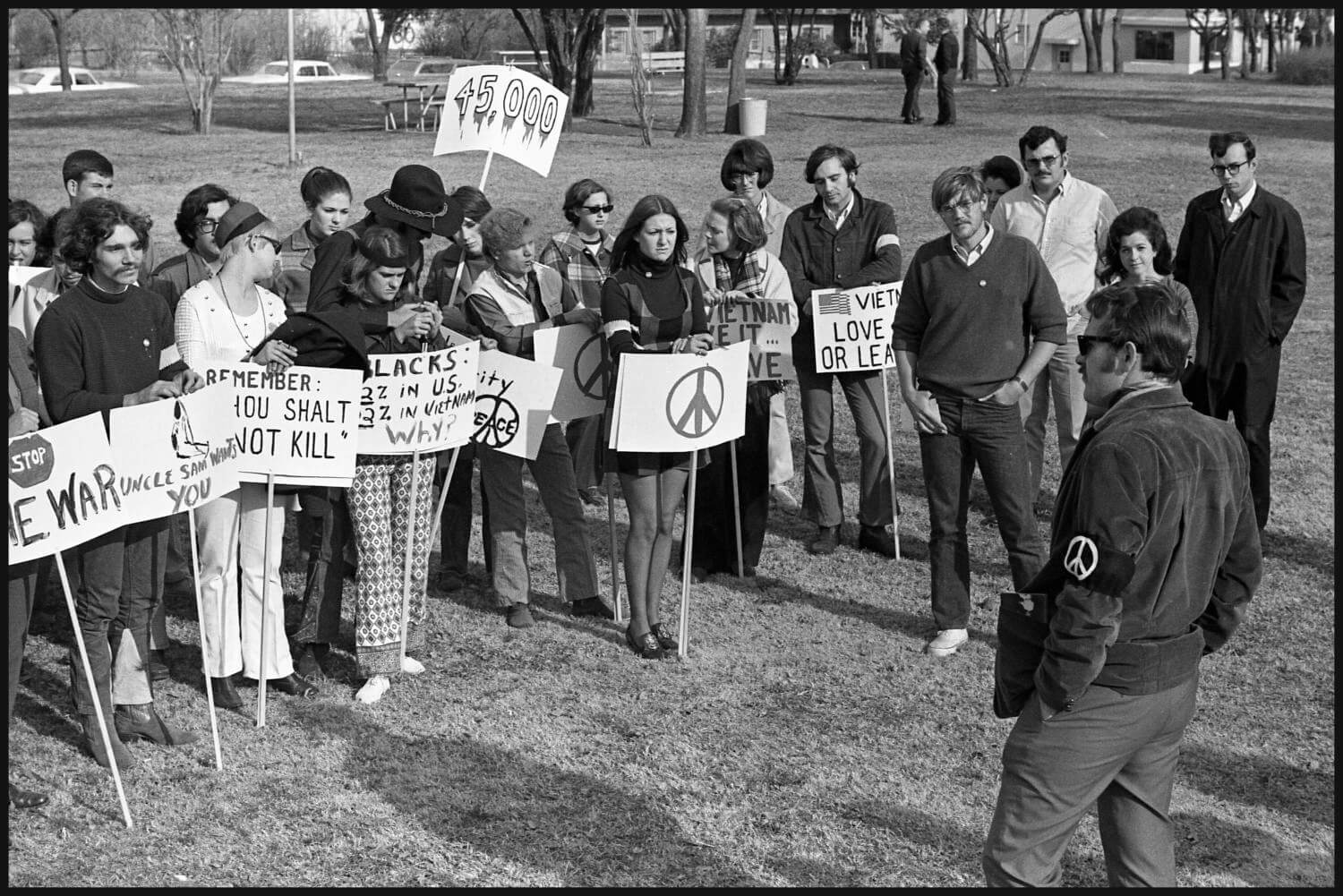
Who Spoke Up? moves into 1969 and discusses the election of Richard Nixon – startling considering the climate in the country – and his decision to invade Cambodia. This leads to discussion of a significant event that took place on Good Friday, 1969. During a sit-in at a draft board in Philadelphia, a group of people gathered and sat silently for three hours at which point various people stood and read off the names of those who had died in Vietnam; the reading of this list took seventeen hours. From this came the March Against Death, during which 45,000 people marched silently through the streets of Washington, each carrying a sign bearing one name of a dead soldier. Later there is a detailed description of Vietnam Moratorium Day, a definite indication that the nation had turned against the overseas conflict. In the fall of ’69, a coordinated demonstration saw millions of people across the United States engage in sit-ins, “teach-ins” and marches. Later in November came the Moratorium to End the War in Vietnam, considered the largest demonstration ever in Washington. An astounding number of people – some estimates are as high as 800,000 – were involved. And there is an incredible story related here about the donations brought in to finance this demonstration that needs to be turned into a screenplay.
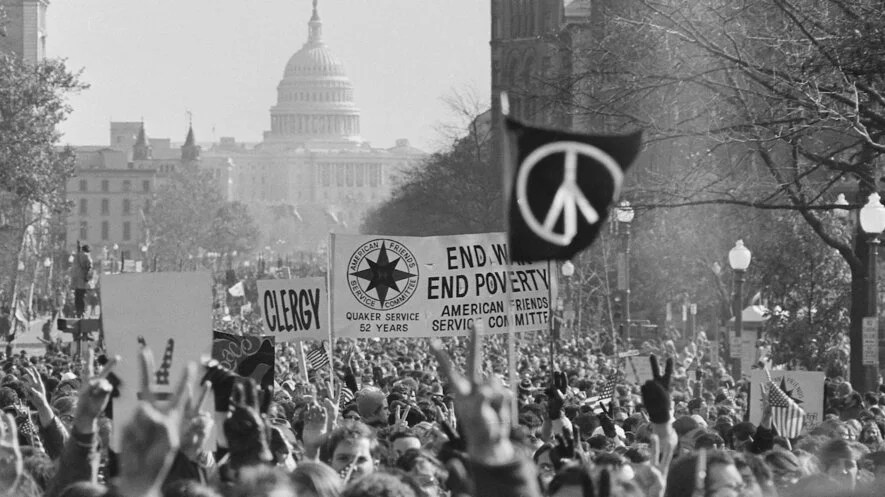
There is a postscript to the Moratorium that is of no little consequence. It came out later that near the end of 1969, Nixon and Kissinger were contemplating a “fierce escalation of the war, possibly to include the use of nuclear weapons”. But with the antiwar sentiment on display that fall – with hundreds of thousands of people marching in protest through the nation’s capitol – it became politically impossible for the president to proceed down this path. Therefore, it is likely that many thousands of lives were spared – because those people spoke up. Because they got up, went out and marched through the streets of Washington.
“The antiwar movement’s root problem was that in 1969 it was engaged…as it had been for six years in an exercise that since the time of the ancients has been self-defeating: like the Persian messenger in Herodotus, the anti-war movement was bringing, ever more insistently, a message to the American people that the American people did not want to hear. Whether or not it was a correct message was beside the point. Americans in general are proud of their country, and rightly so; they do not like to hear her criticized. They do not like to be told that she is wrong. They do not like to be told that she is engaged in an immoral, illegal, savage, Nazi-like, imperialist war. They do not like to think that America the invincible can be defeated. Presented with such claims, they will exercise all their powers of denial. They will ‘kill the messenger’, even as the ancients did, for bringing such bad news.”
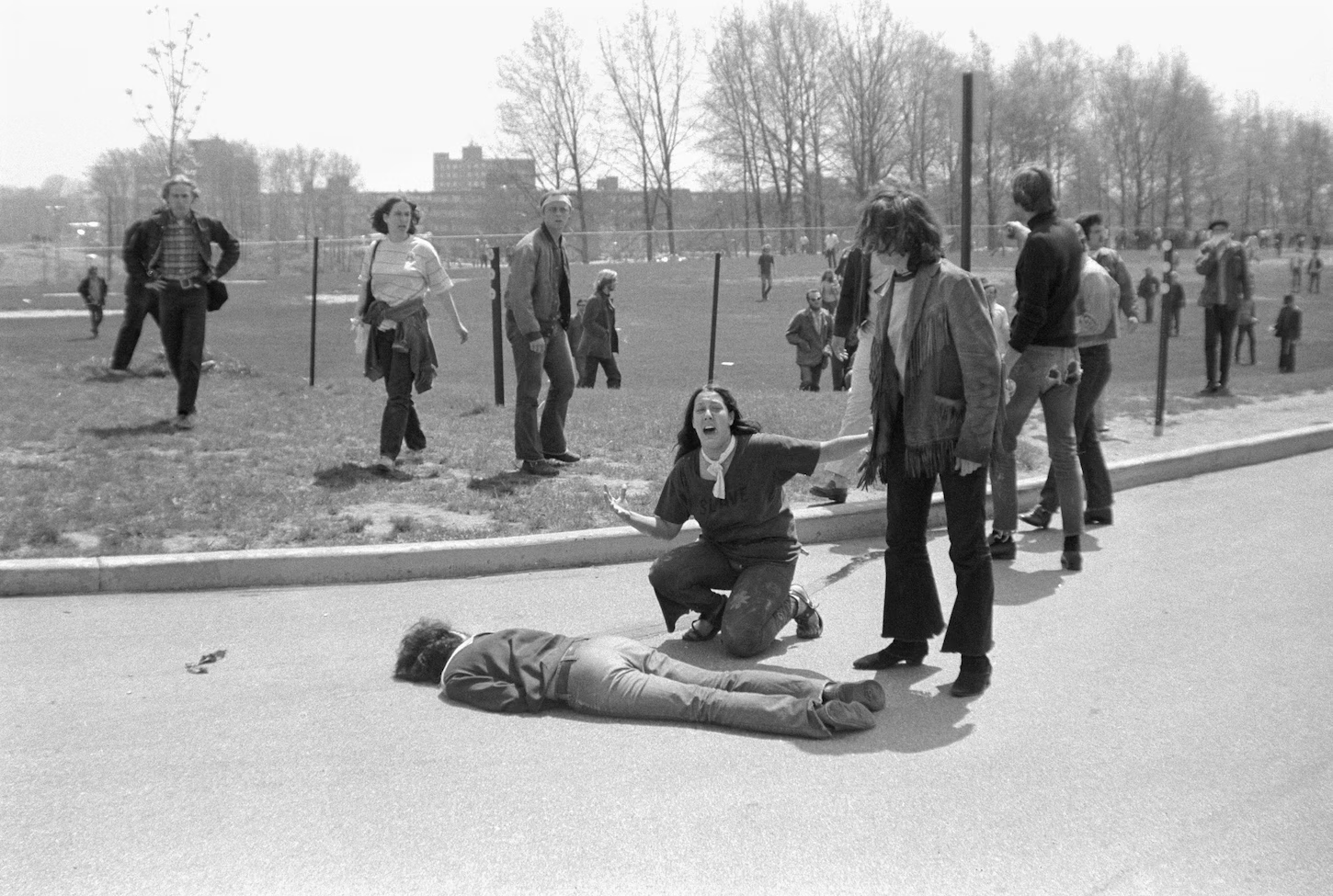
From this book I learned the incredible story of Kent State and the student protestors who were killed there. The “high point of activism” came in the wake of Kent State and after Nixon’s Cambodia speech but it is also noted – and it is a sobering thought – that after the killings at Kent State, many college kids pulled back from engaging in antiwar demonstrations and protests; “students had more or less withdrawn into themselves and their campus lives”. Consider this; many kids felt strongly about what was going on in their country and in Vietnam and Cambodia and wanted to take a stand. But when they saw that their fellow students were getting killed for speaking up, they gave up on these public displays that they had once been so fervent about. That avenue of public declaration had been taking from them.
Once the reader is 400 pages deep into this book, one cannot wait to get to the end. The main reason being that this has been a journey of over ten years; “lives (of activists) were disrupted and sometimes destroyed; careers neglected, sleep lost, recreation time lost, friends and families lost – and for what?”. You will feel drawn and compelled to journey on and arrive at the end of the war and what that meant for the millions who had devoted their lives to attempting to affect change in the country and bring an end to this savage conflict.
Finally, there is a refreshing lack of political bias in this text, which may be hard to believe. But I do think that the text itself – the telling of what actually took place; the facts – makes a strong statement about those in control of the country at this time and the decisions that were made regarding Vietnam. I think it would be hard to go into a debate and to defend these decisions, to claim that anything positive came out of engaging in the fight in Vietnam in the first place and staying at it so long. I found the reading of Who Spoke Up? so very rewarding because of its breadth and depth and because it is about not just events but a whole philosophy. I think at some points I was almost resentful of the book because it seemed to be taking so long to get through it and because it was such a weighty topic but what acute satisfaction I felt having finished it. I enjoyed the many side trips it prompted me to take, drilling down on specific things I ran into like The Pentagon Papers, Kent State and the people in the iconic photos from that tragedy and the veterans who occupied the Statue of Liberty. This was quite a journey and I feel edified. So rewarded. Here is the joy of following your gut, taking the book home, digging in and staying with it. This is the payoff that can come from a good book.
“Like the war it opposed, the antiwar movement arose from obscure beginnings, held the nation’s attention for a time, and then faded away. Afterward those who took part in it, like those who fought the war, found that the nation did not want to hear about their decade-long struggle to speak truth to power. One of those truths, and one of the most important lessons of the war itself, was that America learned that she could be wrong—a profoundly maturing lesson for either an individual or a nation.”