“In a medium that produced few giants, Rod stood bold and tall. He was one of the first dramatists to cast a critical eye upon the social order. And, in time, the medium punished him with its displeasure. Like so many of his contemporaries, he finally had to depart the medium he loved, and for which he was much too good.”
Serling: The Rise and Twilight of TV’s Last Angry Man
by Gordon F. Sander (2012)
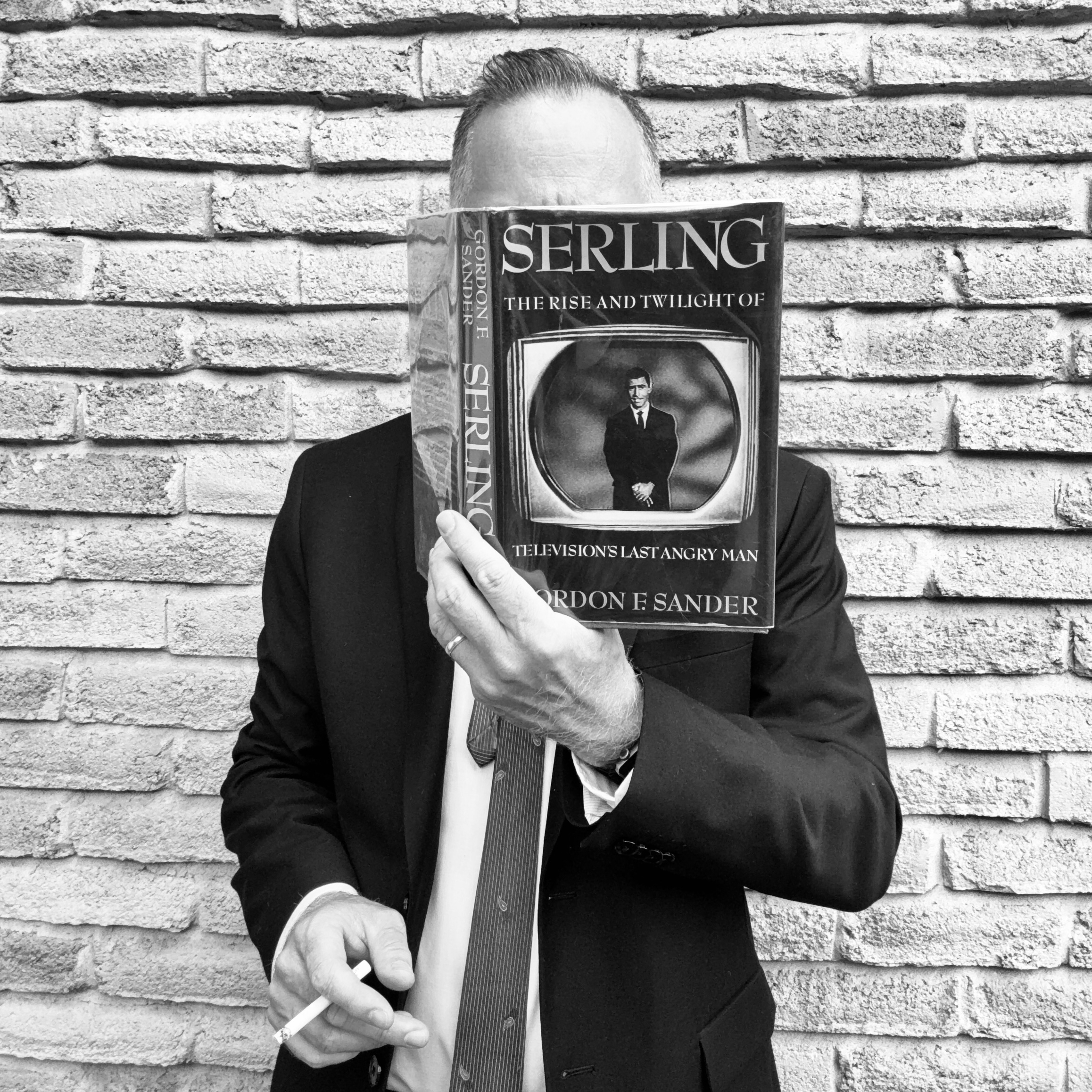
You would be hard pressed, I think, to come up with another television show more beloved by us retro types than The Twilight Zone. Perhaps one could put an even finer point on it by saying that this legendary anthology program ranks with very few other shows as a favourite of classic TV and I’m sure it would be one of the few that even the uninitiated could come up with if asked to name a TV show from the past. It sits in a rarefied position among shows like I Love Lucy, Star Trek and – frankly – few others. While many understand the style, the milieu and the impact of the show, people are perhaps less informed when it comes to the show’s creator, today’s subject, Rod Serling.
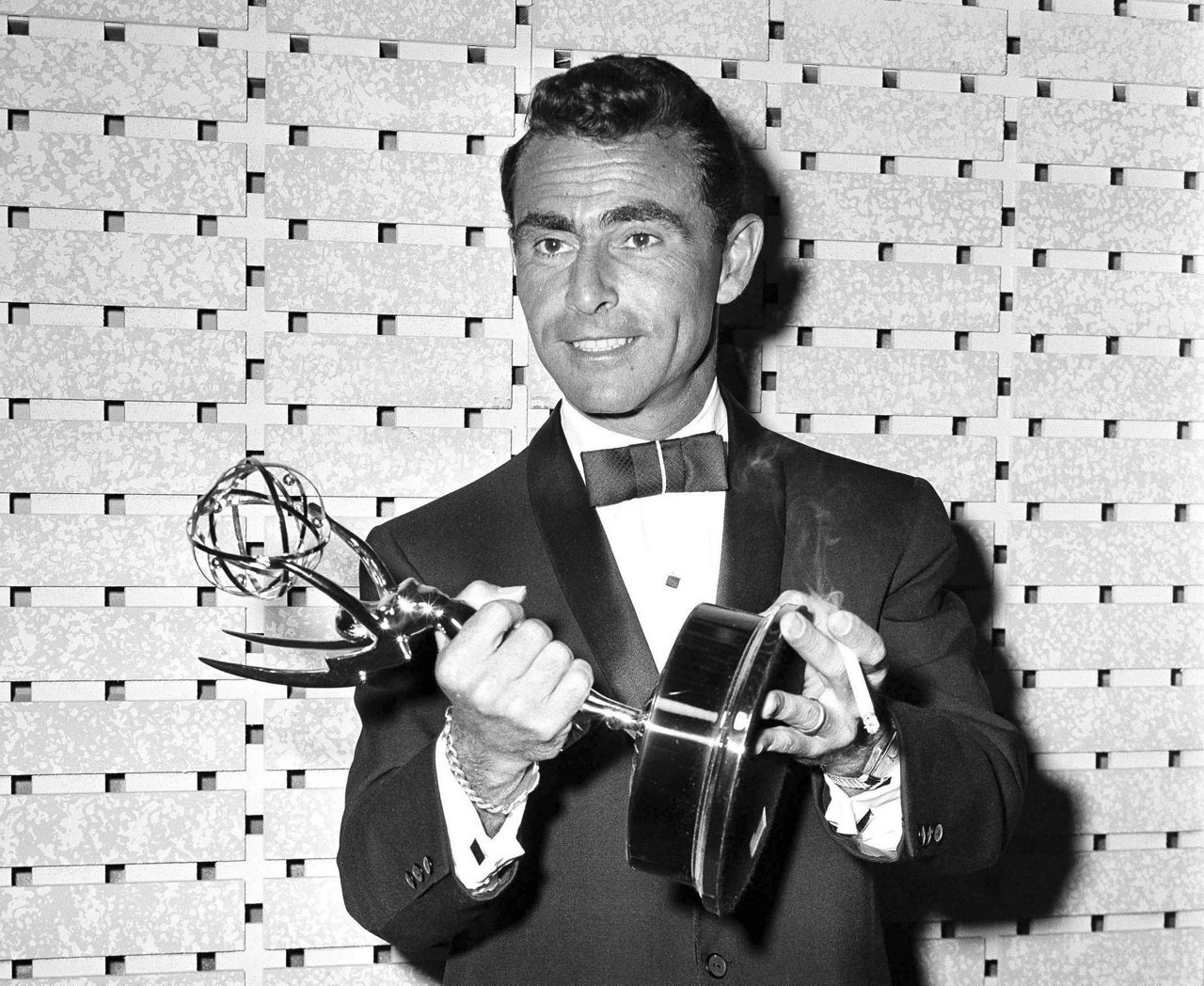
I found the biography we are discussing today at a book store in Erie, Pennsylvania that is fast becoming a favourite of mine. The Rise and Twilight of TV’s Last Angry Man was written by Gordon F. Sander who calls Serling his literary hero. Sander’s book on Serling is his only, to this point, foray into entertainment writing as he has spent his life as an author and a photojournalist as a correspondent primarily dealing with the Nordic and Baltic regions and is currently based in Latvia. Should be noted that this is technically an unauthorized biography; Serling’s widow, Carol, met with Sander but did not offer her support and while the author did interview over 200 people for this book, many withdrew when it became known that Carol would never endorse a biography over which she did not exercise complete control. Lending some credence to Sander’s work, though, is his assertion that the only authorized biographer of Serling’s life abandoned his work and turned his files over to Sander.
“The writer’s role is to menace the public conscience. He must have a position, a point of view. He must see the arts as a vehicle of social criticism and he must focus on the issues of his time.”
– Rod in a speech to the Library of Congress, 1968
Sander begins the Serling tale with talk of Rod’s birth on Christmas Day, 1924 and his rearing in Binghampton, New York, near the Pennsylvania border. Rod as a youth was a born actor, joker and prankster and I was happy to read the many references to Serling’s infinite capacity for nostalgia and the fact that he often looked back to his earlier days for inspiration for much of his writing; this tendency provides a kinship to Rod with me and many other of you who are similarly backward-looking. Serling and his family were Lithuanian Jews – like Al Jolson – and Rod was no stranger to anti-Semitism. He eventually became indifferent to Judaism and turned to Unitarianism.
Rod Serling enlisted in the US Army the morning after his high school graduation and served as a parachutist despite actually being too short for service – his physical stature was something that irked him all his life. The book charts his fascination with radio and his early work in the medium, noting his influences like Norman Corwin and Orson Welles and Sander notes that Serling’s later Twilight Zone openings with their purple prose, love of the common man, etc. came directly from Corwin. He returned from combat mainly in the Philippines a “war-scarred man-child” and met Carol. From an affluent family, Carol’s folks disowned her when she married Rod and Carol became not only her husband’s cheerleader but also his governess.
“Once he had a fix on what his story was, he was able to improvise at almost the rate of speed it would take the director to stage the scene. The people would absolutely materialize on the spot, the dialogue would flow out. It was fascinating. He was the most natural storyteller I ever met.”
– Serling’s friend and associate Dick Berg
After presenting an anthology program on radio, Serling moved into television. In Serling, Sander does well discussing TV’s proliferation throughout America in the 1950s and the preponderance of anthology programs on television. Sander notes that these programs needed writers badly and Serling threw his hat into the ring. Also discussed is the live nature of these programs and the fact that they were performed and filmed like a play but with the added intimacy of the camera. Subtle characterizations were possible due to the actors’ ability to play to the camera as opposed to the back rows of a playhouse. On top of all this was the massive audience that television reached. Good discourse here.
The reader learns that “Patterns” was the big breakthrough for Rod Serling. Presented on Kraft Television Theatre on January 12, 1955, Rod’s teleplay dealt with the ruthless world of corporate business and was immensely popular, so much so that the live TV performance was repeated some weeks later; this was unprecedented and the first time a live television drama was repeated due to its popularity. Inevitably, Rod’s work in the wake of “Patterns” fell under that program’s shadow and Serling had difficulty creating a work to rival it.
“For most writers, the disassociation between name and face is one of the boons of their profession, without which they cannot observe real life. Not for Rod Serling. Eventually, as narrator and host of The Twilight Zone, he would get his wish and more: he would become an American icon.”
By the end of the 1950s, Rod Serling was gaining popularity in television, in Hollywood and indeed across America. Author Sander notes that Rod had in his younger days been scornful of the trappings of Hollywood but when he found himself making good money and with burgeoning recognition, he came to revel in those same trappings and would admit to friends sheepishly that he liked living in the sunshine of Los Angeles as opposed to New York City, he liked his swimming pool and his convertible. He was beginning, however, to dislike the television industry. Or he was at least becoming frustrated with it. Here is where Rod gets his “angry man” appellation as he was a constant watchdog when it came to the quality of television programming and was not shy about voicing his criticisms in interviews.
The industry was in turmoil as the Sixties approached. Rod lamented censorship and increased sponsor interference with programming as these underwriters of TV programs vigorously inflicted their demands on the content of the scripts being filmed. Additionally, the quiz show scandals of this time had shaken the public’s faith in the medium. Out of this came The Twilight Zone. The show actually began as a November, 1958 episode of the anthology program Desilu Playhouse during which Rod’s story “The Time Element” was aired. The episode was a sensation and CBS commissioned a script for a pilot episode of The Twilight Zone. Serling said he was only interested in doing the show if he could have total creative control and that is what he got. In exchange, the contract stipulated that Rod write 90% of the scripts for the first three seasons; no problem for the prolific Serling who would end up writing 90 of the show’s 156 episodes.
“…the scripts he wrote for the third season…closely reflected current events…In this respect, The Twilight Zone, when decoded, becomes a script for the liberal conscience of the early 1960s.”
Here is the meat of TV’s Last Angry Man, of course, the story of this iconic television show. The reader will learn that The Twilight Zone was never a ratings hit but built up a loyal following particularly among teenagers and on college campuses. The first season was a particular success artistically and marked by Serling’s scripts presenting parables with social comments and suggestions. The silly network, unsurprisingly, was concerned with the ratings for the first season and declared the fix would be to add an on-screen host as seen in Alfred Hitchcock hosting his own anthology show. Interesting to learn that Orson Welles was approached. Welles – living in London at the time – expressed interest and so someone was sent out to negotiate. When pressed during lunch, Welles finally said “I don’t feel like doing it” and that was that. Serling jumped at the chance to do it himself and the response was enormous. Who of us today can even think of The Twilight Zone without Rod Serling’s intros?
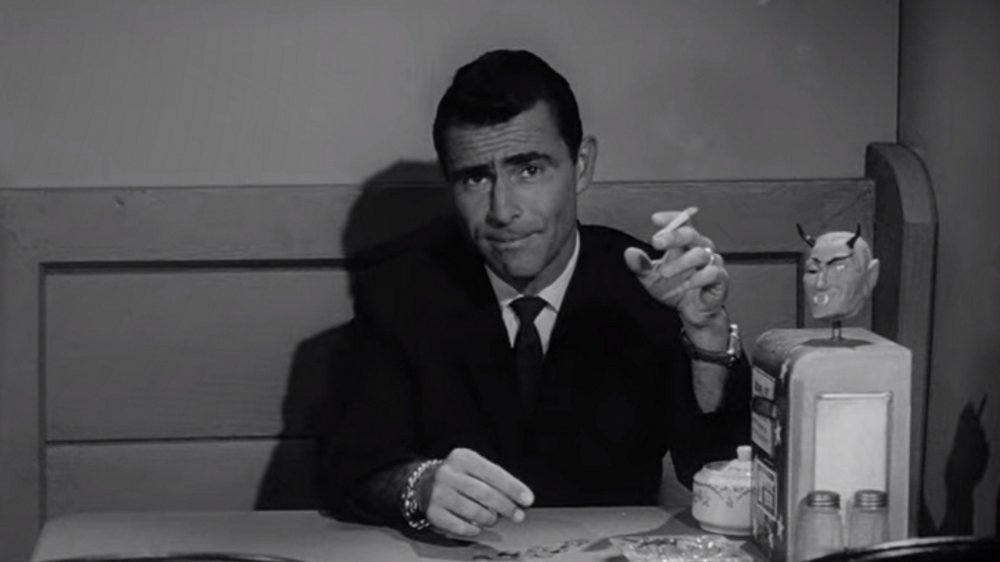
Serling’s production team had the show running like a well-oiled machine as he and other writers churned out realistic fantasies about seemingly average people. But its the same old story; similarly in the case of Star Trek, the network was forever tightening the purse strings ostensibly trying to sink one of the very shows that would someday be emblematic of an era.
Rod Serling and his show The Twilight Zone made a lasting impression in but 5 short years. While Rod had success previous to this TV program, he struggled to carry on after the show had been cancelled. His later series The Loner and Night Gallery were short-lived and left Serling disillusioned and questioning his validity as a TV writer. Those of us of a certain age may have missed this part of his later career and have been spared the sad knowledge that Rod Serling became a pitchman-for-hire who soon came to be known more for his work as a commercial spokesman than as a teleplay artist of the highest calibre with a singular ability to craft indelible and timeless tales, over 200 screenplays in all. Indeed, it is nigh on impossible for many of us to reconcile the Rod Serling of The Twilight Zone with the Rod of game show appearances and commercials.
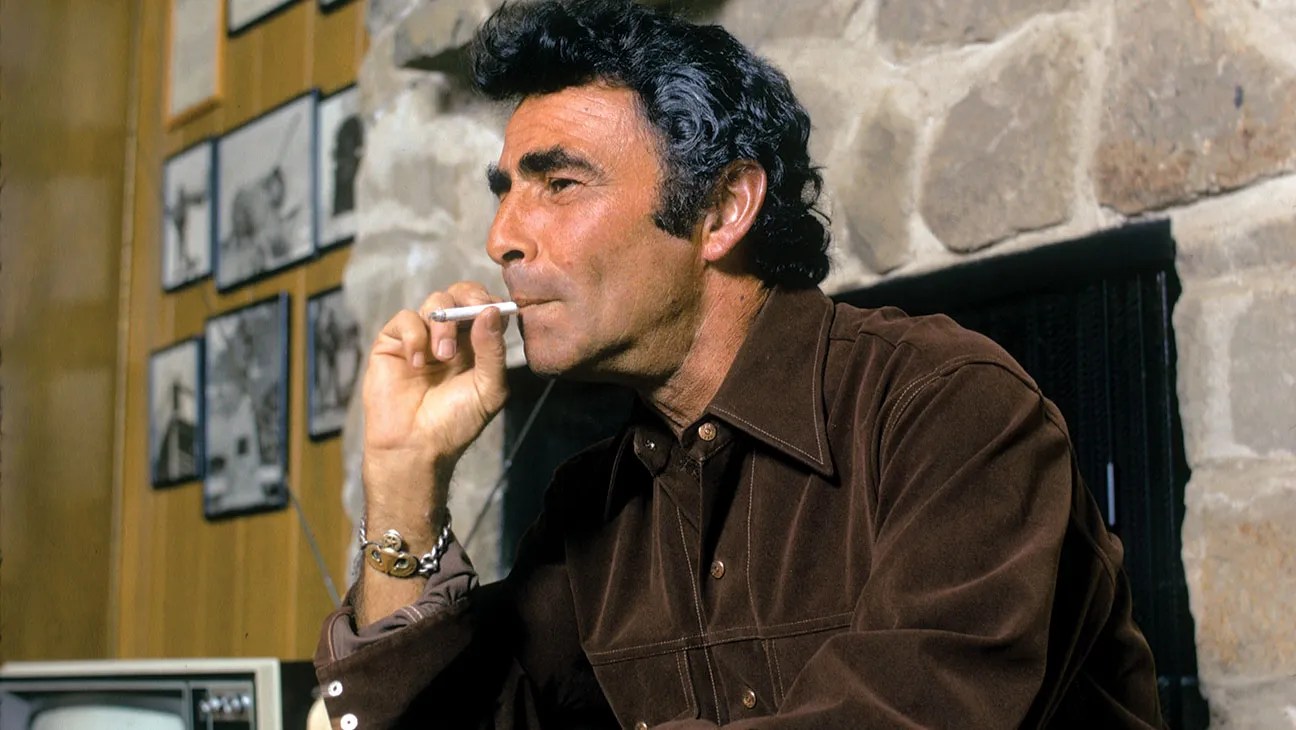
I came away from this book wondering how Rod is remembered today – as the host of a legendary TV show or as the creator of that show and as the writer of the bulk of the scripts? The show was still on the air when the phrase “the twilight zone” began to be utilized by the public at large to refer to any surreal situation and the concept that there is more to things than meets the eye. The show also holds the rare distinction of having been in continuous circulation since its inception; no small accomplishment and one wishes Rod Serling knew the enormity and the immortality of his contribution. This book is an easy read and I can recommend it as a good way to get the story of Serling and his remarkable program, The Twilight Zone, but also the story of his life and his career.


Wow, I need to find this book
Yeah, Rod Serling was a writing machine. Put out so much stuff during his lifetime. So sad that he passed away at the tender age of 50. Smoking 3 to 4 packs of cigarettes a day didn’t help. If you want a book to complement this one, look no further than Marc Scott Zicree’s ‘The Twilight Zone Companion – Third Edition’ (2018), which is a complete show-by-show guide that includes a plot synopsis, Rod Serling’s narrations, critical commentary, behind-the-scenes stories and anecdotes from the original artists who created the series, a complete list of cast and crew, and photographs. One of the best episodes – ‘Where is Everybody?’ – is the very first episode broadcast on October 2, 1959, on CBS. Great story, great acting (by Earl Holliman), and a great score by Bernard Herrmann, who would later go on to work with Alfred Hitchcock.
That sounds like a great book – I will have to seek it out. That premiere episode is one of the ones I have watched recently as I finished this book and wrote the review. It is excellent.
The book I’ve had for years and will have to revisit is Stories from the Twilight Zone that contains some of Rod’s tales that were made into episodes. I could really set up shop with this show and stay here for a while, reading and watching the episodes. Fascinating stuff.
I suppose there’s a thousand episodes of The Twilight Zone that I could cite here as favourites, but as this site is all about nostalgia for the past I thought it pertinent to mention ‘A Stop at Willoughby’, which first aired on CBS way back in 1960. Incidentally, this episode was Serling’s own favourite story from the first season. I won’t go into details and spoil the plot, but it is a very clever story that features a 20th-century New York City advertising executive by the name of Gart Williams who is fed up with his nagging wife and demanding boss and desires to return to simpler days “where a man can slow down to a walk and live his life full measure”. His daily commute by train will allow him to return to those “simpler days”. Don’t miss this one. It’ll tug at your heart strings and may even bring a tear to your eye . . .